Information Links
Related Conferences
Current Issue Volume 10, Issue 3 - 2026
A Note on the Wing Lengths of Male and Female Tumbler Pigeons
Ashraful Kabir*
Department of Biology, Cantonment Public College, Saidpur Cantonment—5311, Nilphamari, Bangladesh
*Corresponding author: Ashraful Kabir, Department of Biology, Cantonment Public School and College, Saidpur Cantonment—5311, Nilphamari, Bangladesh, Phone: +88-01712563750; E-mail: [email protected]
Received Date: March 31, 2026
Published Date: April 17, 2026
Citation: Kabir A. (2026). A Note on the Wing Lengths of Male and Female Tumbler Pigeons. Mathews J Vet Sci. 10(3):110.
Copyrights: Kabir A. © (2026).
ABSTRACT
Tumbler pigeons are popular for their long time flying in the sky as well as their tumbling performance. In this sense, their wings play a significant role to do these, and t-test were used to clarify this query. Numerical data on the wing length of male and female pigeons were used by using R. The mean of male and female pigeons on the basis of wing lengths was found 27.58 ± 3.92 and 26.23 ± 3.72 respectively for 22 individuals. T-test score account for most of the difference between table value and observed value (2.018, 0.26). The observed p value is 0.26 which is greater than 0.05, so null hypothesis is accepted. There is no significant difference between the wing lengths of male and female pigeons (p > 0.26, df = 42).
Keywords: Tumbler Pigeon, Sexual Dimorphism, Wing Length, Highflying, Selective Breeding, Tumbling Behavior.
INTRODUCTION
Tumbler pigeons are specialized athletes in the sky, prized for their ability to sustain long-duration flights and backward somersaults. This uniformity suggests the aerodynamic requirements for tumbling which involve precise balance and rapid navigation. Both genders share nearly identical wing lengths to ensure the balance and lift required for rapid backward somersaults and long-duration flight because tumbling is a high-performance maneuver that demands specific wing-to-body ratios. Unlike other traits like body weight and neck thickness are often larger in males but the wings remain morphologically similar. Males are typically more robust and aggressive, primary flight muscles and wing structures are optimized for the ‘unconditioned reflex’ of tumbling [1]. Highfliers and tipplers can fly from 19 to 22 hours demonstrates a standardized wing length to sustain vertical navigation [2]. Lack of significant difference in wing length between male and female tumbler pigeons is a functional adaptation ensuring aerodynamic and stability for specialized aerial behaviors [1]. The objective of this note is to mention the wing lengths of male and female tumbler pigeons on the verge of more flying and tumbling in the sky.
MATERIALS AND METHODS
For this study, 22 individuals of male and female local tumbler pigeons were used. By using a compass and scale the wing length of male and female pigeons were measured at the random basis [3]. In order to know the mean differences of two independent groups (wing length of male and wing length of female) measured through t-test by using R.
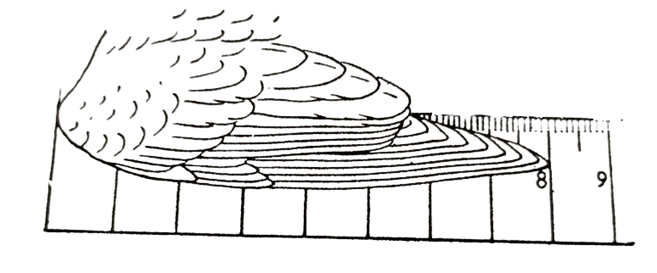
Plate 1. Measurement of wing length of pigeon.
RESULTS AND DISCUSSION
Apparently, there are differences between male and female tumbler pigeons but on the basis of analytical studies on their wing lengths, there were no significant differences. Biewener [1] studied the pros and cons of flight muscles of pigeons. Wing lengths are eumetrical (well-measured) both male and female [4], and these findings are completely matched with this work. For long-time flying in the sky, pigeons need to carry highly specialized wing. This type of observation was noticed by Kabir [2], and Biewener [1]. There is no doubt that through numerous selective breeding on this type of natural mutation supported for the perfection of this peculiar behavior [2].
CONCLUSIONS
Statistical analysis indicates no significant difference in wing length between male and female tumbler pigeons. This finding suggests a standardized wing morphology is maintained across both sexes to support consistent aerodynamic performance for specialized flight behaviors. For more clarification, need to set-up large dataset for this study.
ACKNOWLEDGEMENTS
None.
CONFLICT OF INTEREST
The author declares that there is no conflict of interest
REFERENCES
- Biewener AA. (2011). Muscle function in avian flight: achieving power and control. Philos Trans R Soc Lond B Biol Sci. 366(1570):1496-1506.
- Kabir MA. (2012). Tumbling behaviour of pigeons. Global Journal of Science Frontier Research Biological Sciences. 12(6):16-19.
- Ali S, Ripley SD. (2001). Handbook of the Birds of India and Pakistan. (Vol. 1). Oxford University Press, New Delhi-110001, India. 384 pp.
- Pares-Casanova PM, Kabir A. (2020). Clustering the tumbler pigeons group on their morphological characteristics reveals a eumetrical and a hypermetrical clade. Bulgarian journal of Agricultural Science. 26(3):659-663.
