Information Links
Related Conferences
Current Issue Volume 10, Issue 3 - 2026
Some Myths about Cats Debunked by Science
Alicia Garcia-Falgueras1,2,*
1Psychobiology Department, Spanish University, Madrid, 28019, Spain
2Psychology Department, Netherlands Institute for Neuroscience, Meibergdreef 47, 1105 BA Amsterdam, The Netherlands
*Corresponding author: Alicia Garcia-Falgueras, Psychobiology Department, Spanish University, Madrid, 28019, Spain & Psychology Department, Netherlands Institute for Neuroscience, Meibergdreef 47, 1105 BA Amsterdam, The Netherlands, Phone Numbers: +34 91 398 6291 & +31 20 566 5500, E-mail: [email protected]
Received Date: April 02, 2026
Published Date: April 21, 2026
Citation: Garcia-Falgueras A. (2026). Some Myths about Cats Debunked by Science. Mathews J Vet Sci. 10(3):111.
Copyrights: Garcia-Falgueras A. © (2026).
ABSTRACT
The coexistence of cats and humans has increased exponentially in recent years, improving not only in quantity but also in quality because of a better understanding of their nutritional needs and more specialized veterinary care which have increased the quality and life expectancy of felines compared to previous eras. However, some beliefs or myths persist that contribute to confusion and fuel pseudoscientific notions that, by attributing magical powers to cats, make them potential victims of human abuse. This text analyzes some of these beliefs, for instance, why cats like to accompany us to the bathroom or why cats bury their food, and offers alternative explanations, or hypotheses based on available scientific evidences following literature based on searching scientific approaches. More research and a greater volume of reliable data would be required from the scientific community to completely dispel irrational beliefs about domestic cats to avoid superstitions or darkness in minds.
Keywords: Cat, Main Olfactory System, Vomeronasal Organ, Limbic Structures.
INTRODUCTION
The persistence of myths in the face of scientific evidence among cat owners is more prevalent than we would like. This is partly due to the limited scientific research conducted on domestic felines and their adaptive behaviors. Given the scarcity of references in the scientific literature, we still want to suggest possible hypotheses that, from a scientific perspective, better explain some of the myths and mysteries surrounding these enigmatic animals. Aiming to shed light on these myths and establish their scientific relevance we made a search in the current scientific literature available on the topic, using the strategy Databases of PubMed, Scopus and Google Academic. The criteria of searching was including every time frame, because at the beginning of the 70´s and 80´s there was very relevant research to be mentioned nowadays. The research followed an in-depth analysis strategy, rather than simply compiling a large number of articles on a given topic. When reading the texts, we delved into references that could clarify the objective of our research. The inclusion and exclusion criteria were based on the collection or rejection of empirical data that could confirm or refute our previously defined hypothesis.
1. Why does the cat accompany us to the bathroom?
The cat is a born survivor. Its primary instincts are self-preservation. Therefore, if someone attacks you in the bathroom while you are using the toilet, the cat will not be there to protect and will likely flee rather than defend you, as a dog would. Nevertheless cats would not perceive the toilet water a threat from which they are protecting you, which has also been suggested as a reason why they accompany us to the toilet, since they commonly visit places with water sources along their routes not avoiding them.
It has recently been scientifically proven that cats use their sense of smell to recognize and distinguish humans [1]. This sense in felines is highly evolved, they have a quite advanced olfactory system that is compound of two: one to perceive pheromones (accessory olfactory tract through the vomeronasal organ VNO) and another one (main olfactory system) that detects lower molecular weights odors that are small volatiles that reach the main olfactory epithelium. They also display the Flehmen response, with all the social information involved. This behavior is perceptible and objectively measurable with non-invasive methods in terms of frequency, duration, and intensity. The animal curls back its upper lip exposing its front teeth, inhales with the nostrils usually closed, and then often holds this position for several seconds which helps cats to pull scent particles into the Jacobson's organ to process pheromones. Flehmen is performed by a wide range of mammals, including ungulates and felids [2].
The olfactory brain network has been extensively studied in rodents. It is well understood how these odorous chemicals bind to receptors on the ciliated dendrites in the olfactory epithelium, the axons of which converge onto glomeruli at the main olfactory bulb (MOB). From here, information is conveyed to the primary olfactory cortex via the lateral olfactory tract and further spread to other brain areas (e.g., orbitofrontal cortex) via the hypothalamus but also to parts of the limbic system such as the amygdala (Figure 1).
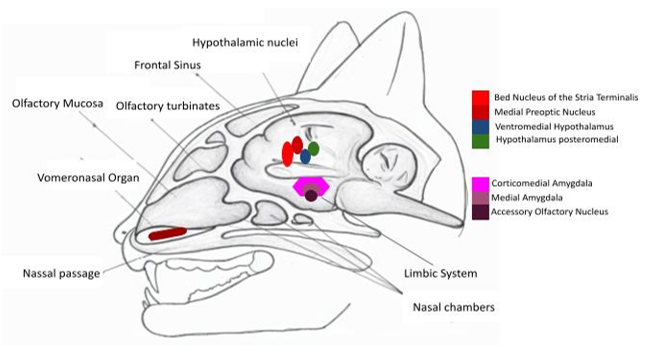
Figure 1. This visual diagram represents the olfactory macrocircuit of the cat, based on knowledge of the similar microcircuit present in rodents. From the vomeronasal organ, air particles with high molecular weight odoriferous components (pheromones) pass to the brain for processing in the hypothalamic areas (nucleus of the stria terminalis and medial subdivisions of the hypothalamus), as well as to some limbic structures related to emotions (amygdala and its subdivisions).
Upon investigating the area, cats often sniff and lick the fluid material and exhibit the Flehmen response which opens the nasopalatine canal and allows the passage of fluid-borne molecules to the VNO [3]. This olfactory sense enabled the cat to initiate behavioral responses, playing critical roles in many cat activities, such as marking and social interactions, cortisol release and stress responses [4]. Other mammals (rabbits, rodents, humans) might have similar olfactory dual systems but do not display this Flehmen behavior after perceiving pheromones, although the molecular mechanism and neural network might be similar [5-7].
That is why we suggest the hypothesis that cats accompany us to the bathroom not to protect us, but to watch over and care for us: they are checking on us. Physicians know that our feces provide clear information about potential mineral imbalances in our urine, the proper functioning of our digestive processes and other relevant data that the cat discreetly wants or needs to know about us. Just as we want to know about them. Let's not forget that their very survival and longevity depend on our own health and metabolic right balance. With their olfaction our healthy checking is done.
2. Black cats are just normal cats with more difficult histories
Throughout history, black cats have been believed to possess special powers, for instance, the Egyptian goddess Bastis, warrior protector of the home, women, children, and disease (Figure 2) was a black cat. But so too did the Romans, for whom the black cat was one of the symbols of the goddess of freedom, Liberta [8].
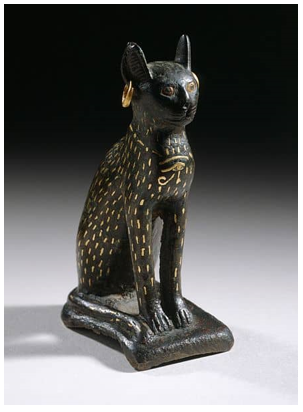
Figure 2. Figurine of the Goddess Bastet as a Cat, Egypt, 21st – 26th Dynasty (1081 – 525 B.C.).
Moreover they were associated with witches, because black cats used to accompany these known as witches women, perhaps because they shared that history of abuse. The Catholic Church, in the XIIIth century, (Pope Gregory IX) in the document Vox in Rama of Monday 13th of June in 1233, described Inquisitorial ideas against felines, and specifically against black cats, as scapegoats to purge evil human sins [9,10]. That statement together with the fact that black cats were thought to be agents and companions of bad women (witches), intensified the cruelty, abuse, mistreatment, and persecution against them. With the justification of a religion, accusations of witchcraft began to spread amongst the ordinary people, as a way of settling grudges or seizing property and cats began to be used as proof of satanic association. Indeed the belief that cats should be beaten, fired or any other cruel form of torture to death to purge the new season of evil spirits continued across northern medieval Europe.
However, these beliefs and myths have proven to be the product of irrational ideas, superstitions and scientific explanation has brought clarity and logic to years of abuse and mistreatment of cats. It has been shown that witches were mostly women who usually used natural medicinal plants to induce sleep or emotional arousal such as falling in love, without magical powers but chemical knowledge. These women suffered great discrimination and mistreatment because they were old and poor ladies who have suffered countless physical and emotional acts of violence. In some cases during the XVI century, strange behaviors in witches might have a clear explanation since they could have been caused by poisoning with certain fungus that provoques ergotism. That condition is caused by rye spurs (Claviceps purpurea), a type of fungus found in cereals, mainly rye, widely used at the witch's time in Massachusetts. Its ingestion, depending on the alkaloids concentration, can result in a variety of clinical symptoms quite similar to a demoniac possession: seizures, apoplectic attack, diarrhea, manic behavior, hallucinations, limb distortion, vomiting, spasms, tingling, numbness of hands and feet and a burning sensation which becomes extremely painful as it gangrenes [11]. Undoubtedly, there were also some few evil women who used poison and chemicals to kill, poison, or harm other people and/or animals. Because as it is said in gallego "Eu non creo nas meigas, mas habelas, haylas".
During the XVIIth century, other types of poisoning also occurred in the United States, due to arsenic (used domestically to control pests and color decorative objects), metal poisoning (lead, mercury in pipes or kitchen utensils) and contamination of drinking water with organic or mineral waste polluted. During the XVIIIth century, improperly distilled alcohol also caused numerous poisonings with contaminated methanol. In the XIXth century, the consumption and poisoning by opiates, morphine, heroin, and cocaine were added, as well as the milk sickness, which caused tremors in children from drinking milk from cows contaminated with toxic plants. At the beginning of the XXth century, poisonings decreased due to advances in medicine, and they became primarily caused by known drugs and psychoactive substances. Thus, we can say, without fear of being wrong, that the advance of medicine and of the biological explanations of exogenous substances on the human nervous system have favored longevity, credibility and respect towards women, their scientific curiosity and black cats all around the world.
An analysis of XIIIth-century partial skeletons of 79 medieval cats showed evidence of a completely distinct consideration of cats: they were treated differently from normal domestic pets (Figure 3), which provide emotional or domestic support, but rather as meat and hides for human consumption that is a clearly ancestral view, similar to that of cave dwellers, who lacked homes and had little control over fire. The study on medieval cat skeletons in Cambridge proved butchery practices because the cat's remaining bones exhibited over 200 instances of cut marks, which were consistent with the animals having their throats cut and being skinned. Because of the number and disposition of teeth in the skulls they were able to determine the age of these cats as juveniles and young adults (often between 9 and 20 months) [12].
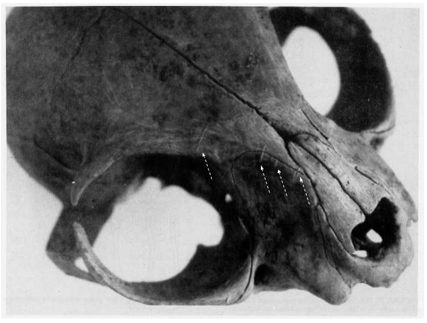
Figure 3. Skull of a 13th century AD medieval cat, recovered from a well in Cambridge, showing knife cut marks (white arrow), that explains how these animals were killed by having their throats cut, skinned and dismembered for human consumptions (from [12]).
These cruel practices continued until 1817 and, consequently, beliefs turned against them, as they had unhealthy, catastrophic, and deadly consequences for human beings: because the widespread persecution and extermination of cats, driven by these superstitions or primitive practices, drastically increased the natural populations of rodents due to the absence of their predator, worsening the spread of infections and diseases by the rat plague and, ultimately, attracting evil, the devil, death, and destruction to humans.
Thus, black cats do not possess supernatural powers; rather, they have adapted effectively to survive in the human world by utilizing their feline senses. It is well known that a human would have very little chance of surviving in the world of cats, since we do not know how to hunt, and our senses of sight, hearing, and smell are far less precise; moreover, we lack the charm, tenderness, and soft fur that characterize cats. However, cats have managed to adapt, some even relinquishing all their feline tools, but retaining their heightened senses. Sometimes, it seems to us that they possess "hidden powers" because of their extraordinary senses, which allow them to live in both the human and feline environments.
3. Cats bury their food out of satiety
Cats are not scavengers. A study conducted in the vast Australian wilderness determined that only a very small percentage of wild cats (10%) fed on carcasses of the sambar deer remains, which is a widespread deer species in Australia. Mainly those remaining were consumed mostly by foxes and wild dogs [13]. Human hunters in Victoria (Australia) harvest approx. 32,000 sambar deer annually and since there is no requirement for hunters to remove or bury the carcass then many will be available to scavengers. However wild cats rarely feed on sambar deer carcasses, preferring to eat live prey or recent prey of one or two days since their death [13,14].
Thus, domestic and stray cats have generally been found to take a very broad range of vertebrate and invertebrate prey. When live prey is limiting, scavenge, carrion and household refuse may be taken. At the population level preferred prey for cats are usually small mammals, birds and lizards, especially those with body weights < 100 g, such as Norway rats Rattus norvegicus, some species of birds or terrestrial mammals or unusual prey such as bats and grasshoppers may also be targeted [14]. They value the freshness and higher quality of recently hunted prey and, therefore, try to avoid the parasites and insects that begin to invade carcasses shortly after death.
Therefore, our hypothesis would be that if a cat buries food or pretends to bury it, the purpose is not hiding it to return later or to scare off other intruders, as a dog would. The cat probably buries it for hygiene, to avoid bad smells or decomposition, because he or she is already full and it is certain that another meal will be eaten again later [13,14].
4. Cats heal their own wounds with their tongue and saliva
However, this statement would only apply to a specific type of wound: accidental or produced by catastrophic injuries, or those sustained in physical fights. On the contrary, surgical wounds performed by humans in veterinary operating rooms under controlled conditions, with the wound closed using sterile, clean, and disinfected sutures, would not require the cat to lick them. In these cases, an Elizabethan collar can be useful if the cat wants to, for example, remove the sutures.
In cases of serious wounds, the cat itself is best suited to apply the disinfectant (its own saliva) to every corner of the wound, without causing excessive pain during handling and reaching the most possible sensitive area with avoiding aggravating the injury. A human attempting to help would not be able to do so with such skill; therefore, it is advisable to trust the limits the cat establishes regarding its own wound, its healing process (time for veterinary visits), and its health and hygiene habits for the proper and most suitable healing.
Licking wounds by cats is optimal from both a chemical and mechanical point of view. Chemically adult cat's saliva contains enzymes like lysozyme and compounds like lactoferrin and immunoglobulines IgG, two subclasses, and IgA which are effective against bacterias and viruses [15]. In a different study, twenty immune-associated molecules were measured in saliva of 25 healthy cats using multiplex assay. The cytokines (IL-1β, IL-12p40) and chemokines (IL-8, RANTES, KC) were found in the cat's saliva indicating an active anti- inflammatory response [16]. Cat saliva is capable of producing Kynurenine aminotransferase (KYNA) by the action of specific proteins KAT I, KAT II and KAT III that were found in cat saliva in the range of approximately 500 to 2500 fmol/μl saliva/h and because KYNA has strong antioxidant properties, this may help wounds to heal more quickly [17]. Moreover the act of licking may provide comfort and reduce stress because cats use saliva for grooming, healing, cooling and cleaning.
A cat's tongue is also an admirable, multifunctional mechanical tool that helps them heal and stay healthy, capable of distributing saliva and all its chemical properties to cleanse, heal, and refresh the coat of fur (Figure 4).
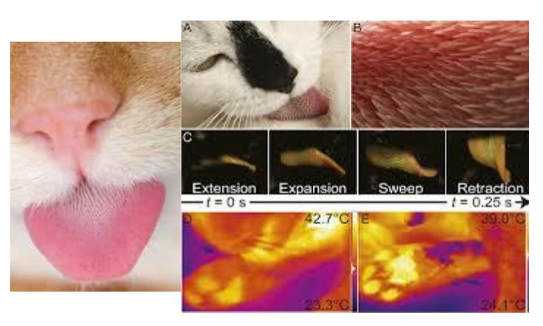
Figure 4. Image detailing the anatomy of the feline tongue, their papillae and the four movements it uses to deposit saliva and absorb liquids (extension, expansion, sweeping and retraction). From [18].
From domestic cats to lions, and in a constant relation to height and body mass, tongue is covered in sharp, rear-facing spines called cavo papillae in the appearance of velcro. These papillae contain hollow cavities at their tips that, spontaneously and through a movement mechanism (extension, expansion, sweeping, and retraction), deposit saliva into the deeper layer of the fur for grooming, cooling or healing. Cats use the surface tension of their tongues to lick and absorb water, while dogs use them like ladles for drinking [18].
Cat’s fur is formed by two layers: an exposed topcoat for protection and hidden undercoat of down hairs for warmth and thermoregulation, in a proportion of 24 hairs in the undercoat per each 1 hair in the topcoat [19]. Directly proportional and depending on the velocity of the groom, the amount of saliva is transferred. Then in cats saliva is also used to cool down while licking themselves such as other mammals do like kangaroos or rodents. Other domestic species such as cows are sprayed with dairy spray water by expensive industries to increase dairy yield. Therefore, this sophisticated tool of chemical and mechanical engineering can only bring benefits to the healing and well-being of felines, reducing thermal stress and accelerating wound healing.
CONCLUSSION
Due to the increasing number of felines that are part of our modern civilized lives, it is necessary to update research on this topic and provide new data and evidence about these creatures. Debunking myths, superstitions, and misconceptions will contribute to the progress of Science and humanity. Furthermore, increased investment in veterinary research to improve access to veterinary care and veterinarian medicines for domestic and wild cats would be an excellent way to show remorse or apologize for past abuses.
ACKNOWLEDGEMENTS
We would like to thank Prof. Dick Swaab from the Netherlands Institute for Neuroscience for his valuable and essential medical alliance. Moreover we would like to express our deepest gratitude to the reviewers for their praise and insightful comments that led to improvements. No artificial intelligence (AI) tools were used in the elaboration of this article, and we confirm that the ethical principles of the COPE position statement on the use of artificial intelligence (AI) and AI-assisted technologies were followed in the preparation of this manuscript.
CONFLICTS OF INTEREST
The Author declares that there are no conflicts of interest.
REFERENCES
- Miyairi Y, Kimura Y, Masuda K, Uchiyama H. (2025). Behavioral responses of domestic cats to human odor. PLoS One. 20(5):e0324016.
- Weeks JW, Cromwell-Davis SL, Heusner G. (2002). Preliminary study of the development of the Flehmen response in Equus caballus. Applied Animal Behavior Science 78(2):329-335.
- De Boer JN, Verberne G. (1981). Slow and fast wave activity in the olfactory system in cats during perception of pheromones. Physiol Behav. 27(2):223-229.
- Zhang L, Bian Z, Liu Q, Deng B. (2022). Dealing With Stress in Cats: What Is New About the Olfactory Strategy? Front Vet Sci. 9:928943.
- Guillamón A, Segovia S. (1997). Sex differences in the vomeronasal system. Brain Res Bull. 44(4):377-382.
- Garcia-Falgueras A, Junque C, Giménez M, Caldú X, Segovia S, Guillamon A. (2006). Sex differences in the human olfactory system. Brain Res. 1116(1):103-111.
- Segovia S, Garcia-Falgueras A, Carrillo B, Collado P, Pinos H, Perez-Laso C, et al. (2006). Sexual dimorphism in the vomeronasal system of the rabbit. Brain Res. 1102(1):52-62.
- Engels DW. (1999). Classical Cats: The Rise and Fall of the Sacred Cat”. New York: Routledge (published 2001). pp. 183. ISBN: 0415261627.
- Carl Rodenberg, Epistolae saeculi XIII e regestis pontificum Romanorum selectae, MGH, Berlin, Weidmann, 1883, p. 432.
- Engels DW. (1999). Appendix III: Pope Gregory and the Vox in Rama" in “Classical Cats: The Rise and Fall of the Sacred Cat. New York: Routledge (published 2001). pp. 183. ISBN: 0415261627.
- Llanes LC, Sa NB, Cenci AR, Teixeira KF, de França IV, Meier L, et al. (2022). Witches, potions, and metabolites: an overview from a medicinal perspective. RSC Med Chem. 13(4):405-412.
- Luff RM, Moreno-García M. (1995). Killing Cats in the Medieval Period: An Unusual episode in the history of Cambridge, England. Archaeofauna. 4(4):93-114.
- Forsyth DM, Woodford L, Moloney PD, Hampton JO, Woolnough AP, Tucker M. (2014). How does a carnivore guild utilise a substantial but unpredictable anthropogenic food source? Scavenging on hunter-shot ungulate carcasses by wild dogs/dingoes, red foxes and feral cats in south-eastern Australia revealed by camera traps. PLoS One. 11:e97937.
- Dickman CR. (1996). Overview of the impacts of feral cats on Australian native fauna. Canberra: Australian Nature Conservation Agency. 92 p. 17.
- Schultz RD, Scott FW, Duncan JR, Gillespie JH. (1974). Feline immunoglobulins. Infect Immun. 9(2):391-393.
- Thomas S, Lappin DF, Bennett D, Nile C, Riggio MP. (2024). Elevated pro-inflammatory cytokines and chemokines in saliva of cats with feline odontoclastic resorptive lesion. Res Vet Sci. 166:105092.
- Baran H, Kronsteiner C, Kepplinger B. (2024). Kynurenine Aminotransferases in Cat Saliva. J Vet Med Res. 11(2):1266.
- Noel AC, Hu DL. (2018). Cats use hollow papillae to wick saliva into fur. Proc Natl Acad Sci U S A. 115(49):12377-12382.
- Miller WH, Griffin CE, Campbell KL, Muller GH. (2013). Muller and Kirk’s Small Animal Dermatology (Elsevier Health Sciences, St. Louis), 7th Ed.
