Information Links
Related Conferences
Previous Issues Volume 9, Issue 8 - 2025
Short Review on the Genetics of Black Pigeons (Aves: Columbidae)
Ashraful Kabir*
Department of Biology, Cantonment Public College, Saidpur Cantonment―5311, Nilphamari, Bangladesh
*Corresponding Author: Ashraful Kabir, Department of Biology, Cantonment Public College, Saidpur Cantonment―5311, Nilphamari, Bangladesh; Email: [email protected]
Received Date: December 04, 2025
Published Date: December 30, 2025
Citation: Kabir A. (2025). Short Review on the Genetics of Black Pigeons (Aves: Columbidae). Mathews J Vet Sci. 9(8):97.
Copyrights: Kabir A. © (2025).
ABSTRACT
In the field of genetics, the plumage colour of pigeons could play a significant role in avian kingdom. Sufficient information on the black pigeons explained the black plumage of pigeons especially the spread black. Out of five types of blacks, in all cases, the black pigments (melanin) spread throughout the body with different amounts, so it looked different like spread black > deep black > dirty > bronze > dun accordingly. Rock-pigeon, racing homer, crossbred, gola were exhibited spread black (+//+), tumblers (deep, sooty, +//+), Berlin short-faced tumbler (bronze black, e//+), and German beauty homer (dun black, d//d or d//+). On the basis of melanin type, all were eumelanic.
Keywords: Black Pigeons, Spread Black, Melanin, Eumelanin, Pigment.
INTRODUCTION
Mutant S (spread) eliminates the differences in the melanin concentrations between the bars and its adjacent areas in pigeons, resulting in a uniform colouration. Its effects on eumelanin and pheomelanin contents vary in dependence from the alleles at the colour locus and from other genes. The greater variation of colouration in domesticated animals exhibited than in their wild ancestors caused by mutations that affect distribution, amounts, and proportions of pigments [1]. Actually, the appearance of blue shows the black granules under the microscope. Glossy black feathers of mookee or other extreme colourful pigeons, these are not the different type of black but their structure of the feathers are different and, on such feathers, light reflections could play a role. Actually, spread factor (S) is not a colour gene, it has no colour. It simply a distribution gene that enables a specific type of colour pigment granules to be dispersed throughout all feathers such that no pattern variation can easily be seen. This condition is known as ‘epistasis’. The smooth spread (darker tail bar) and coarse spread is found on wing shields also at the tip of flight feathers and sometime tips of tail feather of some pigeons, and pigments being clumped together in the cells of the feathers. There are differences in intensity of the clumped part, but that do not change them to spread [2].
Black pigeons as well as spread black
Actually, all black pigeons are spread black. Due to spreading of melanin pigment in various ratios, such pigeons look different. From the melanin, three major mutations change the pigments into blue, brown, red, and yellow. Black pigment (eumelanin) is a basis of blue. Spread is of two types on the basis of its expression—one is rich shiny black and other is intense (chalky/smoky). Spread is epistatic that covers or hides other colours. This intensity depends on the interaction with other factors. In blacks with a bar pattern in the background, the bars often appear darker on the wing shield. This can be remedied by crosses with checked and dark-coloured birds. Colour is changed by modifiers. Pattern is defined by its distribution of pigments in the coarse-spread areas in the plumage. Modifier genes alter the specific expression caused by one or some other non-allelic genes. The modifiers ‘dirty’ and ‘smoky’ intensify the colour. More effective are the ‘deep’ factor first mentioned by ‘Van Hoosen Jones’ [3], and other gross factors that may need to be transferred through crosses from other breeds. Spread is dominant sex-chromosomal gene that spread entire body. Pattern and spread are autosomal genes. Solid plumage colouration covers the pattern. Spread does not mean a self-bird. Irrespective black pigment makes solid black also in the coloured parts of pied marked birds like magpies and others. Sell [4,5] explained all types of blacks clearly in his book.
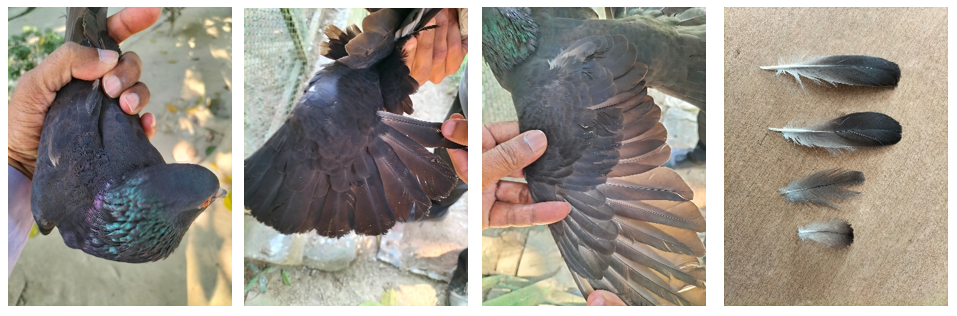
Real black pigeon: spread black
Spread of pigeons are ‘clumping’ and ‘spreading’ and again spreading are of two types ‘smooth’ and ‘coarse’. Smooth spreading is found in the black tail band and in the dark ends of the flights, whereas coarse type is shown by the black wing bars [1]. The phaeomelanin concentration of the bars is increased about 20-fold leading to a pheomelanic type. Eumelanin concentrations are reduced to about 20% of the wild type value and pheomelanin in the bars in increased 4- to 5-fold [6,7]. The high pheomelanin level in the bars of b birds is strongly reduced by S. Eumelanin is decreased three times but pheomelanin is reduced about five times [1]. Andalusian is explained by one-half to one-third pigment which is black vs. blue-black. In pigeons with the wild-type colour locus and S factor, the mutants In (indigo) and d result is almost identical eumelanin and pheomelanin concentrations [1]. Under domestication many internal and external characteristics of plants and animals show a greater variation than nature [8].
Genetic explanation of black feathers in different breeds and one species
Table 1. Blacks in pigeons with some sorts of explanation
|
Type Of Blacks |
Genetic Explanation |
Pigeons |
|
Spread black/Solid black/Self black |
Dominant gene (S); it has epistatic effect such as bar or check; solid black tail is a strong indicator of ‘spread’; this is autosomal gene; pigments spread from tail bar to the entire body in selfs (non-pieds). Spread blacks are of two types–homozygous spread black and heterozygous spread black. |
|
|
Deep black [9] |
Blue-black feathers are seen for the mutation in tyrosinase-related protein; it has solid black tail. |
|
|
Dirty/Sooty/Smoky |
Intensify the colour, dirty with black feet in the first weeks, smoky essential for light beaks. Sooty with flecks at the area around the distal rachis of the coverts. |
|
|
Bronze black |
Complex interaction between eumelanin and pheomelanin; it is a polygenic phenotype influenced by multiple genes; these modifier genes do not stand alone but alters the expression of other base colour genes. |
|
|
Pale black/Dilute black/Dun black |
Dilution of the intensity of black pigment (eumelanin); gray or pale black appearance by pale, dun appearance by the allele dilute in combination with spread (sex-linked genes). |
|
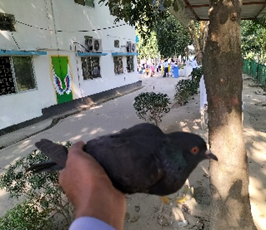
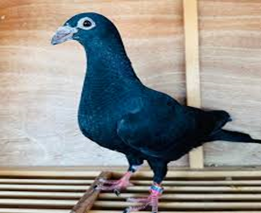
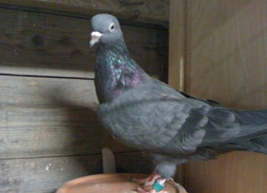
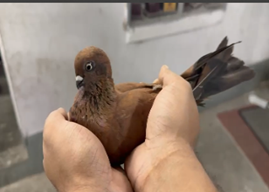
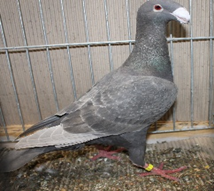
Table 2. Eumelanic concentrations in some common pigeons
|
Sample |
Species/Breed |
Phenotype |
Genotype |
Melanin Type |
|
1 |
Rock-pigeon |
Spread black |
+//+ |
Eumelanic
|
|
2 |
Racing homer |
Spread black |
+//+ |
Eumelanic
|
|
3 |
Crossbred |
Spread black |
+//+ |
Eumelanic
|
|
4 |
Gola pigeon |
Spread black |
+//+ |
Eumelanic
|
|
5 |
Tumbler 1 |
Deep black |
+//+ |
Eumelanic
|
|
6 |
Tumbler 2 |
Sooty black |
+//+ |
Eumelanic
|
|
7 |
Berlin short-faced tumbler |
Bronze black |
e//+ |
Eumelanic
|
|
8 |
German beauty homer |
Dun black |
d//d or d//+ |
Eumelanic
|
CONCLUSIONS
The plumage colour of pigeons is very interesting in avian kingdom especially the blacks. All sorts of black pigeons are nothing but the amounts of black pigments (eumelanin) with various amounts. Most of the pigeons exhibited black plumage on their entire body. Among pigeons, black pigeons could be an excellent bird to understand the mystery of black plumage genetics.
ACKNOWLEDGEMENTS
None.
CONFLICTS OF INTEREST
The author declares that there is no conflict of interest.
REFERENCES
- Haase E, Ito S, Sell A, Wakamatsu K. (1992). Melanin concentrations in feathers from wild and domestic pigeons. The Journal of Heredity. 83(1):64-67.
- Hollander WF. (1994). Origins and Excursions in Pigeon Genetics. Foy’s Pigeon Supplies. Golden Valley, MN. 148 pp.
- Jones SVH. (1922). Studies on inheritance in pigeons. IV. Checks and bars and other modifications of black. Genetics. 7(5):466-507.
- Sell A. (2012). Pigeon Genetics: Applied Genetics in the Domestic Pigeon. Sell Publishing, Germany. 528 pp.
- Sooty/Dirty/Smoky. Available at: https://www.pigeons.biz/threads/sooty-dirty-smoky-what.40870/
- Sponenberg DP, Ito S, Eng LA, Schwink K. (1988). Pigment types of various color genotypes of horses. Pigment Cell Res. 1(6):410-413.
- Sponenberg DP, Ito S, Wakamatsu K, Eng LA. (1988). Pigment types in sheep, goats, and llamas. Pigment Cell Res. 1(6):414-418.
- Darwin CR. (1868). The Variation of Animals and Plants under Domestication. London: Murray.
- Deep black. Available at: https://www.facebook.com/photo.php?fbid=852920773754025&set=a.189761790069930&type=3
