Information Links
Related Conferences
Current Issue Volume 10, Issue 2 - 2026
Self-Emulsifying Lipid Systems for Oral Delivery: From SEDDS to SNEDDS – Design, Mechanisms and Clinical Translation: A Review
Chekwube A Ezegbe1,2*,Obioma R Emeka-Obi3, Kosisochukwu A Emeagwali4, Chikaodi G Onuaja5, Amarachi G Ezegbe6,7, Emmanuella O Ogbonna8, Mercy Onoja1, Nkesi A Amadi9, Ruhuoma G Amadi10, John I Osaro11
1Department of Pharmaceutical Technology and Industrial Pharmacy, University of Nigeria, Nsukka, Nigeria
2Centro de Ciências Naturais e Humanas (CCNH), Universidade Federal do ABC (UFABC), São Paulo, Brazil
3Department of Haematology, School of Basic Clinical Sciences, College of Medicine, Federal University of Technology, Owerri, Imo State, Nigeria
4Department of Production Engineering, University of Sao Paulo, Cidade Universitaria, Butanta, Sao Paulo, Brazil
5Department of Environmental Science and Resource Management, Faculty of Sciences, National Open University of Nigeria, Abuja, Nigeria
6Department of Home Science and Management, University of Nigeria, Nsukka, Enugu, Nigeria
7Department of Nutrition e Engenharia de Alimentos, UNESP IBICLE, São Jose do Rio Preto
8Department of Chemistry, Federal University of Ibadan, Oyo State, Nigeria
9Centre for Occupational Health and Safety, University of Port-Harcourt, Choba, Rivers State, Nigeria
10University of Regina, 3737, Wascana Parkway, Regina Saskatchewan S4S0A2, Canada
11Department of Chemisty, Science and Technology, Universidade Federal do ABC (UFABC), São Paulo, Brazil
*Corresponding author: Ezegbe Chekwube Andrew, Department of Pharmaceutical Technology and Industrial Pharmacy, University of Nigeria, Nsukka, Enugu State, Nigeria & Centro de Ciências Naturais e Humanas (CCNH), Universidade Federal do ABC (UFABC), São Paulo, Brazil, Brazil, Tel: +2348038042802, E-mails: [email protected]; [email protected]
Received Date: May 18, 2026
Published Date: June 09, 2026
Citation: Ezegbe CA, et al. (2026). Self-Emulsifying Lipid Systems for Oral Delivery: From SEDDS to SNEDDS – Design, Mechanisms and Clinical Translation: A Review. Mathews J Pharma Sci. 10(2):62.
Copyrights: Ezegbe CA, et al. © (2026).
ABSTRACT
Lipid-based drug delivery systems (LBDDS) have emerged as versatile platforms to overcome the biopharmaceutical challenges associated with poorly water-soluble, unstable, and rapidly cleared therapeutic agents. This review provides a comprehensive overview of the current applications of LBDDS across multiple routes of administration, emphasizing their role in enhancing solubility, bioavailability, stability, and targeted delivery. The discussion begins with oral LBDDS, including self-emulsifying, self-micro-emulsifying, and self-nanoemulsifying systems, which improve the gastrointestinal solubilization and lymphatic transport of BCS Class II and IV drugs, as exemplified by commercial formulations of cyclosporine and testosterone undecanoate. Topical, transdermal, ocular, and pulmonary applications are examined for their ability to enhance skin and mucosal penetration, prolong residence time, and achieve localized therapy with reduced systemic toxicity. Advances in solid lipid nanoparticles and nanostructured lipid carriers for controlled and sustained release were discussed, alongside surface-modified systems for active targeting to tumors, the central nervous system, and specific cellular receptors. Recent developments in gene and RNA delivery using lipid nanoparticles, immunotherapy platforms, and nutraceutical delivery are also covered, reflecting the expanding scope of LBDDS in precision medicine. Key advantages, including biocompatibility, scalability, and multifunctionality, are balanced against limitations such as physical stability, manufacturing variability, and regulatory considerations. Overall, this review underscores that LBDDS have evolved from conventional emulsions to advanced nanocarriers that enable modern therapeutics, from small molecules to nucleic acids. Future perspectives focus on hybrid lipid-polymer systems, stimuli-responsive carriers, and AI-driven formulation design to further expand clinical translation and patient outcomes.
Keywords: LBDDS, Water-Solubility, Emulsions, Cellular Receptors, Pulmonary Applications.
INTRODUCTION
The delivery of therapeutic agents to the desired site of action at the right concentration and duration remains one of the central challenges in pharmaceutical sciences [1]. A significant proportion of new chemical entities and repurposed drugs exhibit poor aqueous solubility, low permeability, chemical instability, or rapid systemic clearance [2]. These properties limit oral bioavailability, reduce therapeutic efficacy and often necessitate higher doses that increase the risk of systemic toxicity. Conventional dosage forms such as tablets, capsules, and aqueous injections frequently fail to address these limitations, creating a need for advanced delivery systems that can modulate drug disposition and pharmacokinetics [3]. Lipid-based drug delivery systems (LBDDS) have emerged as one of the most clinically successful strategies to overcome these barriers. Lipids are endogenous components of biological membranes and metabolic pathways, which confers inherent biocompatibility, biodegradability, and low immunogenicity [4]. More importantly, lipids can solubilize lipophilic drugs within their hydrophobic domains, protect labile molecules from enzymatic and chemical degradation, and interact with the gastrointestinal lymphatic system to bypass first-pass hepatic metabolism. The versatility of lipids also allows formulation scientists to design carriers ranging from simple oil-in-water emulsions to complex nanostructured systems with controlled release and active targeting capabilities [5]. The evolution of LBDDS reflects advances in both materials science and understanding of physiological barriers. Early systems such as oil solutions and lipid emulsions were developed primarily to improve the oral absorption of fat-soluble vitamins and anesthetics [6]. The introduction of self-emulsifying drug delivery systems (SEDDS) and their successors, SMEDDS and SNEDDS, marked a shift toward spontaneous formation of fine emulsions in vivo, significantly enhancing the dissolution and absorption of poorly soluble drugs [7]. More recently, solid lipid nanoparticles (SLN), nanostructured lipid carriers (NLC), liposomes, and lipid nanoparticles (LNPs) have expanded the scope of LBDDS to parenteral, pulmonary, ocular, and transdermal routes [8]. This progression culminated in the widespread clinical adoption of LNPs for mRNA delivery, as demonstrated by the COVID-19 vaccines from Moderna and Pfizer-BioNTech, which validated lipid nanocarriers as a platform for nucleic acid therapeutics [9]. Despite this progress, the rational design and clinical translation of LBDDS require a clear understanding of how formulation variables, preparation methods, and physiological conditions influence performance. The choice of lipid, surfactant, and processing technique determines particle size, surface charge, drug loading, and release kinetics, all of which affect stability and biological fate. Furthermore, regulatory expectations for nanosystems have become more stringent, emphasizing the need for robust characterization and quality control [10]. This review aims to provide a comprehensive analysis of the current applications of lipid-based drug delivery systems across diverse therapeutic areas. We examined the mechanistic basis for absorption enhancement and targeting, summarize key clinical and preclinical examples, and highlight recent advances in gene therapy, immunotherapy, and personalized medicine. By integrating formulation science with translational outcomes, this review seeks to illustrate why LBDDS have become indispensable tools in modern drug delivery and to identify the opportunities and challenges that will shape their future development.
Oral lipid-based drug delivery systems
Oral administration remains the most preferred route for drug delivery due to its convenience, patient compliance, and cost-effectiveness [11]. However, an estimated 40-70% of new drug candidates and a substantial number of existing drugs are classified as poorly water-soluble according to the Biopharmaceutics Classification System (BCS Class II and IV) [12]. These compounds often exhibit dissolution-rate limited absorption, resulting in low and variable oral bioavailability, erratic pharmacokinetic profiles, and the need for high doses that increase the risk of adverse effects and cost. Beyond solubility, several physiological barriers further complicate oral delivery [13]. In the gastrointestinal tract, drugs are exposed to variable pH, enzymatic degradation, and efflux transporters such as P-glycoprotein. For lipophilic compounds, precipitation upon dilution in intestinal fluids and extensive first-pass metabolism in the liver and gut wall can reduce the fraction of drug reaching systemic circulation to less than 10%. Conventional formulations like immediate-release tablets and suspensions offer limited ability to overcome these obstacles, creating a clear need for delivery strategies that can maintain the drug in a solubilized state, protect it from degradation, and modulate its absorption pathway [14]. Oral lipid-based drug delivery systems (LBDDS) have emerged as a robust solution to these challenges. LBDDS encompass a range of formulations including oils, emulsions, self-emulsifying drug delivery systems (SEDDS), self-micro-emulsifying drug delivery systems (SMEDDS), self-nanoemulsifying drug delivery systems (SNEDDS), and lipid particulate systems such as solid lipid nanoparticles and nanostructured lipid carriers. The underlying principle is to present the drug in a dissolved or molecularly dispersed form within a lipid vehicle that mimics dietary fats. Upon ingestion, these systems interact with gastrointestinal fluids, bile salts, and pancreatic enzymes to form fine oil-in-water emulsions, micelles, or mixed micelles. This in-situ emulsification prevents precipitation and maintains the drug in a solubilized state that is readily available for absorption [15]. The enhancement in oral bioavailability achieved with LBDDS arises from multiple, often synergistic mechanisms. First, solubilization within the lipid phase increases the apparent solubility of the drug and reduces the energy barrier for dissolution. Second, the small droplet size generated by SEDDS/SNEDDS provides a large interfacial area for drug diffusion and interaction with the absorptive epithelium. Third, certain lipids and surfactants can transiently modulate membrane fluidity and inhibit efflux pumps, improving transcellular uptake [16]. Fourth, long-chain triglycerides and their digestion products stimulate chylomicron formation, diverting drug-loaded lipid moieties into the intestinal lymphatic system. This lymphatic transport bypasses hepatic first-pass metabolism, which is particularly advantageous for highly lipophilic drugs with high log P values. Clinically, the impact of oral LBDDS is well established [17]. Cyclosporine A, a classic example of a poorly soluble and highly metabolized immunosuppressant, showed a 2- to 5-fold increase in bioavailability when formulated as Neoral® using a microemulsion system. Similar success has been observed for drugs such as ritonavir, saquinavir, isotretinoin, and halofantrine [18]. Beyond marketed products, extensive research has demonstrated the applicability of oral LBDDS for anticancer agents, antifungals, antihypertensives, and nutraceuticals. Despite these advantages, the design of oral LBDDS requires careful consideration of lipid selection, surfactant-to-cosurfactant ratios, drug-lipid miscibility, and the effects of food and digestion on performance. Issues related to physical stability, drug precipitation upon dilution, and scalability also influence formulation success [19].
Self-emulsifying drug delivery systems (SEDDS)
The oral delivery of poorly water-soluble drugs remains a major challenge in pharmaceutical development [20]. For BCS Class II and IV compounds, dissolution in the gastrointestinal tract is the rate-limiting step for absorption, often leading to low, erratic, and food-dependent bioavailability. Conventional approaches such as micronization, salt formation, and solid dispersions address solubility to some extent, but they frequently suffer from stability issues, complex manufacturing, and limited scalability [21]. Self-emulsifying drug delivery systems (SEDDS) were developed to circumvent these limitations by presenting the drug in a pre-dissolved state within a lipid vehicle that spontaneously forms an emulsion in vivo [22]. SEDDS are defined as isotropic mixtures of oil, surfactant, and co-surfactant/co-solvent that emulsify spontaneously under mild agitation provided by gastrointestinal motility, forming fine oil-in-water emulsions or microemulsions upon dilution with aqueous fluids. When the droplet size is below 100 nm, the system is often termed a self-micro emulsifying drug delivery system (SMEDDS); systems forming droplets in the 20-50 nm range are called self-nanoemulsifying drug delivery systems (SNEDDS) [23].
Mechanism of Action of SEDDS
The core advantage of SEDDS lies in bypassing the dissolution step [24]. The drug is already dissolved in the lipid phase of the preconcentrate, eliminating the need for disintegration and dissolution. Upon oral administration and contact with gastric and intestinal fluids, the system disperses rapidly with minimal agitation to form fine droplets [25]. This creates a large interfacial surface area that enhances drug partitioning into the aqueous phase and promotes absorption across the intestinal epithelium. Several additional mechanisms contribute to bioavailability enhancement: Solubilization maintenance: The emulsion droplets keep the drug solubilized throughout transit, preventing precipitation in the low-surfactant environment of the distal intestine [26]. Lymphatic transport: Lipids in the formulation stimulate chylomicron formation. Highly lipophilic drugs can associate with chylomicrons and enter systemic circulation via the lymph, avoiding hepatic first-pass metabolism. Membrane permeation enhancement: Certain surfactants and co-solvents transiently increase membrane fluidity and inhibit efflux transporters like P-glycoprotein, improving transcellular uptake. Prolonged gastric residence: The lipid phase can delay gastric emptying, providing more time for absorption [27].
Formulation Components of SEDDS
A typical SEDDS consists of three components: Oil phase: Usually medium- or long-chain triglycerides, partial glycerides, or fatty acids [28]. They solubilize the drug and facilitate lymphatic uptake. Examples include Capryol™, Labrafil®, and Capmul®. Surfactant: Provides emulsification by lowering interfacial tension. Non-ionic surfactants with HLB > 12 are preferred for spontaneous emulsification. Common choices are Cremophor® EL, Tween® 80, and Labrasol®. Co-surfactant/Co-solvent: Short-chain alcohols or glycol ethers such as Transcutol® P, PEG 400, and ethanol improve drug solubility and fluidize the interfacial film, enabling smaller droplet formation [29,30]. The ratio of these components is optimized using pseudo-ternary phase diagrams to identify the region of spontaneous emulsification.
Advantages of SEDDS
SEDDS offer several practical and biopharmaceutical benefits:
Enhanced and more reproducible oral bioavailability for lipophilic drugs
Reduced food effect and inter-subject variability
Protection of labile drugs from hydrolysis and enzymatic degradation
Ease of manufacturing and scalability using conventional liquid filling into capsules
Ability to load high doses of drug in a small volume
Challenges and Limitations of SEDDS
Despite their advantages, SEDDS have formulation and regulatory challenges:
Physical stability issues such as phase separation and drug precipitation upon storage
Limited loading capacity for highly hydrophilic drugs
Potential for irritation or toxicity at high surfactant concentrations
In vitro-in vivo correlation can be difficult due to the dynamic nature of digestion and emulsification.
Regulatory requirements for lipid excipients and nano-sized droplets require thorough characterization
Clinical Relevance of SEDDS
The clinical utility of SEDDS is demonstrated by marketed products such as Neoral® (cyclosporine A), Sandimmune® Oral Solution, and Norvir® (ritonavir). These products showed significant improvements in bioavailability and reduced variability compared to their conventional counterparts [31]. Ongoing research is extending SEDDS to peptides, proteins, and nucleic acids by incorporating digestion-resistant lipids and targeting ligands. Figure 1 depicts the formation of SEDDS.
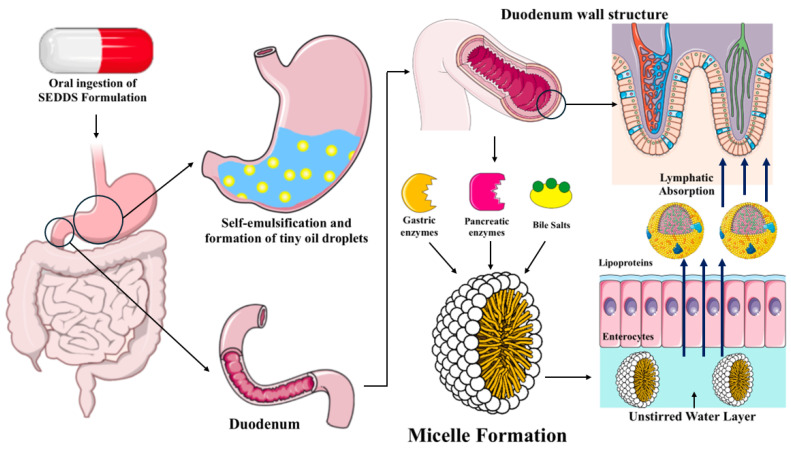
Figure 1. Formation of SEDDS.
Self-micro emulsifying drug delivery systems (SMEDDS)
Oral delivery of poorly water-soluble drugs remains a bottleneck in drug development. For BCS Class II and IV compounds, low aqueous solubility and dissolution rate limit gastrointestinal absorption, resulting in bioavailability often <10% and high inter-subject variability [32,33]. While strategies like solid dispersions and micronization improve dissolution, they frequently face stability, scale-up, and manufacturing.
Challenges associated with SMEDDS
Self-micro emulsifying drug delivery systems (SMEDDS) address this by delivering the drug in a pre-dissolved state within a lipid-based preconcentrate that spontaneously forms a microemulsion upon contact with gastrointestinal fluids [34,35]. SMEDDS are a subclass of lipid-based systems positioned between conventional self-emulsifying systems (SEDDS) and self-nanoemulsifying systems (SNEDDS), distinguished primarily by droplet size and thermodynamic stability.
SMEDDS are defined as isotropic mixtures of oil, surfactant, and co-surfactant/co-solvent that form oil-in-water microemulsions with droplet sizes typically in the range of 10–100 nm upon mild agitation in aqueous media as shown in Figure 2.
Key characteristics of SMEDDS
Thermodynamic stability: Unlike coarse emulsions, microemulsions form spontaneously and are stable over time without phase separation.
Optical transparency: Due to the small droplet size, microemulsions appear transparent or translucent.
Low interfacial tension: Achieved through the combination of surfactant and co-surfactant, allowing spontaneous emulsification with minimal energy input from GI motility.
High drug loading capacity: The drug remains molecularly dispersed in the lipid phase, avoiding dissolution limitations.
Mechanism of bioavailability enhancement of SMEDDS
SMEDDS enhance oral absorption through multiple synergistic mechanisms [36]:
In-situ solubilization: The drug is maintained in a solubilized state in the GI tract, bypassing the dissolution step and preventing precipitation upon dilution. Increased surface area: Nano-sized droplets provide a large interfacial area for drug release and diffusion across the intestinal membrane. Lymphatic transport: Long-chain lipids stimulate chylomicron formation, shunting drug-loaded particles into the lymphatic system and bypassing hepatic first-pass metabolism. Membrane permeation and efflux inhibition: Non-ionic surfactants like Cremophor® EL and Tween® 80 can transiently modulate membrane fluidity and inhibit P-glycoprotein and CYP3A4, reducing efflux and metabolism. Prolonged residence time: Lipid digestion products can slow gastric emptying, extending the window for absorption.
Advantages over conventional and SEDDS systems
Compared to conventional tablets and coarse emulsions, SMEDDS offer [37-41]:
Faster onset and higher bioavailability: Demonstrated for cyclosporine, ritonavir, and fenofibrate.
Reduced food effect: Drug absorption is less dependent on gastric conditions and bile secretion.
Lower dose variability: More consistent pharmacokinetics across patients.
Protection of labile drugs: Shielding from acidic pH and enzymatic degradation.
Ease of manufacturing: Simple blending and liquid filling into hard or soft gelatin capsules.
Compared to SEDDS, SMEDDS form smaller droplets with greater thermodynamic stability, leading to more reproducible performance and reduced precipitation risk.
Challenges and Limitations
Despite their advantages, SMEDDS face several practical challenges:
Surfactant toxicity: High surfactant concentrations required for emulsification may cause GI irritation.
Drug precipitation: Dilution in GI fluids can destabilize the system if drug solubility in the aqueous phase is low.
Stability issues: Phase separation or drug crystallization during storage, especially for solid SMEDDS.
Regulatory complexity: Nano-sized droplets and novel excipients require extensive safety and characterization data.
Limited hydrophilic drug loading: SMEDDS are best suited for lipophilic compounds.
Evolution and clinical relevance of SMEDDS
SMEDDS evolved from first-generation SEDDS to address variability and precipitation issues. Commercial success includes formulations like Neoral® (cyclosporine A), which uses a microemulsion preconcentrate to improve absorption consistency. Recent research extends SMEDDS to solid dosage forms via adsorption onto solid carriers, producing solid-SMEDDS with improved stability and patient acceptability [42].
Formulation components of SMEDDS.
The performance of SMEDDS depends on the rational selection and optimization of excipients as shown in Table 1:
Table 1. Formulation components of SMEDDS
|
Components |
Roles |
Examples |
|
Oil |
Solubilize the drug; promote lymphatic uptake |
Capmul® MCM, Labrafil® M 1944 CS, Maisine® CC |
|
Surfactants |
Lower interfacial tension; enable spontaneous emulsification |
Cremophor® RH40, Tween® 80, Labrasol® |
|
Co-surfactants/co-solvents |
Fluidize the interfacial film; increase drug solubility |
Transcutol® P, PEG 400, Propylene glycol, Ethanol. |
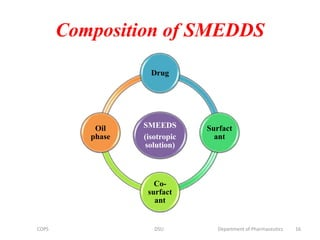
Figure 2. Composition of SMEDDS.
Self-Nanoemulsifying Drug Delivery Systems (SNEDDS)
Oral delivery of poorly water-soluble drugs accounts for ∼40% of marketed drugs and ∼70% of new chemical entities in development [42]. For BCS Class II and IV compounds, dissolution in the gastrointestinal tract is the rate-limiting step, leading to low, variable, and food-dependent bioavailability. Lipid-based systems have proven effective by presenting the drug in a solubilized state, but conventional emulsions and SEDDS often form droplets >200 nm, which are prone to coalescence and drug precipitation upon dilution [43]. Self-nanoemulsifying drug delivery systems (SNEDDS) emerged to address these limitations. They represent the most advanced subclass of self-emulsifying systems, forming nano-sized droplets with enhanced thermodynamic stability, higher surface area, and more predictable in vivo performance [44]. SNEDDS have gained significant attention since the early 2000s and now underpin several marketed products and clinical candidates.
Key characteristics associated with SNEDDS
SNEDDS are isotropic mixtures of oil, surfactant, co-surfactant, and drug that spontaneously form oil-in-water nano emulsions with droplet sizes typically between 20–50 nm upon mild agitation in aqueous media, such as gastrointestinal fluids. Key characteristics that distinguish SNEDDS from SEDDS and SMEDDS [45,46].
Droplet size: <50 nm, often 20–30 nm, leading to optical transparency and near-molecular dispersion.
Thermodynamic stability: Stable to phase separation, creaming, and precipitation over a wide range of dilution and temperature.
Spontaneous formation: Requires minimal energy input from peristaltic motion; no high-shear homogenization needed in vivo.
High interfacial area: Droplet sizes in the nano-range provide surface areas >100 m²/g, accelerating drug release and membrane contact.
Mechanisms of bioavailability enhancement of SNEDDS
SNEDDS improve oral absorption through mechanisms that are amplified compared to SEDDS/SMEDDS due to their smaller droplet size as shown in Figure 3:
Suppressed precipitation: The drug remains molecularly dispersed in the oil phase and within nano-droplets, maintaining supersaturation even after dilution in intestinal fluids. Enhanced permeability: Nano-droplets interact more efficiently with the unstirred water layer and epithelial membrane, increasing transcellular and paracellular transport. Lymphatic uptake: Medium- and long-chain lipids stimulate chylomicron assembly, shunting lipophilic drugs into the lymphatic system and bypassing hepatic first-pass metabolism.
Efflux and metabolism inhibition: Surfactants like Cremophor® EL, Tween® 80, and Labrasol® inhibit P-gp and CYP3A4, increasing the fraction of drug absorbed.
Mucus penetration: Small size and near-neutral surface charge allow better penetration through the mucus layer, reaching the absorptive epithelium.
Formulation components of SNEDDS
The performance of SNEDDS is highly dependent on excipient selection and ratio. Components are chosen based on drug solubility, HLB, and digestibility as shown in Table 2.
Table 2. Formulation components of SNEDDS
|
Components |
Roles |
Examples |
|
Oil |
Solubilize drug; provide substrate for lymphatic transport |
Capryol™ 90, Labrafil® M 1944 CS, Maisine® CC, Capmul® MCM |
|
Surfactants |
Lower interfacial tension to <1 mN/m; stabilize nano-droplets |
Cremophor® RH40, Tween® 80, Solutol® HS15, Labrasol® |
|
Co-surfactants/co-solvents |
Fluidize interfacial film; increase drug loading and reduce surfactant amount |
Transcutol® P, PEG 400, Propylene glycol, Ethanol. |
Advantages over SEDDS and SMEDDS
Smaller droplet size: Leads to faster drug release, better membrane contact, and reduced food effect.
Greater thermodynamic stability: No phase separation upon storage or dilution, reducing batch variability.
Lower surfactant requirement: More efficient emulsification allows reduced surfactant load, minimizing GI irritation.
Improved reproducibility: More consistent pharmacokinetic profiles across fed/fasted states and between subjects.
Suitability for solidification: SNEDDS can be converted to solid-SNEDDS by adsorption onto silica, MCC, or porous carriers, improving stability and patient compliance.
Challenges and limitations of SNEDDS
Despite advantages, SNEDDS face formulation and translational hurdles:
High excipient load: Large amounts of surfactants/co-solvents may be needed for poorly soluble drugs, raising toxicity concerns.
Drug precipitation during digestion: Lipolysis can reduce drug solubility in the aqueous phase, causing recrystallization.
Characterization complexity: Nano-droplet size, polydispersity, and in vitro-in vivo correlation require advanced techniques like DLS, cryo-TEM, and dynamic lipolysis models.
Regulatory scrutiny: Nano-sized systems require detailed safety, stability, and quality control data under ICH guidelines.
Limited loading for hydrophilic drugs: SNEDDS are primarily suited for lipophilic, neutral, or weakly basic drugs.
Clinical and commercial relevance
SNEDDS have moved from academic research to clinical use. Examples include: Fenofibrate SNEDDS: Improved bioavailability and reduced fed-fasted variability compared to conventional formulations.
Ritonavir and Lopinavir: Used in fixed-dose HIV combinations to enhance absorption.
Curcumin and CoQ10: Nutraceutical SNEDDS showing 5–20× higher plasma levels in human studies.
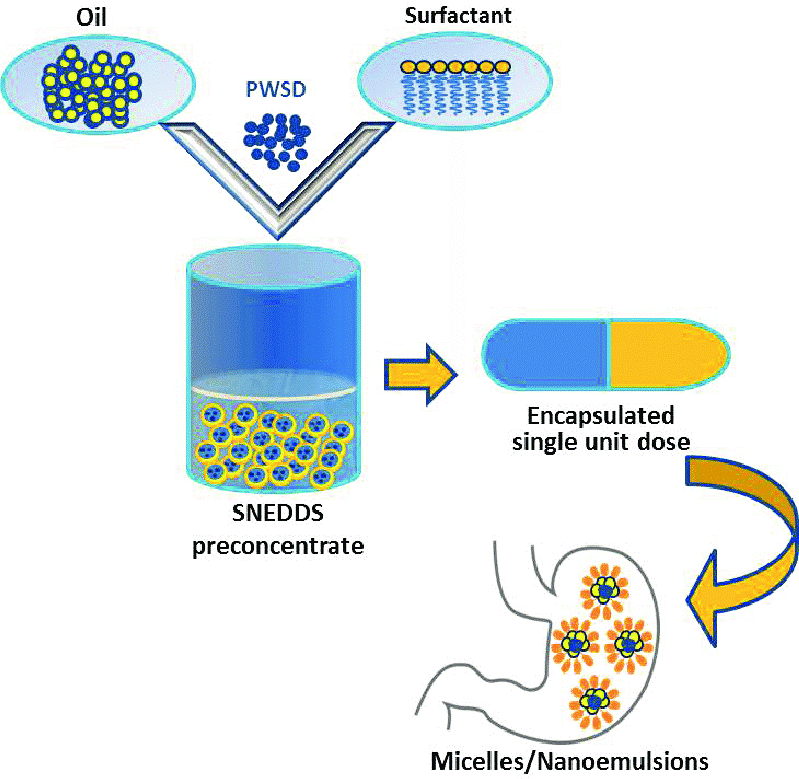
Figure 3. Formation of SNEDDS.
Comparison of SEDDS, SMEDDS, and SNEDDS
Table 3 shows the breakdown of the three main self-emulsifying lipid systems used for oral delivery of poorly soluble drugs:
Table 3. Comparison of SEDDS, SMEDDS and SNEDDS
|
Parameters |
SEDDS |
SMEDDS |
SNEDDS |
|
Definition |
Self-Emulsifying Drug Delivery Systems: Isotropic mixtures that form coarse emulsions upon dilution |
Self-Micro emulsifying Drug Delivery Systems: Form microemulsions upon dilution |
Self-Nanoemulsifying Drug Delivery Systems: Form nano emulsions upon dilution |
|
Droplet size |
200 nm – 5 µm |
10 – 100 nm |
20 – 50 nm |
|
Appearance |
Cloudy, milky emulsion |
Translucent to slightly bluish |
Transparent to slightly bluish |
|
Thermodynamic stability |
Kinetically stable; prone to phase separation and coalescence |
Thermodynamically stable; resistant to phase separation |
Highly thermodynamically stable; resistant to dilution, pH, and temperature changes |
|
Emulsification energy required |
Low agitation from GI motility |
Very low agitation; spontaneous |
Minimal agitation; spontaneous |
|
Interfacial tension |
Moderately reduced by surfactants |
Low, due to surfactant + co-surfactant |
Very low, due to optimized surfactant/co-surfactant ratio |
|
Excipient’s requirements |
Higher oil and surfactant content often needed; co-surfactant optional |
Surfactant + co-surfactant required for microemulsion formation |
Optimized surfactant/co-surfactant ratio; lower surfactant load possible |
|
Drug loading capacity |
Moderate to high for lipophilic drugs |
High for lipophilic drugs |
High, but sensitive to drug precipitation upon digestion |
CONCLUSION AND FUTURE PERSPECTIVES
Oral lipid-based drug delivery systems have transformed the formulation landscape for poorly water-soluble drugs by addressing the fundamental limitations of dissolution, solubility, and first-pass metabolism. The evolution from conventional emulsions to SEDDS, SMEDDS, and SNEDDS reflects a progressive refinement in controlling droplet size, thermodynamic stability, and in vivo performance. Each system operates on the principle of presenting the drug in a solubilized state within a lipid vehicle that spontaneously emulsifies in the gastrointestinal tract, but they differ in droplet size, excipient requirements, and the degree of reproducibility achieved. SNEDDS represent the current state of the art, generating nano emulsions with droplet sizes below 50 nm that minimize precipitation, reduce variability, and allow lower surfactant loads. The clinical adoption of SNEDDS for drugs like fenofibrate and ritonavir underscores their translational potential. Despite these advances, several challenges remain. High surfactant concentrations can cause gastrointestinal irritation and limit patient acceptability. Drug precipitation during digestion and dilution continues to be a barrier for compounds with poor aqueous solubility even in the dispersed state. The complexity of in vitro-in vivo correlation for lipid systems requires more predictive tools, particularly dynamic lipolysis models that better mimic human digestion. Regulatory expectations for nano-sized systems also demand rigorous characterization of droplet size, polydispersity, and long-term stability. The future of oral LBDDS lies in overcoming these barriers through hybrid and intelligent designs. Solid-SNEDDS and solid-SMEDDS address stability and dosing convenience by adsorbing liquid preconcentrates onto porous carriers, enabling tablet and capsule formats with improved shelf life. Stimuli-responsive and targeted systems that release drug in specific GI regions or exploit receptor-mediated uptake are expanding the scope to peptides, proteins, and nucleic acids. Advances in excipient science, such as digestible surfactants and biocompatible lipids, are reducing toxicity concerns while maintaining emulsification efficiency. Computational modeling and machine learning are beginning to accelerate formulation optimization by predicting phase behavior and digestion outcomes.
In summary, oral lipid-based systems have moved from empirical formulations to rationally designed platforms that bridge the gap between drug discovery and clinical use. SEDDS, SMEDDS, and SNEDDS each occupy a distinct niche, but the trend is toward smaller, more stable, and more patient-friendly systems. As manufacturing, characterization, and regulatory frameworks mature, these systems will continue to enable the oral delivery of drugs that were once considered undeliverable, ultimately improving therapeutic outcomes and patient access.
ACKNOWLEDGEMENTS
None.
CONFLICT OF INTEREST
No conflict of interest is associated with this work.
CONTRIBUTIONS OF AUTHORS
Chekwube A. Ezegbe: Conceptualization, writing, revision; Obioma R. Emeka-Obi: Conceptualization, writing, revision; Kosisochukwu A. Emeagwali: Conceptualization, writing, revision; Emmanuella O. Ogbonna: writing, revision; John I Osaro: writing, revision., Amarachi G. Ezegbe: Conceptualization, writing, revision; Nkesi A. Amadi: writing, revision; Ruhuoma G. Amadi: writing, revision; Chikaodi G. Onuaja: writing, revision, Mercy Onoja: writing, revision.
REFERENCES
- Liu X, Zhao L, Wu B, Chen F. (2023). Improving solubility of poorly water-soluble drugs by protein-based strategy: A review. Int J Pharm. 634:122704.
- Thomas N, Holm R, Garmer M, Karlsson JJ, Müllertz A, Rades T. (2013). Supersaturated self-nanoemulsifying drug delivery systems (Super-SNEDDS) enhance the bioavailability of the poorly water-soluble drug simvastatin in dogs. AAPS J. 15(1):219-227.
- Morakul B. (2020). Self-nanoemulsifying drug delivery systems (SNEDDS): an advancement technology for oral drug delivery. Pharm Sci Asia. 47(3):205-220.
- Chatterjee B, Hamed Almurisi S, Ahmed Mahdi Dukhan A, Mandal UK, Sengupta P. (2016). Controversies with self-emulsifying drug delivery system from pharmacokinetic point of view. Drug Deliv. 23(9):3639-3652.
- Zafar A, Imam SS, Alruwaili NK, Alsaidan OA, Elkomy MH, Ghoneim MM, et al. (2021). Development of piperine loaded solid self-nanoemulsifying drug delivery system: optimization, in-vitro, ex-vivo, and in-vivo evaluation. Nanomaterials. 11(11):2920.
- Zingale E, Bonaccorso A, D'Amico AG, Lombardo R, D'Agata V, Rautio J, et al. (2024). Formulating Resveratrol and Melatonin Self-Nanoemulsifying Drug Delivery Systems (SNEDDS) for Ocular Administration Using Design of Experiments. Pharmaceutics. 16(1):125.
- Tashish AY, Shahba AA, Alanazi FK, Kazi M. (2022). Adsorbent Precoating by Lyophilization: A Novel Green Solvent Technique to Enhance Cinnarizine Release from Solid Self-Nanoemulsifying Drug Delivery Systems (S-SNEDDS). Pharmaceutics. 15(1):134.
- Ujilestari T, Martien R, Ariyadi B, Dono ND. (2018). Self-nanoemulsifying drug delivery system (SNEDDS) of Amomum compactum essential oil: design, formulation, and characterization. J Appl Pharm Sci. 8(6):14-21.
- Kim JS, Din FU, Lee SM, Kim DS, Woo MR, Cheon S, et al. (2021). Comparison of Three Different Aqueous Microenvironments for Enhancing Oral Bioavailability of Sildenafil: Solid Self-Nanoemulsifying Drug Delivery System, Amorphous Microspheres and Crystalline Microspheres. Int J Nanomedicine. 16:5797-5810.
- Yasser M, Gad S, El-sayed M, Ghorab M. (2013). The effect of converting liquid valsartan SNEDDS into solid SNEDDS using different solid carriers on its performance. International Journal of Biological & Pharmaceutical Research. 4(12):1015-1026.
- Alhakamy NA, Fahmy UA, Ahmed OAA, Almohammadi EA, Alotaibi SA, Aljohani RA, et al. (2020). Development of an optimized febuxostat self-nanoemulsified loaded transdermal film: in-vitro, ex-vivo and in-vivo evaluation. Pharm Dev Technol. 25(3):326-331.
- Rasoanirina BNV, Lassoued MA, Kamoun A, Bahloul B, Miladi K, Sfar S. (2020). Voriconazole-loaded self-nanoemulsifying drug delivery system (SNEDDS) to improve transcorneal permeability. Pharm Dev Technol. 25(6):694-703.
- Abushal AS, Aleanizy FS, Alqahtani FY, Shakeel F, Iqbal M, Haq N, Alsarra IA. (2022). Self-Nanoemulsifying Drug Delivery System (SNEDDS) of Apremilast: In Vitro Evaluation and Pharmacokinetics Studies. Molecules. 27(10):3085.
- Nielsen FS, Petersen KB, Müllertz A. (2008). Bioavailability of probucol from lipid and surfactant based formulations in minipigs: influence of droplet size and dietary state. Eur J Pharm Biopharm. 69(2):553-562.
- Food and Drug Administration (.gov) (2008). ACCUTANE® (isotretinoin capsules). Available at: https://www.accessdata.fda.gov/drugsatfda_docs/label/2008/018662s059lbl.pdf
- European Medicines Agency Rapamune, INN-sirolimus. Available at: https://www.ema.europa.eu/en/documents/product-information/rapamune-epar-product-information_en.pdf
- European Medicines Agency Aptivus, INN-Tipranavir. Available at: https://www.ema.europa.eu/en/documents/product-information/aptivus-epar-product-information_en.pdf
- Schmied F-P, Bernhardt A, Engel A, Moers C, Endres T. (2021). Solid self-nanoemulsifying drug delivery system (SNEDDS). Available at: https://patentimages.storage.googleapis.com/fd/11/e4/22c7625f328831/WO2021239798A1.pdf
- Teksin ZS, Yilmaz Usta D. (2022). Formulations of bosentan monohydrate loaded self-nanoemulsifying drug delivery systems prepared with long-chain mono and diglyceride mixtures. Available at: https://patentimages.storage.googleapis.com/2f/ce/9f/8babe7e1efbb5e/WO2022108572A1.pdf
- Moers C, Schmied F-P, Seibel M, Bernhardt A. (2022). Solid SNEDDS based on a specific mixture of acrylic polymers. Available at: https://patentimages.storage.googleapis.com/af/11/ca/66a7cb7d14dc5a/WO2022184549A1.pdf
- Shah CR, Joshi HR, Schwarz J, Weisspapir M. (2023). Pharmaceutical composition for oral administration of cannabinoids. Available at: https://patentimages.storage.googleapis.com/8c/97/97/5fcad9a9c82c87/WO2023240348A1.pdf
- Kazmi I, Beg S, Rahman M, Al-Abbasi FA, Afzal M, Altayeb HN. (2023). Chemotherapeutic self-nanoemulsifying drug delivery systems and uses thereof. Available at: https://patents.google.com/patent/US11547690B1/en
- Ahmed TA, Felimban RI, Tayeb HH, El-Say KM, Rizg WY, Alnadwi FH. (2022). Self-nanoemulsifying 3D-printed tablet composition and method of use thereof. Available at: https://patents.google.com/patent/US11253481B1/en
- Nunes AMV, Arcanjo DDR, De Oliveira Borba EF, De Oliveira Rocha HA, Batista MIF, Lima LR, et al. (2024). Colloidal SNEDDS formulation containing anacardium occidentale L. Taninins Pharmacol Potent Against Covid-19. Available at: https://patents.google.com/patent/BR102024000877A2/en?oq=BR102024000877A2
- Schmied F-P, Bernhardt A, Endres T, Beekmann U, Nollenberger K. (2023). Solid self-nanoemulsifying drug delivery system having biosynthetic cellulose as adsorbent. Available at: https://patents.google.com/patent/EP4529919A1/en?oq=EP4529919A1
- Mahmood A, Bernkop-Schnürch A. (2019). SEDDS: A game changing approach for the oral administration of hydrophilic macromolecular drugs. Adv Drug Deliv Rev. 142:91-101.
- Maji I, Mahajan S, Sriram A, Medtiya P, Vasave R, Khatri DK, et al. (2021). Solid self emulsifying drug delivery system: Superior mode for oral delivery of hydrophobic cargos. J Control Release. 337:646-660.
- Matsaridou I, Barmpalexis P, Salis A, Nikolakakis I. (2012). The influence of surfactant HLB and oil/surfactant ratio on the formation and properties of self-emulsifying pellets and microemulsion reconstitution. AAPS PharmSciTech. 13(4):1319-1330.
- Mehta P, Parekh P. (2011). Self-emulsifying drug delivery system: a novel approach to enhance oral bioavailability of poorly soluble drugs. J Pharm Res. 4:2191-2194.
- Mishra V, Nayak P, Yadav N, Singh M, Tambuwala MM, Aljabali AAA. (2021). Orally administered self-emulsifying drug delivery system in disease management: advancement and patents. Expert Opin Drug Deliv. 18(3):315-332.
- Mohsin K, Long MA, Pouton CW. (2009). Design of lipid-based formulations for oral administration of poorly water-soluble drugs: precipitation of drug after dispersion of formulations in aqueous solution. J Pharm Sci. 98(10):3582-3595.
- Nigade PM, Patil SL, Tiwari SS. (2012). Self-emulsifying drug delivery system (SEDDS): a review. Int J Pharm Biol. Sci 2(2):42-52.
- Patel P, Patel M, Patel K, Patel N. (2014). A review on self-micro emulsifying drug delivery systems. Adv Res Pharm Biol. 4:590-598.
- Page S, Szepes A. (2021). Impact on drug development and drug prod uct processing. In: Gruss M, Ed. Solid state development and processing of pharmaceutical molecules: salts, cocrystals, and polymorphism. Vol. 79. pp. 325-364.
- Park H, Ha E-S, Kim M-S. (2020). Current status of super saturable self-emulsifying drug delivery systems. Pharmaceutics. 12(4):365.
- Pouton CW. (2000). Lipid formulations for oral administration of drugs: non-emulsifying, self-emulsifying and 'self-microemulsifying' drug delivery systems. Eur J Pharm Sci. 11(Suppl 2):S93-S98.
- Qian C, McClements DJ. (2011). Formation of nano emulsions stabilized by model food-grade emulsifiers using high-pressure homogenization: factors affecting particle size. Food Hydrocolloids. 25(5):1000-1008.
- Rahman MA, Hussain A, Hussain MS, Mirza MA, Iqbal Z. (2013). Role of excipients in successful development of self-emulsifying/microemulsifying drug delivery system (SEDDS/SMEDDS). Drug Dev Ind Pharm. 39(1):1-19.
- Rajesh BV, Reddy TK, Srikanth G. (2010). Lipid based self-emulsifying drug delivery system (SEDDS) for poorly water-soluble drugs: a review. J Glob Pharma Technol. 2(3):47-55.
- Rajpoot D, Kumar A, Kumar A. (2019). Self-emulsifying drug delivery system: a review. Int J Pharm Biol Arch. 10:1-7.
- Rani ER, Radha GV. (2021). Insights into Novel Excipients of Self-Emulsifying Drug Delivery Systems and Their Significance: An Updated Review. Crit Rev Ther Drug Carrier Syst. 38(2):27-74.
- Rani S, Rana R, Saraogi GK, Kumar V, Gupta U. (2019). Self-Emulsifying Oral Lipid Drug Delivery Systems: Advances and Challenges. AAPS PharmSciTech. 20(3):129.
- Rao SV, Yajurvedi K, Shao J. (2008). Self-nanoemulsifying drug delivery system (SNEDDS) for oral delivery of protein drugs: III. In vivo oral absorption study. Int J Pharm. 362(1-2):16-19.
- Ezegbe CA, et al. (2026). A Review on Fabrication Techniques and Applications of Cellulose-Based Biomaterials for Sustainable Environmental Remediation. Mathews J Pharma Sci. 10(1):61.
- Andrew CE, Ogochukwu U, Sabinus IO. (2022). Drug Carriers. J. Current Biomed Res. 2(1):77-105.
- Ezegbe CA, Ezegbe AG, Anikwe CC, Odo KB, Onyia OC, Agu-kalu A, et al. (2025). The role of polysaccharide aerogel in tissue regeneration and repair. Univers J Pharm Res. 10(1):56-60.
