Information Links
Related Conferences
Previous Issues Volume 10, Issue 2 - 2026
Principal Tumbler-Roller Pigeons in Bangladesh
Ashraful Kabir*
Department of Biology, Cantonment Public College, Saidpur Cantonment—5311, Nilphamari, Bangladesh
*Corresponding author: Ashraful Kabir, Department of Biology, Cantonment Public College, Saidpur Cantonment—5311, Nilphamari, Bangladesh, Phone: +88-01712563750; E-mail: [email protected]
Received Date: February 26, 2026
Published Date: March 12, 2026
Citation: Kabir A. (2026). Principal Tumbler-Roller Pigeons in Bangladesh. Mathews J Vet Sci. 10(2):105.
Copyrights: Kabir A. © (2026).
ABSTRACT
Bangladesh is rich with many tumbler and roller pigeons. Divisional cities of Bangladesh especially Dhaka and Rajshahi are the major cities of available tumbler and roller pigeons. Month-wise visits in mentioned pigeon markets of Bangladesh resulted the PCA (principal component analysis) with training set and test set where Vienna short-faced tumbler, komorner tumbler, Dhaka tumbler (produced from Pakistani highflyer), Iranian tumbler, indigenous lotan, parlor roller, and English magpie were mostly preferred out of 21 tumbler-roller pigeons. Further studies need to be noted with sufficient data in future.
Keywords: Tumbler Pigeon, Roller Pigeon, Highflyer Pigeon, Morphometrics, Characteristics, Bangladesh.
INTRODUCTION
Rock-pigeons could have been domesticated for squabs in nesting caves [1]. Pigeon rearing was practiced by the Romans for a very early date and France especially has a long history of keeping pigeon [2]. Greece, Italy, Spain, Germany, Netherlands, and England have dovecote history [3]. The chequer pattern with blue color was common in dovecote pigeons, and this pattern is the result of mutation with wider wing bars and black markings. Darwin [4] described that all species originated from an ancestor by natural selection. It is assumed that there is a neurological defect in tumbler pigeons [5,6]. A problem was found in vestibular apparatus of the inner ear which is the sensory part of the balance mechanism [5]. Subsequently, an abnormality has been found at the junctions between peripheral nerves and skeletal muscle cells in parlor tumblers but this is not considered to be the explanation for their tumbling behavior [6]. Grimshow [7] and Gilbert [8] also described the tumbler and their performance. The objective of this write-up is to focus the most common tumbler pigeons among other pigeons in the markets.
MATERIALS AND METHODS
Observed pigeons: Total 21-types of pigeons like Vienna short-faced tumbler, komorner tumbler, Dhaka tumbler, Iranian tumbler, indigenous lotan, Indian lotan, parlor roller, English magpie, erlau tumbler, stargard shaker, Turkish tumbler, Hamburg helmet, Serbian highflyer, flying tippler, Uzbek tumbler, Pakistani highflyer, mookee, German nun, English nun, bald-headed tumbler, and parlor tumbler were observed in the markets of Dhaka and Rajshahi District of Bangladesh.
PCA analysis by RStudio: Principal component analysis (PCA) was used for the data analyses. Out of 11 parameters (weight, wing length, height, beak base thickness, beak length, nape length, neck thickness, tail length, tarsus length, and tarsus thickness were analyzed with the acceptance of the buyers of such pigeons. For this scientific note, a dataset on 21-types of tumbler pigeons of Bangladesh was used for statistical analyses [9].
RESULTS
Explanation of the results: Out of training set and test set, the SVM (support vector machine) visualized with same-colored dots of pigeons which were common in such markets.
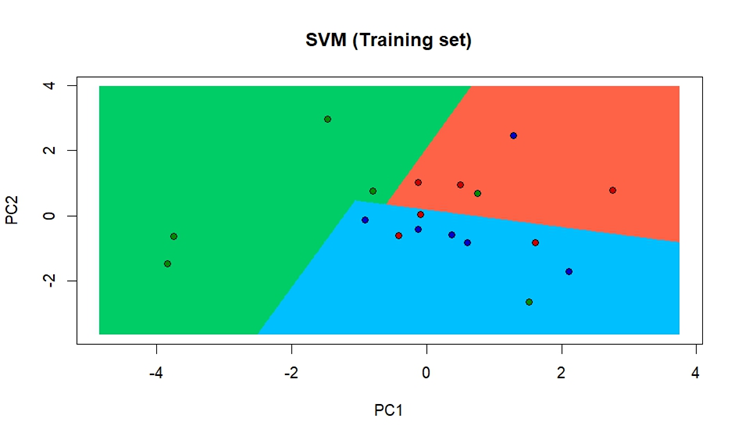
Figure 1. In green area, all dots are green, there are no different dots, so in this group pigeons are more acceptable by the breeders in the market. Blue and red area are mixed with blue and red dots.
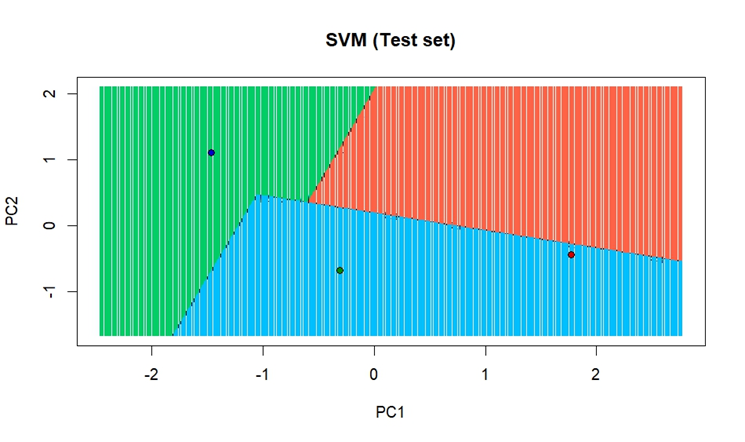
Figure 2. In green area, only one green dot is there. In blue area, there is red dot from the red area, so the blue portion and red portion are not considerable in this case.
Breeders’ perceptions about some tumblers/rollers
Huge tumbling of some pigeons supported these findings. Serbian and erlau pigeons are rare in Bangladesh. People do not know enough about these pigeons. Lotans are the same to the local pigeons, so it can easily mix with local ones. Without shaking, breeders cannot know about this breed, so naturally these pigeons can mate with others and produce different pigeons (genetically mixed).
Table 1. Tumbler/Roller at Dhaka and Rajshahi pigeon markets
|
Tumbler/Roller Pigeons |
Origin |
Status in Markets |
Characteristics |
|
*Vienna short-faced tumbler |
Vienna |
Uncommon |
Alien-like appearance; tiny and short beak; large, prominent dark-irised eyes; small cubical remarkable head |
|
*Komorner tumbler |
Hungary |
Common |
Very remarkable crest and pied marking |
|
*Dhaka tumbler |
Dhaka, Bangladesh |
Common |
Somewhat Pakistani highflyer but small in size |
|
*Iranian highflyer |
Iran |
Uncommon |
Mid-size beak; sleek feather; staying in the air for many hours |
|
*Indigenous lotan |
Bangladesh |
Common |
Self-white and self-red with peak crest; clean-legged; small in size; rolls after shaking |
|
Indian lotan |
India |
Common |
Self-white with broad crest; muffed; large in size; rolls after shaking |
|
*Parlor roller |
USA |
Common |
Small in size; continuous rolling on the ground after releasing |
|
*English magpie |
England |
Common |
Long head-neck-leg-body; pied marking; pearl eyes |
|
Erlau tumbler |
Hungary |
Uncommon |
Small head; curved head |
|
Stargard shaker |
Germany |
Common |
Tremulous long neck; elongated body and legs |
|
Turkish tumbler |
Turkey |
Uncommon |
Double crested; muffed; abnormal tumbling from the short height |
|
Hamburg helmet tumbler |
Germany |
Uncommon |
Short beak; helmet marking; clean-legged |
|
Serbian highflyer |
Serbia |
Uncommon |
High altitude flying capability |
|
Flying tippler |
England |
Uncommon |
Very nice feather texture; short beak |
|
Uzbek tumbler |
Uzbekistan |
Uncommon |
Single broad crest; huge tumbling pigeon unlike Turkish tumbler |
|
Pakistani highflyer |
Pakistan |
Common |
Big-headed with long neck; posture is somewhat snake-like |
|
Mookee |
India |
Common |
S-marked tremulous neck; small in size |
|
German nun |
Germany |
Common |
Nun-marked face with broad crest; small head and beak; clean-legged |
|
English nun |
England |
Uncommon |
Nun-marked face with broad crest; broad head but small beak; clean-legged |
|
Bald-headed tumbler (gorra in Bangladesh) |
Germany and England |
Common |
White-headed with many colors |
|
Parlour tumbler (English short-faced tumbler) |
England |
Common |
Small in size; interrupted rolling on the ground after releasing |
*First priority pigeons at the markets
Used dataset: Pares-Casanova and Kabir [9] used this dataset in a broader way. By using that dataset only PCA was carried out just for knowing the acceptance of tumbler and roller pigeons in the markets on the basis of the following parameters.
Appendix 1. Observed tumblers and rollers in pigeon markets
|
Weight |
Wing_length |
Height |
Beak_base_thickness |
Beak_length |
Nape_length |
Neck_thickness |
Tail_length |
Tarsus_length |
Tarsus_thickness |
Buyer |
|
230 |
19 |
18.5 |
1.1 |
1.2 |
4.1 |
4.3 |
8.8 |
2.3 |
0.6 |
1 |
|
250 |
18 |
21 |
1 |
1.4 |
2.9 |
5.8 |
10 |
2.3 |
0.6 |
1 |
|
280 |
22.8 |
19 |
1 |
1.6 |
3.2 |
5.2 |
12 |
2.5 |
0.6 |
1 |
|
290 |
24.5 |
18.9 |
1.1 |
1.8 |
4.8 |
5.9 |
12 |
2.4 |
0.6 |
1 |
|
290 |
22 |
17.7 |
0.9 |
1.8 |
4.9 |
4.4 |
11 |
2.8 |
0.7 |
1 |
|
290 |
22.3 |
15 |
0.9 |
1.4 |
3.7 |
4.8 |
12 |
2.1 |
0.4 |
1 |
|
300 |
22.5 |
18 |
1.2 |
2.2 |
5.2 |
4 |
10.4 |
3.3 |
0.6 |
1 |
|
300 |
23.3 |
20.4 |
1.1 |
2 |
5 |
3.3 |
10.2 |
2.4 |
0.5 |
2 |
|
300 |
22 |
20.3 |
1 |
1.4 |
3.6 |
4.7 |
11.2 |
2.7 |
0.6 |
2 |
|
300 |
22.5 |
28 |
0.9 |
2 |
6.8 |
4.8 |
11 |
2.7 |
0.6 |
2 |
|
310 |
22 |
15.5 |
0.5 |
2 |
4.2 |
5.3 |
10 |
2.1 |
0.5 |
2 |
|
320 |
22 |
22 |
1 |
1.5 |
4.5 |
5.4 |
11 |
2.7 |
0.6 |
2 |
|
320 |
23.6 |
17.5 |
0.6 |
1.7 |
5.5 |
4.5 |
12.4 |
2.5 |
0.5 |
2 |
|
330 |
23.3 |
20.5 |
1 |
1.6 |
4.5 |
4.1 |
10.5 |
2.7 |
0.6 |
2 |
|
330 |
23 |
15 |
1.1 |
1.3 |
4.6 |
5.2 |
12.5 |
2.5 |
0.7 |
3 |
|
330 |
23 |
21 |
1.1 |
1.7 |
5.2 |
5.4 |
12.5 |
3 |
0.7 |
3 |
|
340 |
22.6 |
19.2 |
1 |
1.8 |
4.7 |
7 |
11.6 |
2.4 |
0.6 |
3 |
|
340 |
22.7 |
22.7 |
1 |
1.5 |
3.8 |
6 |
11.5 |
2.5 |
0.7 |
3 |
|
360 |
21.7 |
22.8 |
1.2 |
1.6 |
4 |
5.5 |
10.5 |
2.3 |
0.6 |
3 |
|
360 |
23 |
20.4 |
1.1 |
2 |
4.7 |
5 |
11 |
2.6 |
0.7 |
3 |
|
400 |
24 |
22 |
1.1 |
2 |
5.5 |
4.9 |
12.4 |
2.4 |
0.5 |
3 |
DISCUSSION
Darwin [4] described that all species originated from an ancestor by natural selection, and these tumblers or rollers are not exception in this case. There is a neurological defect in tumbler pigeons [5,6]. A problem was found in vestibular apparatus of the inner ear which is the sensory part of the balance mechanism [5]. An abnormality has been found at the junctions between peripheral nerves and skeletal muscle cells in parlor tumblers [6]. Semi-intensive rearing system is suitable for the proper breeding of lotan pigeons [10]. Colorful highflying pigeons are known as gorra pigeons and most of them were found black-pied [11]. Interbreeding suggested that roller genes (ro) are found in any breeds due to escaping behavior of pigeons as well as non-selective breeding by the breeders. Recently, in Bangladesh, pigeon importers are importing uncommon tumbler pigeons from the abroad.
CONCLUSIONS
Bangladesh is the land of various types of pigeons especially tumblers. From the very beginning, many highflyers were found in Bangladesh. Some highflyers were found in the top height of the sky. From the core of collection, many people are habituated to fly highflyer pigeon, and by the course of time, due to loss of such pigeons, or caught by the predator birds like falcons, now breeders prefer short height tumbler pigeon not extreme highflyer pigeon. Out of many tumbler/roller pigeons, people choice Vienna short-faced, komorner tumbler, Dhaka tumbler, Iranian tumbler, indigenous lotan, parlor roller, and English magpie mostly for their short height tumbles or rolls and beautiful appearance. Additionally, the price of these pigeons was reasonable at pigeon markets. These pigeons could be significant pigeon breeds for the profit with the fulfilment of the hobby. Considering limitations, need to establish this type of experimental design with sufficient data for more clarification.
ACKNOWLEDGEMENTS
None.
CONFLICT OF INTEREST
Ther is no conflict of interest.
REFERENCES
- Hausheer JE. (2026). Where did pigeons come from? The Nature Conservancy. Available at: https://blog.nature.org/2022/08/09/where-did-pigeons-come-from/
- Verschoyle J. (2024). History the pigeonniers of France in perspective. Available at: https://www.facebook.com/groups/352181896150872
- One Foot Forward Team. (2019). Pigeon towers—dovecotes of Andros. Available at: https://onefootforward.gr/pigeon-towers-dovecotes-of-andros/#:~:text=The%20large%20stone%2Dbuilt%20dovecotes,the%20house%20of%20their%20owners.
- Darwin CR. (1959). On the Origin of Species by means of Natural Selection or The Preservation of Favoured Races in the Struggle for Life. John Murray, London.
- Mowrer OH. (1940). The tumbler pigeon. Journal of Comparative Psychology. 30(3):515-533.
- Entrikin RK, Bryant SH. (1975). Electrophysiological properties of biventer cervicis muscle fibers of normal and roller pigeons. J Neurobiol. 6(2):201-212.
- Grimshow R. (1922). About parlour tumblers. American Pigeon Keeper. 24(5):25.
- Gilbert RE. (1947). Inheritance of tumbling in parlour tumbler pigeons. MS thesis, University of Utah, Salt Lake City, Utah, United States.
- Pares-Casanova P-M, Kabir A. (2020). Clustering the tumbler pigeons group on their morphological characteristics reveals a eumetrical and hypermetrical clade. Bulgarian Journal of Agricultural Science. 26(3):659-663.
- Kabir MA. (2014). Management and breeding of lotan pigeon. Palgo Journal of Agriculture. 1(1):8-9.
- Kabir A. (2025). Grading and color genetics of gorra pigeons (Columba livia domestica) in Bangladesh: a study on their phenotypic variations and inheritance patterns. Mathews J Vet Sci. 9(3):72.
