Information Links
Related Conferences
Previous Issues Volume 10, Issue 1 - 2026
Prevalence of Wound and Associated Risk Factors in Horses in and around Debre Markos City, Northwest Ethiopia
Berhan Abebe Tenaw*
East Gojjam Zone Livestock and Fishery Resource Development, Animal Health Team, Debre Markos, Ethiopia
*Corresponding Author: Berhan Abebe Tenaw, East Gojjam Zone Livestock and Fishery Resource Development, Animal Health Team, Debre Markos, Ethiopia, Phone: +25118372783, Email: [email protected]
Received Date: February 05, 2026
Published Date: March 05, 2026
Citation: Tenaw BA. (2026). Prevalence of Wound and Associated Risk Factors in Horses in and around Debre Markos City, Northwest Ethiopia. Mathews J Vet Sci. 10(1):103.
Copyrights: Tenaw BA. © (2026).
ABSTRACT
A cross-sectional study was conducted from October 2024 to February 2025 with the objectives of estimating the prevalence of wound and associated risk factors in 400 randomly selected horses in and around Debremarkos City, North west Ethiopia. The findings revealed wound prevalence of 38%. Work overload, overloading, harness type, age of horses and body condition scores were the major risk factors associated with occurrence of wound in the study area. The association was statistically significant (p-value < 0.05). Owners who work with horses for many days per a week and for long time per a day have more wounded horses than owners working for few days per a week and for short time per a day. Owners who put heavy load on their horses had more wounded horses than those put light load on their horse. Owners work with horse by poor harnessing material had more wounded horses than those use good harness material. Older horses and poor body conditioned horses were at greater risk of developing wound than young and good body conditioned horses. The distribution of wound on the affected horses showed differences, in which higher proportion (41.4%) of wound found at the back whereas moderate proportions (18.4%) and (20.4%) were at the head and wither regions respectively, lower proportions (6.6%) and (13.2%) were under belly and on legs respectively. In general, the present study revealed high overall prevalence of wound in horses in the study area that require training of owners and giving advice services in the area to ensure better management practices, to improve productivity of the animals and the community’s livelihood.
Keywords: Causes, Ethiopia, Horses, Wound, Prevalence, Risk Factors.
INTRODUCTION
Horses are present throughout the world. Horses have been with humans throughout history and have served a variety of practical purposes. These include serving as a means of transport, a work animal in agriculture and in war. Horses were domesticated and utilized by humans since ancient times [1]. Ethiopia holds large potential for equine production. Horses, donkeys and mules belong to the equine group. They are found mainly in temperate, semi-arid or highland areas [2]. The world's equine population is now estimated to be 112.5million, with 44.3 million donkeys, 58.5 million horses, and 9.7 million mules [3]. The number of equines in Africa was in the range of 17.6 million comprising 11.6 million donkeys, 2.3 million mules and 3.7 million horses. Ethiopia possessed approximately half of Africa’s equines population with 37%, 58% and 46% of all Africa, donkeys, horses and mules, respectively [4].
In Ethiopia, the human population has increased and is expected to increase even more in the near future [5]. The increasing human population, demands for transport of goods to and from far, remote areas and construction activities around towns are making equines highly demanded animals [6]. Equines are important animals to the resource poor communities in rural and urban areas of Ethiopia, providing traction power and transport services at low cost. The use of equines in door-to-door transport service also provides urban dwellers with the opportunity of income generation [7]. In urban and peri-urban areas, horses are mainly used in pulling carts to transport people and materials such as water, crop, vegetable, construction materials, firewood and other goods to market [8].
Environmental factors, the type of harness material used (natural or synthetic), the fit of the harness, the behavior of the owner, the frequency of work and the load all contribute to the onset of health problems. Bumpy roads and rugged land-scape, a loose fit and synthetic harness materials, frequent beating and overwork may induce lesions and lameness [9]. Among other health threats confronting equines, wounds remain the most common of all [10]. There are limited studies on the causes of external injuries or accidents in working Equines during transport [11]. According to [12] the prevalence of wounds on equines is mostly caused by certain methods of hobbling to restrain equines. On the other hand, [13] noted that the occurrence of wounds on equines is due to loading with minimal use of padding as well as overloading for a long distance. Asfaw R, et al. [14] indicated that the possible causes of wounds in equines include punctures from sharp object like metal and glass; shear wounds from barbed wire sticks; collusion injuries from falling or running in to the object and entrapment, such as getting a leg hung up in a rope. Gizachew A, et al. [15] note that wounds on working equines are frequently observed on the leg, girth, tail, saddle and wither regions.
The objective of this study is to assess the prevalence of wound in horses in and around Debremarkos City and identify the associated risk factors that may aggravate the occurrence of wound in horses. There were no researches conducted in horse wound in this area so this research is conducted to fill information gap.
MATERIALS AND METHODS
Study design and study area
A cross-sectional study was conducted in the study population (horses) in and around Debremarkos City in Amhara regional state, North West Ethiopia from October 2024 to February 2025 to estimate the prevalence of wound in horses and the associated risk factors. Debremarkos City is located north west of Addis Ababa to Gonder road at an elevation 2400 meters. The area is geographically located at 10°19'N and a longitude 37°43'E. It has a temperate and warm climate typical of the elevated portions of Ethiopia. The climate is classified subtropical highland, despite proximity to the equator. The minimum and maximum temperature averages between 14 and 20°c. March and April are the warmest month with average temperature of 19.8°c. July and August are the coldest months with average temperature of 15.7°c. The mean annual air temperature is17.5°c. The average rainfall is considerably irregular going from 15mm in January to 433mm in July being therefore still the main differentiator of the season of the year [16]. In Debremarkos City, 'there are 6529 horses, 11323 donkeys and 38 mules' [17].
Study animals
The study animals were all horses found in and around Debremarkos City. Horses in all age groups were included in the study. Age of the horses was categorized as young (less than 5 years), adult (5-10 years) and old above 10 years.
Sampling technique and sample size determination
Simple random sampling technique was used to select samples in the study area. Since there was no previous study in the area, 50% expected prevalence was considered to determine the sample size with 95% confidence level and 5% absolute precision; and the total number of horses required for the study was calculated based on the formula given by Thrusfield M [18].
n= 1.962Pexp (1-Pexp)
d2
Where n= the required sample size; 1.96 is the value of z at 95% confidence level; Pexp=expected prevalence of wounds; d= desired absolute precision level at 95% confidence level. Accordingly, the sample size required for the study was 384, but to increase the precision a total of 400 horses were included in the study.
Study methodology
Questionnaire survey
Primary data was collected through administering a structured questionnaire to randomly sampled horse owners. First of all, consent was requested from horse owners whether he/she was voluntary for responding or not and if he/she was not willing the next owner was asked, because of fear that he/she might give irrelevant information if he/she was not willing. One owner interviewed for a short time because if he/she stayed for longer time he/she might go even if the interview was not finished. The questionnaire was covered various respondents detail, working condition, harnessing type and communication aspect questions among residents. Questionnaire collection was carried out by the researcher.
Observation
Each randomly selected horse was observed for the presence of wound. Regardless their severity wounds were defined for their presence (yes, no). During this time location of wound and body condition score were observed and recorded carefully. If there were wound the findings were recorded on a structured body map format. Body condition scores were categorized in to two (poor and good) to do meaning full data analysis.
Data analysis
All the data collected during the study was properly coded and entered into a Microsoft Excel spread sheet and checked for any invalid entry. Data analysis was made using Statistical Package for Social Science (SPSS 2007 version 20) software. Descriptive statistics was used to compare occurrence of wound between the different risk factors. In all the analyses, confidence levels at 95 % were calculated, and a p < 0.05 was used for statistical significance level.
RESULTS
Respondent characteristics and its association with wound
For this study 340 respondents were included. All respondents were horse owners. Among these owners 10(2.9%) were females and 330(97.1%) were males. According to their age 140(41.1%), 90(26.5%) and 110(32.4%) were in the age less than 30, 30-40 and above 40 years old respectively. In educational status 210(61.8%) were illiterate, 70(20.6%) were elementary and 60(17.6%) were junior and above. From 340 owners 130 male owners had wounded horses. No one female respondent had wounded horse. Among these wounded horse owners 50(38.5%), 50(38.5%), 30(23.1%) were in the age of less than 30, 30-40 and above 40 years old respectively. Respondents who had educational status of illiterate, elementary and junior and above had 80(61.5%), 30(23.1%), 20(15.4%) wounded horses respectively. Sex of horse owner respondents was significantly associated with occurrence of wound (p-value < 0.05 and 95% CI did not include 1). Age and educational status of horse owners were not significantly associated with occurrence of wound (p-value > 0.05 at 95% CI).
Table 1. Association between respondents' sex and occurrence of wound on their horses
|
Factor |
Category |
Number of Respondents |
Owners have Wounded Horse |
Percentage (%) |
95% CI |
p-value |
|
Sex |
Male |
330 |
130 |
100 |
(1.95-1.99) |
0.011 |
|
Female |
10 |
0 |
0 |
|||
|
Total |
340 |
130 |
38.2 |
|||
Table 2. Association between respondents' age and occurrence of wound on their horses
|
Factor |
Category |
Number of Respondents |
Owners have Wounded Horse |
Percentage (%) |
95% CI |
p-value |
|
Age |
<30 years |
140 |
50 |
38.5 |
(1.82-2.00) |
0.26 |
|
30-40 years |
90 |
50 |
38.5 |
|||
|
>40 years |
110 |
30 |
23 |
|||
|
Total |
340 |
130 |
38.2 |
|||
Table 3. Association between respondents' educational status and occurrence of wound on their horses
|
Factor |
Category |
Number of Respondents |
Owners have Wounded Horse |
Percentage (%) |
95% CI |
p-value |
|
Edu. status |
Illiterate |
210 |
80 |
61.5 |
(1.47-1.64) |
0.7 |
|
Elementary |
70 |
30 |
23.1 |
|||
|
Junior & above |
60 |
20 |
15.4 |
|||
|
Total |
340 |
130 |
38.2 |
|||
Working conditions and its association with wound
Horse owners had one or more horses they work with. 80 (23.5%) respondents had one horse, 110 (32.4%) respondents had two horses and the remained 150(44.1%) respondents had three and more horses. All respondents were using the horses for the purpose of work that was for cart pulling 190(55.9%) to transport goods and people, for pack transport 70(20.6%) and for farming 80(23.5%). Among these owners work with their horse 120(35.3%) for less than 4 days per a week, 180(52.9%) four to six days per a week and 40(11.8%) all days of a week. Regarding to the length of time per a day one owner work with horse 40(11.8%) for less than two hours, 120(35.3%) for two to six hours and 180(52.9%) work above six hours. To perform one duty 180(52.9%) owners put less than 500 kg load and 160(47.1%) put equal or greater than 500kg load on their horse. In this study 130(38.2%) owners had wounded horses and 210(61.8%) owners had safe horses. Among 130 wounded horse owners 10(7.7%) were working with one horse, 60(46.1%) were working with two horses and 60(46.1%) were working with three and more horses.
About 20(15.4%), 90(69.2%) and 20(15.4%) wounded horse owners were working with horses for less than four days, four to six days and all days of a week respectively. Regarding the length of time work with horse 10(7.7%), 40(30.7%) and 80(61.5) were working for less than two hours, two to six hours and above six hours respectively. 40(30.7%) and 90(69.2%) wounded horse owners were loading less than 500kg weight and equal or greater than 500 kg weight on their horses. The occurrence of wound was associated with the number of days per a week owners work with horses, the length of time per a day owners work with horses and the load one horse carry to perform one duty (p-values<0.05 and 95% CI did not include 1).
Table 4. Association of number of horse one owner has with occurrence of wound on horses
|
Factor |
Category |
Number of Respondents |
Owners have Wounded Horse |
Percentage (%) |
95% CI |
p-value |
|
Number of Horses |
One |
80 |
10 |
7.7 |
(2.12-2.29) |
0.65 |
|
Two |
110 |
60 |
46.1 |
|||
|
Three & more |
150 |
60 |
46.1 |
|||
|
Total |
340 |
130 |
38.2 |
|||
Table 5. Association of purpose of horse with occurrence of wound on horses
|
Factor |
Category |
Number of Respondents |
Owners have Wounded Horses |
Percentage (%) |
95% CI |
p-value |
|
Purpose |
Pack transport |
70 |
10 |
7.7 |
(1.96-2.10) |
0.3 |
|
Cart pulling |
190 |
100 |
76.9 |
|||
|
farm |
80 |
20 |
15.4 |
|||
|
Total |
340 |
130 |
38.2 |
|||
Table 6. Association of number of working days per a week with occurrence of wound on horses
|
Factor |
Category |
Number of Respondents |
Owners have Wounded Horses |
Percentage (%) |
95% CI |
p-value |
|
Working days per a week |
Below 4 days |
120 |
20 |
15.4 |
(1.69-1.83) |
0 |
|
4-6 days |
180 |
90 |
69.2 |
|||
|
All days |
40 |
20 |
15.4 |
|||
|
Total |
340 |
130 |
38.2 |
|||
Table 7. Association of length of working time per a day with occurrence of wound on horses
|
Factor |
Category |
Number of Respondents |
Owners have Wounded Horses |
Percentage (%) |
95% CI |
p-value |
|
Working hours per a day |
<2 hours |
40 |
10 |
7.7 |
(2.33-2.48) |
0.008 |
|
2-6 hours |
120 |
40 |
30.7 |
|||
|
>6 hours |
180 |
80 |
61.5 |
|||
|
Total |
340 |
130 |
38.2 |
|||
Table 8. Association of load with occurrence of wound on horses
|
Factor |
Category |
Number Owners Asked |
Owners have Wounded Horses |
Percentage (%) |
95% CI |
p-value |
|
Load |
<500 kg |
180 |
40 |
30.7 |
(2.41-2.52) |
0 |
|
>500kg |
160 |
90 |
69.2 |
|||
|
Total |
340 |
130 |
38.2 |
|||
Harnessing type and communication with horses and association of these factors with wound
Horse owners were working with horse whether they have knowledge about the wellbeing of their horse or not. From 340 respondents interviewed, only 20(5.9%) were using improved harness. The remained 320(94.1%) were using poor harnessing material. When owners work with their horses they were use different methods for communication. From 340 owners 250(73.5%) use oral and 90(26.5%) use rubber rope and stick for communication with their horses. Even though respondents use stick for communication, they may beat or may not beat (use it for giving direction to the horse).
Table 9. Association of harnessing type with wound occurrence
|
Factor |
Category |
Number Owners Asked |
Owner have Wounded Horse |
Percentage (%) |
95% CI |
P- value |
|
Harnessing type |
good |
20 |
0 |
0 |
(1.92-1.97) |
0 |
|
poor |
320 |
130 |
100 |
|||
|
Total |
340 |
130 |
38.2 |
|||
Table 10. Association of communication with horses and wound occurrence
|
Factor |
Category |
Number Owners Asked |
Owner have Wounded Horse |
Percentage (%) |
95% CI |
P- value |
|
Communication with horse |
Oral |
250 |
90 |
69.2 |
(1.22-1.31) |
0.15 |
|
Rubber rope & stick |
90 |
40 |
30.7 |
|||
|
Total |
340 |
130 |
38.2 |
|||
Observation of wound
Observation was conducted on 400 horses sampled from the study area. These horses were observed while at rest. From observed horses 50(12.5%) were within the age less than five years (young), 190(47.5%) were in the age range from five to ten years (adult) and the remained 160(40%) were above ten years (old). Regarding to body condition score 112(28%) were in good body condition score and 288(72%) were in poor body condition score. In this observation 152(38%) horses were wounded and 248(62%) horses were safe. Horse age and body condition score were significantly associated with occurrence of wound (p-value < 0.05 and 95% CI did not include 1).
Table 11. Association of horses' age with wound occurrence
|
Factor |
Category |
Number Examined |
Number Wounded |
Prevalence (%) |
95% CI |
p-value |
|
Age in years |
<5 |
50 |
2 |
4 |
(2.20-2.34) |
0.013 |
|
05-Oct |
190 |
90 |
47.3 |
|||
|
>10 |
160 |
60 |
37.5 |
|||
|
Total |
400 |
152 |
38 |
|||
Table 12. Association of body condition score with wound
|
Factor |
Category |
Number Examined |
Number Wounded |
Prevalence (%) |
95% CI |
p-value |
|
Body condition score |
good |
112 |
64 |
57.1 |
(1.68,1.76) |
0 |
|
poor |
288 |
88 |
30.5 |
|||
|
Total |
400 |
152 |
38 |
|||
Wound location
Wounds were observed on different body regions of horses’ body, depending on the cause of wound. The cause of the wound was infectious or traumatic. From 152 wounded horses 63 (41.4%), 28 (18.4%), 10 (6.6%), 31 (20.4%) and 20 (13.2%) wounds were located on back, head, under the belly, wither and on leg respectively. When there was any wound on horses and left for grazing flies and some birds rest on the wound and disturb horses. Do to this disturbance some wounded horses were losing their time by protecting itself by using its' tail and mouth rather than grazing. So these horses lose comfortable environment for grazing and it became emaciated. Other wounded horses were stand on the road to use the pressure when car move. Due to this reason many horses were exposed for car accident.
Table 13. Wound location on different body parts of horses
|
Wound Location |
Number of Wounded Horses |
Percentage (%) |
|
Back |
63 |
41.4 |
|
Head |
28 |
18.4 |
|
Under belly |
10 |
6.6 |
|
Wither |
31 |
20.4 |
|
Leg |
20 |
13.2 |
|
Total |
152 |
100 |
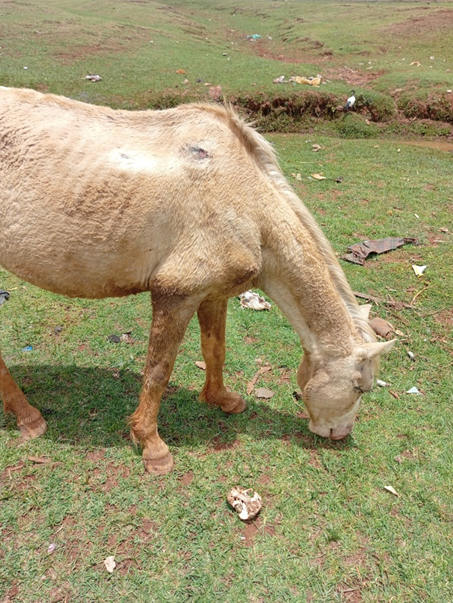
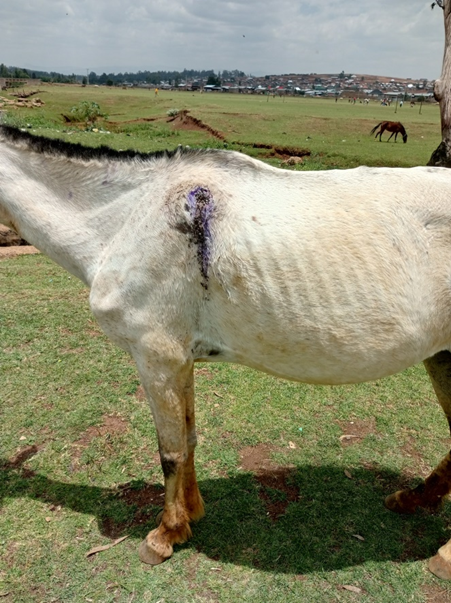
Figure 1. Wound on scapular area.
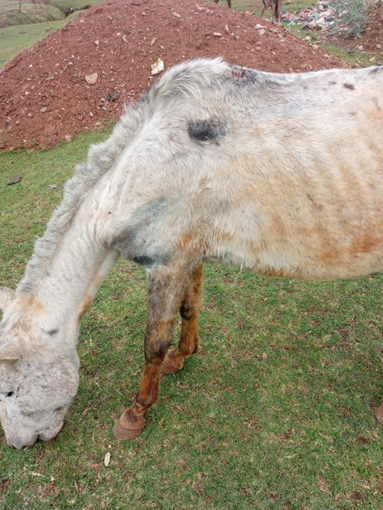
Figure 2. Wound on the back.
Figure 3. Wound on leg.
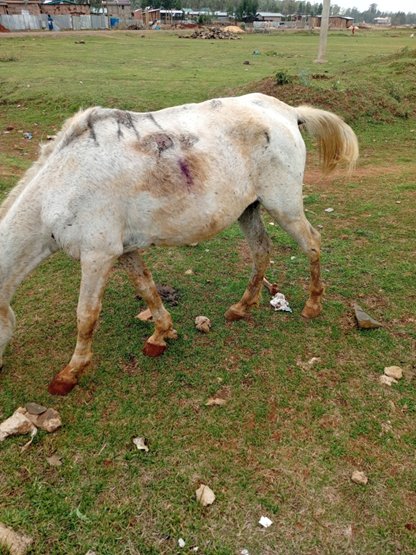
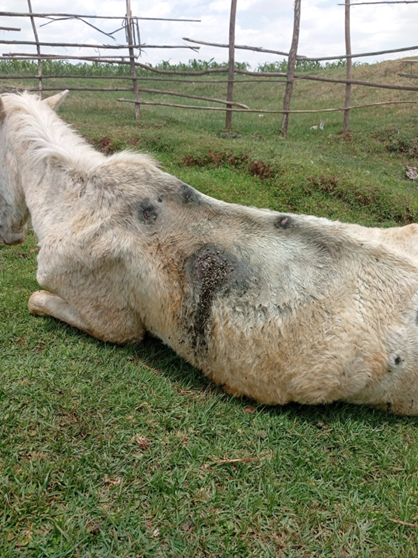
Figure 4. Wound on back and ribs.
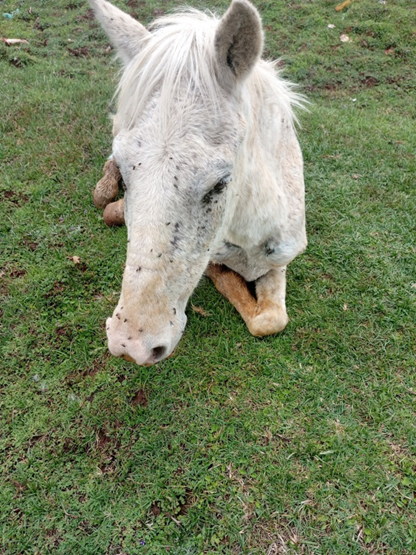
Figure 5. Occular lesion.
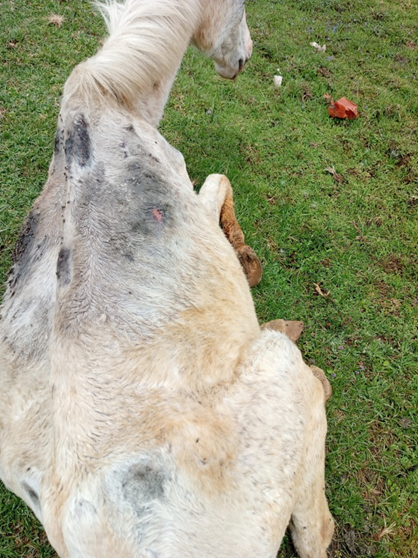
Figure 6. Wound on different body parts.
DISCUSSION
The contribution of equines in sustaining the livelihoods of many people, particularly in developing countries is evident. However, their socioeconomic importance is often overlooked and consequently they are given poor husbandry practices which substantially threaten their welfare. The occurrence of wounds is among other health threads which stem from such poor practices [19]. Horses were important animals used for cart puling, pack transport and farming in the study area. The present study was closely in agreement with reports by Fasil N, et al. [20] describing that the majority of equine observed (100%) were used for work, mainly used for plowing of land (farming especially horses and mules) and transporting goods and people by cart, packs or ridding. The study was also in closely agreement with reports by Salim U, et al. [ 21] revealed that equids are mainly kept for transport purposes and only rarely as source of meat or milk.
In this observation the overall wound prevalence was 38%. This result was in agreement with the report by Salim U, et al. [21] revealed that the prevalence of wound in equine was 37.9% in and around Batu Town, East Shoa, Central Ethiopia. This result was also in agreement with report by Urge B, et al. [22] revealed that the prevalence of wound in horses was 37.5% in and around Bishofitu, Oromiya. This result was in moderate proximity to [23] revealed that the prevalence of wound in cart pulling horses was 42.5% in Bishoftu Town, Central Ethiopia. The present study revealed lower prevalence of wound than reports by Teferi M, et al. [24] revealed that the prevalence of wound in carthorses was 51% in ten selected towns of Ethiopia. The present study also revealed lower wound prevalence than reports by Biffa D, et al. [11] revealed that the prevalence of external injuries among the working equines were (72.1%) in Hawassa. compared to the 25% prevalence reported from Mekelle town by Sisay WZ. [25], the present result was high. This result was also higher than the findings of [26] revealed that the prevalence of wound in working equines was 30.3% in and around Mekelle town, Northern Ethiopia. The difference in wound prevalence might be due to variation in working condition and management practice by the owners among the different geographic area.
In the present study wound was significantly associated with the sex of horse owners (p-value was 0.01 and 95% CI (1.95, 1.99)). All 130 owners who had wounded horses were males. No one female owner has wounded horses. This shows females were good in managing equines which reduce their work load. Equines were involved in fetching water and carry different goods to the market that were assumed the job of females in the society.
In the present study the occurrence of wound on horse was not significantly associated with the age of horse owners (p-value was 0.26 and 95% CI (1.82, 2.00)). This was in line with reports by Teferi M, et al. [24] revealed that the age of the drivers, was not statistically associated with the occurrence of wound.
In the present study the occurrence of wound was not significantly associated educational status of horse owners (p-value 0.70 and 95% CI (1.47, 1.64)) and also the occurrence of wound was not significantly associated with the number of horses one owner has (p-value 0.65 and 95% CI (2.12, 2.29)). This was in contrary to report by Teferi M, et al. [24] revealed that educational status and number of horses owned were a possible risk factors associated with the occurrence of wound (p<0.05). The finding in the present study might be due to nothing done to intervene owners. Also this might be due to lack of inclusive educational curriculum which did not include animal welfare and animal right.
The occurrence of wound was significantly associated with number of days one owner work with their horses per a week (p-value was 0.00 and 95% CI (1.69, 1.83)) and also with length of time horse owner work with their horses per a day (p-value was 0.008 and 95% CI (2.33, 2.48)). The present study was in agreement with [22] revealed that length of working time and other risk factors contributed to the occurrence of wounds in these species. This finding was in contrast with [24] revealed that working hours per a day were not statistically associated with the occurrence of wound. Overworking may cause harness induced wound.
The occurrence of wound was significantly associated with load that one horse can carry to perform one duty (P-value<0.05 and 95% CI (2.41, 2.52)). This was in line with reports by Biffa D, et al. [11] revealed that overloading was the causes of wounds in equines in Hawassa, Ethiopia. This result was also in line with [22] revealed that heavy load and overwork were responsible for the presence of injuries on the back region of mules.
In the present study wound was significantly associated with harness type (p-value 0.00 and 95% CI (1.92, 1.97)). Horses with poor harness were at greater risk of developing wound than those with good harness. This result was in line with the findings of [11] and [22] reported the main causes of injuries on various body parts of horses were harness related problems. A properly designed, well-fitted and comfortable harness allows the working animal to pull the equipment to the best of its ability without risk of injuries [27]. This study was in contrast with report by Abdela N, et al. [28] revealed that prevalence of wound in equine is not statistically significant with harness type in and around Asella town, South Eastern Ethiopia.
In this study wound and communication with horses were not significantly associated (p-value 0.15 and 95% CI (1.22, 1.31)). But higher proportion of horse owners (44.4%) who manage their horses by rope and stick had wounded horses than those who manage their horses orally (36%). In addition, some owners beat wounds on their equines as ‘accelerators’ since the animals move faster when the wound is beaten [29].
In this observation wound prevalence was significantly associated with the age of the horse (p-value 0.013 and 95% CI (2.20, 2.34)). From total 152 wounded horses observed 1.3% were in the age less than five years (young), 59.2% were in the age range from five to ten years(adult) and 39.5% were in the age of greater than 10 years (old). This was in line with [28] revealed that the age of animals was significantly associated with wound prevalence. This finding was in contrast with [24] revealed that the age of horses was not statistically associated with the occurrence of wound.
In this observation wound was significantly associated with body condition score (p-value 0.00 and 95% CI (1.68, 1.76)). Horses with poor body condition were at greater risk of developing wound (72%) than those with good body condition score (28%).this finding is in agreement with the reports by Mekuria S, et al. [30]; and Solomon M, et al. [31] but contrary to the report by Sells P, et al. [32] and Urge B, et al. [22] who reported no significant association between wound prevalence and body condition score. Besides, equids with low body condition score have reduced body fat and consequently, may have less natural padding protecting them from wound caused by harness [33].
This observation revealed that wounds at the back in equine were common relative to other body regions. The distribution of wound on affected horses shows differences, in which higher proportion (41.4%) of wound was found at the back where as moderate proportions (18.4%) and (20.4%) were at the head and wither regions respectively and lower proportions (6.6%) and (13.2%) were under the belly and on legs respectively. These results were similar to the findings of [34], who stipulated that the prevalence of wounds in equines was higher on the back relative to other body regions in Shashogo Woreda, Hadiya zone, Southern Ethiopia. Similar result was reported in central Ethiopia by Tesfaye A, et al. [35] who articulated that the prevalence of wounds was significantly higher on the back than other body parts. This result was also in agreement with reports by Gizachew A, et al. [15] wounds on working equines are frequently observed on the saddle (back) and wither regions. The result of present study was in contrast to [36] the highest numbers of wounds were recorded in pre-scapular areas of equines in kombolcha town, Northern Ethiopia. These differences might be due to difference in work type the horse involved, harness type and owner management practice.
CONCLUSION AND RECOMMENDATIONS
The present study revealed high overall prevalence of wound in horses in and around Debremarkos city, North Ethiopia. Over working, overloading and poor harness materials were major contributors to the higher prevalence of wound in the study area. Although horses have significant role to the daily life and livelihoods of the community, majority of them are exposed to discomfort working condition. This strongly calls for a continuous awareness creation to horse owners on the proper management and handling of their animals so as to enhance their utilization by the community. Furthermore, policies and legal frameworks that support animal welfare issues and inspect animal facilities should be promoted in order to ensure animal productivity. A comprehensive equine health and welfare promotion program through a legal institution is recommended to alleviate the problem.
ACKNOWLEDGMENT
First of all, praise is to almighty God for his gracious and merciful helping to do this research. Then I would like to express my heartfelt thanks to my family whose moral support has always been with me. I would like to thank all my staff members for their support by giving comment. I have no words powerful enough to express my great full pretty thanks, sincere appreciation and great respect for all respondents who gave me real information without agitation in this study.
COMPETING INTERESTS
The author declares that she has no competing interests.
REFERENCES
- Hall SJG, Raune J. (1993). Livestock Breeds and their Conservation. A Global Review. Conservation Biology. 7(4):815-825.
- FAO State (2014). Ethiopia, faculty of veterinary medicine Addis Ababa University, PO Box 34, Debre-Zeit Ethiopia.
- FAO (2015). FAO statistical database website. In: Food and Agriculture Organization. Rome, Italy.
- Blench R, Slay CR, Marker T. (2003). A study of role of livestock in poverty reduction strategy paper. Pro-poor livestock initiative working paper, FAO. pp. 52.
- Worldometers. (2016). Ethiopia Population. Available at: http://www.worldometers.info/worldpopulation/ethiopia-population/
- Oppong E. (1997). Disease of horse and donkey in Ghana. Bull Anim Prod Africa. 27:47-49.
- Genetu H, Yohannes G, Abdela N, Ibrahim N. (2017). Prevalence of Wounds and Associated Risk Factors in Working Equines in Jimma Town of Oromia Region, South-Western Ethiopia. Acad J Anim Dis. 6(2):23-29.
- Mekuriaw H. (2019). The socio-economic importance of horses used for carting in Bishoftu, central Ethiopia. DVM Thesis, College of Veterinary Medicine and Agriculture, Addis Ababa University, Bishoftu, Ethiopia.
- Mekuria S, Mulachew M, Abebe R. (2013). Management practices and welfare problems encountered on working equids in Hawassa town, Southern Ethiopia. Vet Med Anim Health. 5(9):243-250.
- Sells PD, Pinchbeck G, Mezzane H, Ibourki J, Crane M. (2010). Pack wounds of donkeys and mules in the Northern High Atlas and lowlands of Morocco. Equine Vet J. 42(3):219-226.
- Biffa D, Woldemeskel M. (2006). Causes and factors associated with occurrence of external injuries in working equines in Ethiopia. Int J Appl Res Vet Med. 4(1):1-7.
- Dinka H, Shelima B, Abalti A, Geleta T, Mume T. (2006). Socio-economic Importance and Management of Carthorses in the Mid Rift Valley of Ethiopia, Proceedings of the 5th International Colloquium on Working Equines.
- Mekuria K, Tesfaye W. (2016). Prevalence of wound and associated risk factors in working donkeys in and around Wolaita Sodo Town, Southern Ethiopia. Int J Agric Sci Vet Med. 4(4):75-83.
- Asfaw R, Pal M, Ameni G. (2012). Prevalence of Epizootic Lymphangitis in Cart Horses in Southwest Shewa of Oromia Region, Ethiopia. Int J Livest Res. 2:146-151.
- Gizachew A, Schuster RK, Joseph S, Wernery R, Georgy NS. (2013). Piroplasmosis in Donkeys - A Hematological and Serological Study in Central Ethiopia. J Equine Vet Sci. 33(1):18-21.
- Wkipedia (2019). Geographical location of Debremarkos city. The Wikipedia Free Encyclopedia. Available at: https://en.wikipedia.org/wiki/Debre_Markos
- DMLRP. (2024). Debremarkos city livestock resource promotion. Debremarkos, Ethiopia.
- Thrusfield M. (2005). Veterinary Epidemiology. 3rd ed. Edinburgh, UK: Blackwell Science, Ltd. pp. 182-189.
- Kompi PP, Molapo S, Mosebo KA. (2023). Prevalence of Equine Wounds and Associated Risk Factors in Different Agro-ecological zones of Lesotho. Journal of Advanced Veterinary Research. 13(8):1664-1667.
- Fasil N, Yenewhunegnaw M. (2017). Assessment of Welfare and Health Related Problems of Working Equines in Wogera District, Northern Ethiopia. Arch Pet Environ Biotechnol: AVST-133.
- Salim U, Haimanot D, Tadele K, Tilahun Z, Girma K. (2015). Health and Welfare Related Assessment of Working Equine in and Around Batu Town, East Shoa, Central Ethiopia. Wollega University, School of Veterinary Medicine: Nature and Science. 13(10):5-6.
- Urge B, Kassa T, Gutema F, Tadele M, Seyoum T. (2021). Occurrence of Wound in Working Equids and Associated Risk Factors in and around Bishoftu Oromia Region, Ethiopia. Int J Curr Res Aca Rev. 9(11):31-39.
- Chala F, Birhanu A, Tsegaye TBA. (2017). Prevalence of Work Related Wound and the Associated Risk Factors in Cart Horses in Bishoftu Town, Central Ethiopia. Journal of Biology, Agriculture and Healthcare. 7(17):80-86.
- Teferi M, Tesfaye R, Zewdu H, Gemechu G, Gebre T, Tibebu A. (2020). Prevalence of wound, its associated risk factors and wound management practices in carthorses of ten selected towns of Ethiopia. Ethiop Vet J. 24(2):1-15.
- Sisay WZ. (2013). Causes and Factors Associated with the Episode of External Injuries in Cart-Horses of Mekelle Town, North Ethiopia. J Vet Adv. 3:265-274.
- Tesfaye A, Yohannes T, Habtamu T, Kalab G, Hagos T. (2015). Survey of Common Skin Problem of Working Equines in and Around Mekelle, North Ethiopia. Acad J Anim Dis. 4(1):30-38.
- Pearson RA, Simalenga TE, Krecek RC. (2006). Harnessing and hitching donkeys, horses and mules for work. Centre for Tropical Veterinary Medicine, University of Edinburgh, Scotland, UK.
- Abdela N, Teshome E, Hassan A, Deressa FB. (2017). Prevalence and associated risk factors of equine wound in and around Asella town, South Eastern Ethiopia. J Vet Med Anim Health. 9(4):63-71.
- Brooke. (2007). Bearing a Heavy Burden. Available at: http://www.fao.org/fileadmin/user_upload/animal welfare/BROOKE Report.Pdf
- Mekuria S, Matusala M, Rahameto A. (2013). Management practices and welfare problems encountered on working equids in Hawassa town, Southern Ethiopia. Journal of Veterinary Medicine and Animal Health. 5(9):243-250.
- Solomon M, Rahmeto A. (2010). Observation on major welfare problems of equine in Meskan district, Southern Ethiopia. Hawassa University, Livestock Research for Rural Development. 22(3):1-15.
- Sells P, Pinchbeck G, Mezzane H, Ibourki J, Crane M. (2010). Pack wounds of donkeys and mules: In the Northern high atlas and lowlands of Morocco. Equine Vet J. 42(3):219-226.
- Pritchard JC, Lindberg AC, Main DC, Whay HR. (2005). Assessment of the welfare of working horses, mules and donkeys, using health and behaviour parameters. Prev Vet Med. 69(3-4):265-283.
- Jobir D, Belayneh M, Shewangizaw D. (2021). Prevalence of work related wound and associated risk factors in donkeys in Shashogo Woreda, Hadiya zone. Southern Ethiopia. Int J Adv Res Biol Sci. 8(7):218-226.
- Tesfaye A, Curran M. (2005). A longitudinal survey of market donkeys in Ethiopia. Trop Anim Health Prod. 37(1):87-100.
- Fikru A, Tadese A, Gebreegziabher Z. (2015). Prevalence of Equine Wound and Associated Risk Factors in and around Kombolcha Town, North Ethiopia. J Vet Sci Technol. 6(4):234.
