Information Links
Related Conferences
Previous Issues Volume 9, Issue 8 - 2025
Mandai Bird Paradise: A Daily Guide to the Pigeons and Doves
Ashraful Kabir*
Department of Biology, Cantonment Public College, Saidpur Cantonment―5311, Nilphamari, Bangladesh
*Corresponding Author: Ashraful Kabir, Department of Biology, Cantonment Public College, Saidpur Cantonment―5311, Nilphamari, Bangladesh; Email: [email protected]
Received Date: December 04, 2025
Published Date: December 31, 2025
Citation: Kabir A. (2025). Mandai Bird Paradise: A Daily Guide to the Pigeons and Doves. Mathews J Vet Sci. 9(8):98.
Copyrights: Kabir A. © (2025).
ABSTRACT
As a significant bird collection, Mandai Bird Paradise (formerly Jurong Bird Park) is the largest bird park in Asia. ArcGIS pro and R package helped to explain the habitats and abundance of pigeons and doves inside this park. A day-long visit dated 28 September 2025 provided information about these pigeons and doves. From 9 a. m. to 5 p. m. (Singapore time), following 17 types of pigeons and doves have been observed with their feeding time and interaction with visitors. Based on the number of pigeons and doves and their habitats, results were not significant (p = 0.9574), so there were no significant differences between two major habitats (tree and ground) sharing in pigeons and doves. Highest percentages on the basis of tree sharing were 0.74% at Mandai Bird Paradise. Binomial test is not suitable here because in the same community available pigeons and doves were not significantly different from a hypothesized population. Data were not in normal distribution due to observed small population, so within pigeons-doves, specific species were not observed frequently. In nature, due to hunting and pet-trade, pigeons and doves are decreasing, so this type of bird park could play a significant role to reintroduce these birds for ecological balance.
Keywords: Mandai Bird Paradise, Jurong Bird Park, Pigeon, Dove, Habitat, Singapore.
INTRODUCTION
Mandai Bird Paradise is Singapore’s newest bird park located within the Mandai Wildlife Reserve (Figure 1). This renowned and the largest bird park opened in the year 2023, it replaces the former Jurong Bird Park and features a modern and nature-inspired design. Spanning 17 hectares, the park is home to thousands of birds across hundreds of species, immersive aviaries that replicate habitats from around the world. Visitors can enjoy close-up encounters, interactive feeding sessions, educational bird shows, making Bird Paradise a vibrant destination for wildlife lovers. In Mandai Bird Paradise, scientists, vet officers, and workers are very much dedicated to welfare of all birds. They always care their birds, and researchers always update their research findings in their park’s website. Anyone could get informed about any birds from that webpage (Table 1) [1]. Western crowned-pigeon (Goura cristata) are found in Bangladesh [2]. In natural habitat, due to hunting most pigeons and doves are decreasing. Successful breeding in bird park, and then reintroduction of such birds could balance ecological pathway. The objective of this write-up is to mention the present status of pigeons and doves inside this bird paradise.
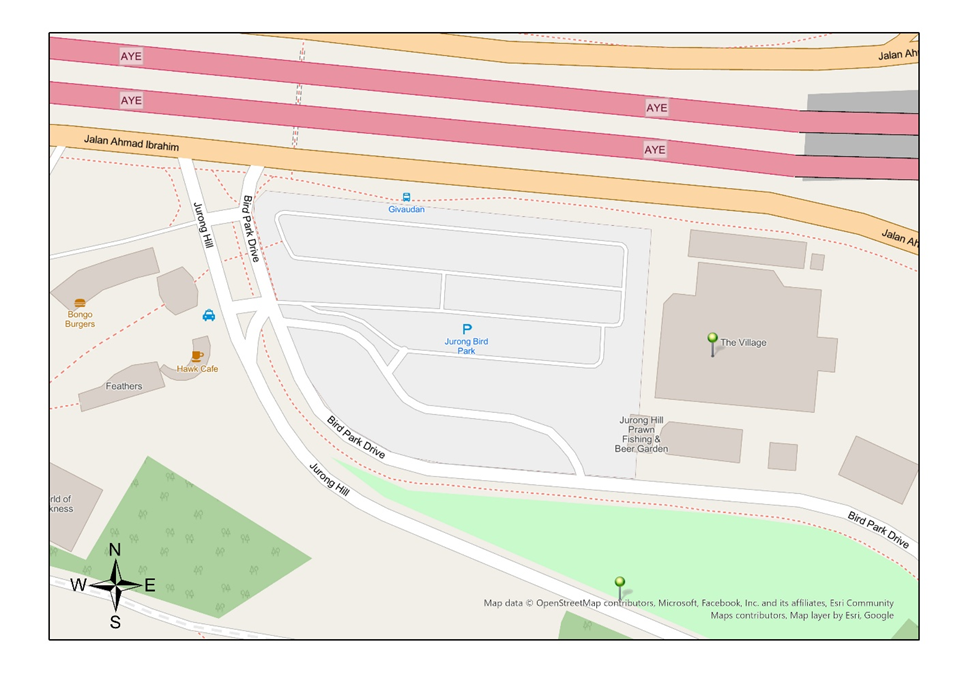
Figure 1. Mandai Bird Paradise is Singapore’s newest bird park located within the Mandai Wildlife Reserve [3].
Table 1. Commonly observed pigeons and doves in Mandai Bird Paradise
|
Names |
Salient Features |
Pigeons/Doves |
|
Barred cuckoo dove, Macropygia unchall |
1. Graduated noticeably long and tapering tail 2. Distinctive barred feather around the body 3. Short black beak 4. Red feet 5. Internationally least concern |
|
|
Chestnut-naped imperial pigeon, Ducula aenea paulina |
1. Notable chestnut or orange-patched neck 2. Flight is fast, strong, and direct 3. Presence high in the treetops 4. Internationally near threatened |
|
|
Pinon imperial pigeon, Ducula pinon |
1. Important seed disperser 2. Bare red skin around the eyes 3. White or pale grey band across the centre of the tail 4. Black ‘V’ marked on the back 5. Internationally least concern |
|
|
White imperial pigeon, Ducula bicolor |
1. Distinctive black-white plumage 2. Seed disperser 3. Highly gregarious 4. Long distance flyer 5. Internationally least concern |
|
|
Pacific imperial pigeon, Ducula pacifica |
1. Black bill with fleshy knob 2. Seed disperser 3. Internationally least concern |
|
|
Luzon bleeding heart, Gallicolumba luzonica |
1. Distinctive red-breasted feathers 2. Ground-dwelling bird 3. Endemic to the Philippine (Luzon Island) 4. Internationally near threatened |
|
|
Sulawesi ground dove, Gallicolumba tristigmata maculata |
1. Two distinct purple nape spots 2. Forehead is bright golden 3. It exhibits excellent camouflage for ground-dwelling lifestyle 4. Endemic to the island of Sulawesi (Indonesia) 5. Internationally least concern |
|
|
Santa Cruz ground dove, Pampusana sanctaecrucis |
1. Believed to be small population 2. Sexual dimorphism is prominent 3. Ground-dwelling lifestyle 4. Internationally critically endangered |
|
|
Jambu fruit-dove, Ramphiculus jambu |
1. Sexually dimorphic 2. Good seed disperser 3. Distinctive bright orange bill 4. Unusual ability to suck water 5. Internationally near threatened |
|
|
Green-naped pheasant pigeon, Otidiphaps nobilis |
1. Resemblance to pheasant 2. Laterally compressed tail 3. Ground-dwelling lifestyle 4. Endemic to the New Guinea 5. Internationally least concern |
|
|
Victoria crowned pigeon, Goura victoria |
1. Fan-shaped lace like-crest; distinctive white tips 2. Measuring 73-75 cm (the largest pigeon) 3. Weighing 3.5 kg 4. 16 tail feathers 5. Lacks gall bladder 6. Internationally near threatened |
|
|
Scheepmaker's crowned pigeon, Goura scheepmakeri |
1. Elaborate blue crest 2. Deep maroon breast 3. Highly terrestrial 4. Vocalization (heartbeat rhythm) 5. Internationally vulnerable |
|
|
Nicobar pigeon, Caloenas nicobaricus |
1. Hair-like neck feather (hackles) 2. Living relative to extinct dodo 3. White tail (immature black tail) 4. Blackish knob cere 5. Generally quiet, make grunting sounds 6. Internationally near threatened |
|
|
Speckled pigeon, Columba guinea |
1. Distinctive red eya patches 2. White wing spots 3. Noisy calls 4. Similar to rock-dove 5. Gregarious 6. Internationally least concern |
|
|
Madagascar turtle-dove, Columba picturata |
1. Forked neck feathers 2. Close relative to pink pigeon 3. Internationally least concern |
|
|
Crimson-crowned fruit-dove, Ptilinopus porphyraceus |
1. Crimson crowned 2. Canopy dwelling habit 3. The belly colour is variable 4. Terrestrial species (solitary or pair) 5. Internationally least concern |
|
|
Laughing dove, Spilopelia senegalensis |
1. Distinctive laugh-like call 2. Highly adapted in human-modified environment 3. Primarily terrestrial 4. Quick and direct flight 5. Internationally least concern |
|
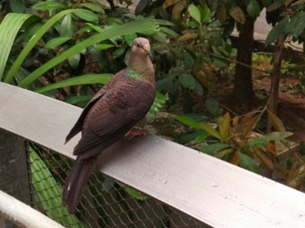
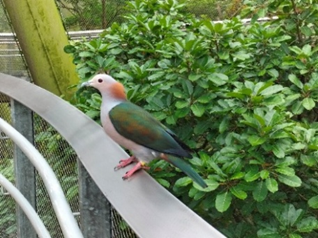
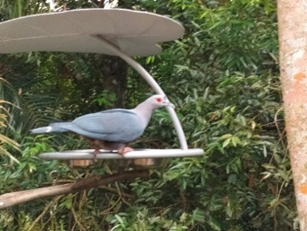
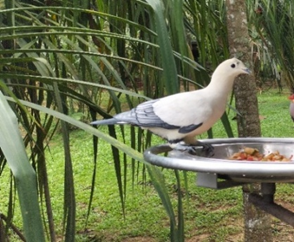
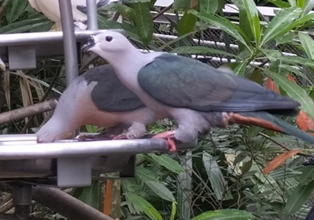
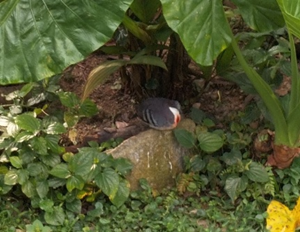
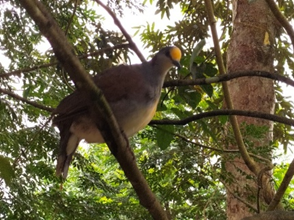
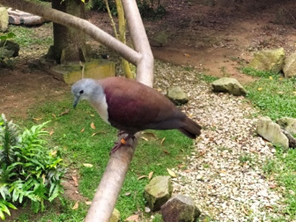
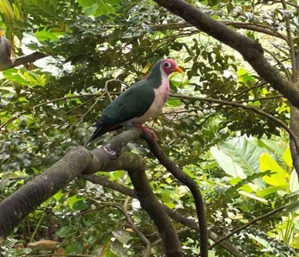
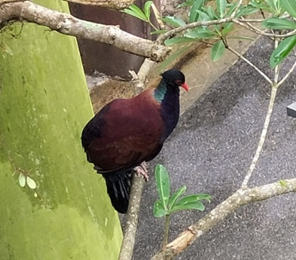
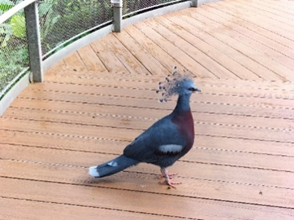
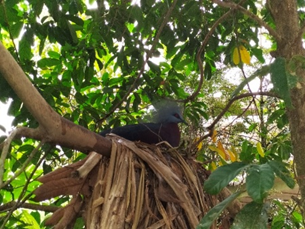
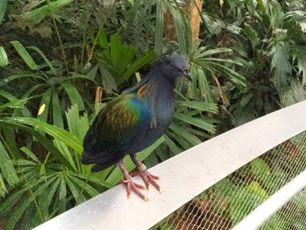
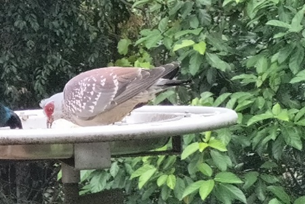
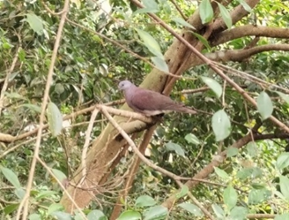
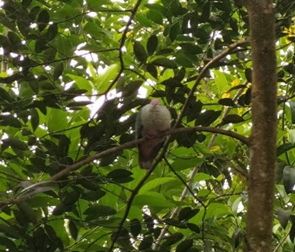
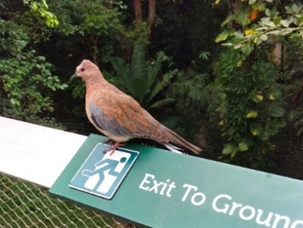
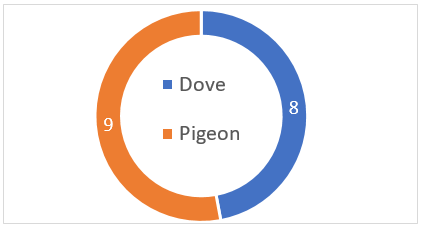
Figure 2. Observed columbids.
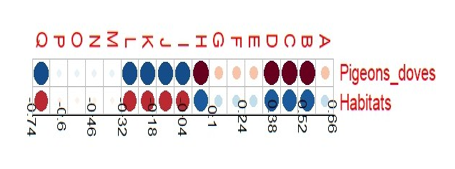
Figure 3. Habitats sharing of columbids.
CONCLUSIONS
Mandai Bird Paradise reflect the park’s dedication to celebrating avian diversity and protecting wildlife with rare and endangered species. This park provides a sanctuary where birds can thrive in habitats designed to mirror their natural territories (Figure 2 and Figure 3). Through careful conservation plans, exhibition facilities, and educational programs, Mandai Bird Paradise not only offers visitors to engulf the beauty and behavior of birds but also highlights the importance of birds for their future conservation. Small amount of time was not sufficient to make a conclusion of this write-up, so in future, enough time and effective experimental design could promote more standard findings on avian population.
ACKNOWLEDGEMENTS
None.
CONFLICT OF INTEREST
There is no conflict of interest.
REFERENCES
- Mandai Wildlife Reserve. (2025). Available at: https://www.mandai.com/en/care-for-planet/animal-welfare.html
- Kabir MA. (2015). Most beautiful pigeons of Bangladesh. Cell Biology. 3(2):34-37.
- Jurong Bird Park, Singapore-Location Points. (2025). Available at: https://www.arcgis.com/apps/mapviewer/index.html?webmap=541f2eff7a4f4bf4ab12621f7eeccc2f
