Information Links
Related Conferences
Previous Issues Volume 10, Issue 1 - 2026
Hubble Pigeons: Breeding Performance and Commercial Meat Potential
Ashraful Kabir1,*, Mamata Rani Das2
1Department of Biology, Cantonment Public College, Saidpur Cantonment-5311, Nilphamari, Bangladesh
2Department of Natural History, Bangladesh National Museum, Shahbag, Dhaka-1000, Bangladesh
*Corresponding Author: Ashraful Kabir, Department of Biology, Cantonment Public College, Saidpur Cantonment-5311, Nilphamari, Bangladesh; Email: [email protected]
Received Date: January 14, 2026
Published Date: February 23, 2026
Citation: Kabir A, et al. (2026). Hubble Pigeons: Breeding Performance and Commercial Meat Potential. Mathews J Vet Sci. 10(1):101.
Copyrights: Kabir A. © (2026).
ABSTRACT
As a double-breasted meat breed and successful cut breed from the king pigeons of the USA and some parts of the Europe, Hubble pigeon is an exception at all. The Hubble was highly inbred and had poor numbers of squabs/pair/year. To produce this pigeon, farmers face higher rearing cost. With the king pigeons in the USA or other countries, it is possible to run these pigeons as another commercial breed. Proper selection between or among white Hubble, it is possible to keep white pure line, actual-size, and remarkable breeding pairs. Result suggested that the protein content (17.5-23 g) is more or less same with king pigeon (20.82-23.68 g) but the cholesterol was very high in Hubble pigeon (90 mg) compared to the king (30.2-44.4 mg). To strengthen the meat from Hubble pigeon farm, genetic analyses need to enhance for the continuity of this breed.
Keywords: Hubble Pigeons, Prospect, Breeding, Meat Processing, Meat Selling, Nutritional Values.
INTRODUCTION
Global demand for animal protein is increasing steadily, particularly in developing regions where limitations in land availability, feed resources, and production infrastructure constrain conventional livestock systems. In this context, alternative meat sources that require lower resource inputs and offer shorter production cycles represent a promising pathway toward improved food security and economic sustainability. Domestic pigeons (Columba livia domestica) have long been utilized for recreational, and breeding for meat production. The Hubble pigeon, a recently developed selective line, is hypothesized to combine high reproductive efficiency with favorable carcass characteristics. These attributes position the breed as a potentially valuable candidate for both smallholder farming system and emerging commercial meat enterprises. Pigeon consumption for human food dates back to Roman times [1]. Due to high protein level, low fat quantity, and highly digestible meat, pigeons are well for human health [2]. It is considered a good source of different types of vitamins and essential minerals [3,4]. Native pigeons have low breeding performance but their natural resistance supports them to protect many diseases [5]. Around 50 meat-type pigeons are currently known, few of them have remarkable productivity [6]. The Hubble pigeon emerged in the 1920s. They may have been crossed with kings, Swiss mondains, and giant homers. This pigeon first bred by Dr. G. M. Hubble who was actually a successful king pigeon breeder [7]. Hubble pigeons are utility pigeons selectively bred for meat production. Their rapid growth, high reproductive efficiency and tender, and protein-rich meat make them suitable for small to large scale commercial squab production. Globally, pigeon meat is prized in gourmet, ethnic and traditional cuisines. With rising interest in alternative poultry sources, Hubble pigeons offer a niche but profitable livestock option. The objective of this review is to focus some productive characteristics of Hubble pigeons to ensure its farm for human consumption.
Hubble pigeons with their analytical features
This study employed a qualitative review and comparative analytical approach to evaluate the breeding, nutritional, and commercial characteristics of Hubble pigeons (Plates 1-2). Data were compiled from published literature on pigeon genetics, breeding practices and meat production, as well as historical documentation of Hubble pigeon development and reports from commercial pigeon farms. Nutritional values of major meat pigeon breeds were compared on a per 100 g edible portion basis to assess protein, fat, and cholesterol content. The analysis focused on synthesizing existing information rather than conducting primary experimental trials, providing a comprehensive evaluation of the Hubble pigeon’s production potential, meat quality, and breeding prospects.
Large- and small-scale breeding system
Original Hubble was white and colors were added over years through crosses with other breeds. This breed is distinguished by its heavy double-breasted musculature, broad chest, and large body frame which contribute to its high meat yield. Hubble pigeons also exhibit a strong parental instinct, making them reliable foster parents for show king pigeons (Plates 1-2). The naturally white skin of the breed is highly preferred in meat markets, enhancing its commercial value and consumer acceptance. This is a very special breed as ‘cattle pigeon’ in the USA. Sell [8] mentioned this pigeon in his renowned book on pigeon genetics. Haag-Wackernagel [9] mentioned Hubble pigeon as a street pigeon. Hubble pigeon exhibited high levels of inbreeding and relatively low squab production per pair. This limitation increased rearing costs compared with king pigeons. However, selective breeding among white Hubble lines demonstrates potential for improving reproductive efficiency while maintaining desirable carcass traits. Marketable squab weight ranges between 450–500 g, comparable to commercial king pigeons.
Processing and selling of meat
White skinned squabs are always acceptable in the market [10]. Carpenter Pigeon Farm of California covers only 10% squab of this Hubble pigeons, and the Los Angeles Chinatown’s restaurants are full with these pigeons [11]. Breast meat possesses high protein value whereas leg meat is characterized by high fat content [12]. The proportion of breast (42.80%) and tight (thigh) (14.90%) from the carcass weight of California pigeons is relatively high, and a high average carcass yield (71.12%) was found [13]. This is a wonderful cut pigeon with double-breast [14]. Marketable squab weight ranges from 450 to 500 g. Hubble pigeons are remarkable foster parents for the show king pigeons. This pigeon is known as ‘King squab’ [11]. Old people of the USA always like to eat the squab of Hubble pigeons.
Reproductive and growth performance
Squabs exhibited rapid growth and reached marketable body weight within four weeks. Body mass increased consistently across the rearing period, indicating stable growth dynamics under the given feeding regime (Table 1).
Table 1. Reproductive performance parameters of Hubble pigeon breeders
|
Parameters |
Mean ± SD |
Age (days) |
Body weight (g) (Mean ± SD) |
|
Eggs per clutch |
2.1 ± 0.15 |
7 |
160 ± 12 |
|
Fertility rate (%) |
93.2 ± 2.1 |
14 |
263 ± 16 |
|
Hatchability (%) |
88.5 ± 3.4 |
21 |
342 ± 19 |
|
Hatch interval (days) |
17.8 ± 0.5 |
28 |
410 ± 22 |
The average feed conversion ratio (FCR) from 0–28 days was 1.9:1, reflecting efficient feed utilization, and favorable growth efficiency compared to many conventional small-scale poultry systems. An FCR of 1.9:1 indicates that squabs required approximately 1.9 kg of feed to produce 1 kg of live body weight gain. This review suggests that Hubble pigeon squabs have strong early growth potential, a desirable trait for commercial meat production where rapid turnover is economically advantageous.
Nutritional value of some common meat pigeon breeds in the world
In the king pigeon group, only white utility king is the best as squab in the world as well as in the USA. White Carneau is also common in the USA with the king pigeon. Hubble and giant homer are not much popular than king pigeon. Table 2 represents a comparison of nutritional values among major meat pigeon breeds. Protein content in Hubble pigeons is comparable to king pigeons, though cholesterol levels are higher.
Table 2. Nutritional value of some selected common meat pigeon breeds (per 100 g)
|
Meat pigeons |
Calorie (kcal) |
Protein (g) |
Fat (g) |
Cholesterol (mg) |
|
Hubble |
142 |
17.5-23 |
7.5 |
90 |
|
Utility white king |
128-142 |
20.82-23.68 |
1.21-4.95 |
30.2-44.4 |
|
White Carneau |
128-142 |
17.5-22 |
7.5 |
~90 |
|
Giant homer |
142-294 |
22-24 |
4-7.5 |
~90-226 |
Source: [15-18].
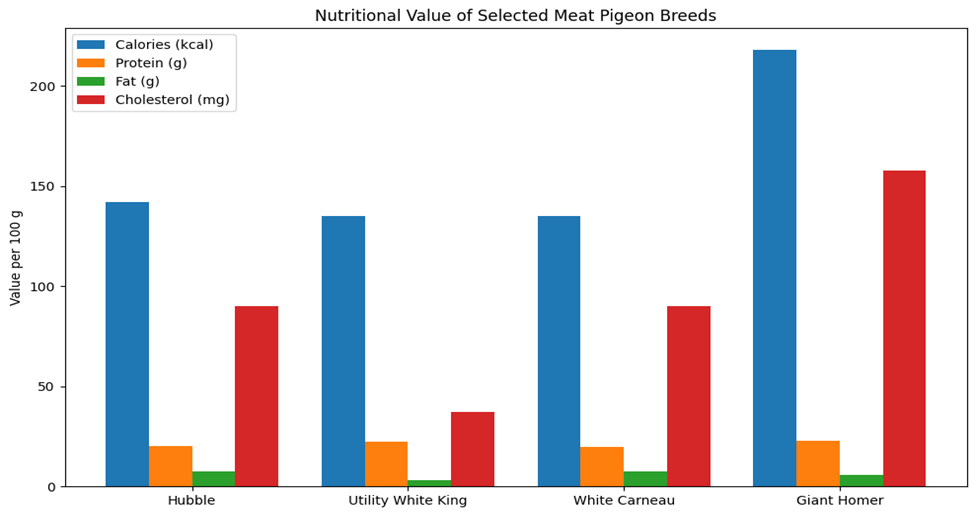
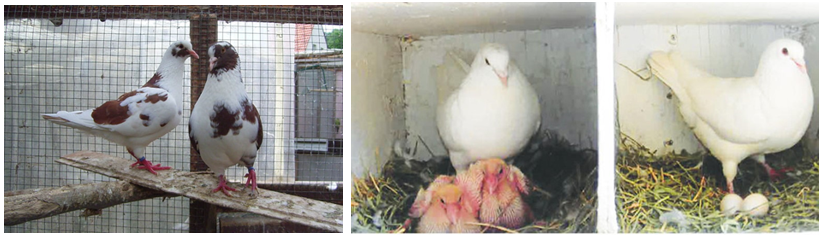
Plate 1. [7,19].
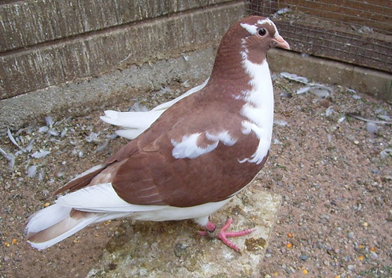
Plate 2. [7].
CONCLUSIONS
Double-breasted meat of Hubble pigeon breed is an exception protein dish for everybody. The breed has faced challenges such as inbreeding and low reproductive output, but modern genetic selection and structured breeding programs have the potential to improve productivity and reproductive efficiency significantly. Except the cholesterol content, its amount of protein is more or less same with king pigeon. Hubble pigeons are found in the USA and some parts of Europe. To increase the squab number per year from the Hubble pigeon, genetic analyses need to enhance for the continuity of this significant breed. The Hubble pigeon, with its distinctive double-breasted carcass and high protein content, has significant potential as a specialized meat breed for Bangladesh’s emerging poultry and squab markets. While cholesterol levels are higher than in king pigeons, the breed’s protein-rich meat makes it nutritionally valuable. Introducing and promoting Hubble pigeons in Bangladesh could diversify local poultry production and meet niche consumer demand for high-quality squab. Future programs should focus on reducing inbreeding depression, increasing squab production per pair, enhancing feed conversion efficiency, maintaining carcass quality, and preserving genetic lines to ensure breed sustainability. Such initiatives would not only enhance commercial viability but also contribute to the conservation of this unique pigeon breed within the country.
ACKNOWLEDGEMENTS
None.
CONFLICT OF INTEREST
The Authors declare that there is no conflict of interest.
REFERENCES
- Levi WM. (1992). The Pigeon. The R. L. Bryan Company, Columbia, S. C. 512 pp.
- Buculei A, Gontariu I, Rebenciuc I. (2010). Comparative study regarding the aging influence upon the quality of pigeon and turkey meat. Scientific Papers. 53:485-490.
- Paripuranam D. (2014). Proximate, physical and mineral compositions of pigeon meat used as fish bait. J Chem Pharm Res. 6(1):669-673.
- USDA Nutrient Database. (2020). Squabs (pigeon). Meat only, raw. Available online: https://fdc.nal.usda.gov/index.html.
- Migdal W, Kulig R, Walczycka M, Wesierska E, Zajac M, Tkaczewska J, et al. (2020). The quality of traditionally smoked tenderloins obtained from meat of native pig breeds. Biotechnology in Animal Husbandry. 36(1):49-61.
- Brzoska F. (2019). Squabs-fattened slaughter pigeons are exclusive poultry, part I. Pol Poultry. 3:77-78.
- Hubble farming pigeons. (2020). Available at: https://www.pigeontype.info/2020/12/25/hubble-farming-pigeons/#google_vignette
- Sell A. (2012). Pigeon Genetics: Applied Genetics in the Domestic Pigeon. Sell Publishing, Germany. 528 pp.
- Haag-Wackernagel D. (1994). Ethology of the pigeon (Columba livia). Tierarztliche Praxis. 22(4):358-363.
- Hazard FA. (1922). Profitable Pigeon Breeding. American Pigeon Journal Company. 236 pp.
- Chawkins S. (2002). Raising squab nowadays not for pigeon-hearted. Los Angeles Times. Available at: https://www.latimes.com/archives/la-xpm-2002-jan-14-me-22529-story.html
- Hossain MJ, Salah Udolin M, Jalil MA, Yasmin T, Paul DC, Chamda GC. (1994). Meat composition of indigenous pigeons an influenced by sex, age and seasons. Asian-Australasian Journal of Animal Sciences. 7(3):321-324.
- Hascik P, Pavelkova A, Fik M, Bucko O. (2024). Meat performance and physiochemical evaluation of pigeon meat. Journal of Microbiology, Biotechnology and Food Sciences. 13(6):1-4.
- Carpenter G. (2013). Getting to know your farmer. Available at: https://inthefieldblog.com/2013/03/13/getting-to-know-your-farmer-gary-carpenter-squab-ranchojai-ca/
- Hubble pigeon. Available at: https://www.caloriemenu.com/pigeon
- White king. Available at: https://www.sciencedirect.com/science/article/pii/S0032579119391953
- Carneau pigeon. Available at: https://www.pashudhanpraharee.com/health-benefit-of-pigeon-meat/
- Giant homer. Available at: https://www.pashudhanpraharee.com/health-benefit-of-pigeon-meat/
- Giant white Hubble utility pigeons. (2024). Available at: https://www.strombergschickens.com/shop-all/giant-white-hubble-utility-pigeons/?srsltid=AfmBOoo5dfRU74zpwjdlCh0AYEowaQlkzFH1MMIudb30sNTz365kRtAs
