Information Links
Related Conferences
Previous Issues Volume 9, Issue 8 - 2025
Exploring Avian Heritage in Bheramara Upazila of Bangladesh
Ashraful Kabir*
Department of Biology, Cantonment Public College, Saidpur Cantonment―5311, Nilphamari, Bangladesh
*Corresponding Author: Ashraful Kabir, Department of Biology, Cantonment Public College, Saidpur Cantonment―5311, Nilphamari, Bangladesh; Email: [email protected]
Received Date: November 21, 2025
Published Date: December 26, 2025
Citation: Kabir A. (2025). Exploring Avian Heritage in Bheramara Upazila of Bangladesh. Mathews J Vet Sci. 9(8):95.
Copyrights: Kabir A. © (2025).
ABSTRACT
Bheramara Upazila of Bangladesh is a significant place to observe avian population. At the time of surveying, direct observation, and interviews with local people could help to write this paper. The avian diversity in the Bheramara Upazila of Bangladesh resulted the richness of birds with 48 species. The Shannon-Wiener index suggested very high richness in Site D (tree), Site E (bush), and Site F (flying) with 3.533, 3.562, and 3.679 values, and high diversity in Site A (waterbody) and Site B (cropland) with 3.394 and 3.196 values accordingly. Shannon-Wiener index value in Site C (ground) (2.902) was not significant on the basis of birds’ population. Based on the number of the species and their abundance, the Simpson index was carried out with high diversity in all sites with 0.939, 0.918, 0.895, 0.957, 0.960, 0.970 values. Relative abundance of different species in this area was found the highest in flying condition (0.950) whereas the lowest on ground (0.750), so the results exhibited according to the Shannon-Wiener indices are F > E > D > A > B > C sites accordingly. Values of the Berger-Parker did not find significant in all sites. Out of 48 species, passerine birds were 18 in number and non-passerine 30 species. Within all species, orders were 14, families 30, breeding birds 15, and resident birds were 48 (94%). Based on availability of the birds, this upazila focused very common birds 23, common 16, few 4, uncommon 3, and rare 1. This study was carried out from July 2024 to October 2025.
Keywords: Bheramara Upazila, Birds, Distribution, Abundance, Breeding, Bangladesh.
INTRODUCTION
Bheramara Upazila is a significant town in Bangladesh (Figure 1). This upazila has an area of 153.71 km2. The average highest temperature is 35 °C and the lowest 15 °C. Annual rainfall averages 348.94 mm and humidity around 81%. It is consisted of Ashmatpur, Moshan, and Juniadah villages. Little urbanization is a common scenario in this area, and is alarming to sustain avian species. Urbanization effects on the animal population [1]. Railway station of Bheramara Upazila and their surrounding areas play a significant role for many wild birds. Inside Bheramara Government College and around Bheramara Pilot High School are pronounced with many trees and birds. Parks and botanical gardens are always significant for foraging birds [2]. Kabir [3] reported the breeding biology of bird in a village under Rajshahi Division of Bangladesh. In Columbiformes order, the spotted-dove (Table 1) is abundant in rural and urban areas of Bangladesh [4]. Remarkable plants were banyan (Ficus benghalensis), rubber (Ficus elastica), American mahogany (Swietenia mahagoni), coconut (Cocos nucifera), karoi (Albizia procera), and some village ponds supported for the successful breeding of birds in this area. The objective of this study is to understand the present status of birds in Bheramara Upazila for their conservation.
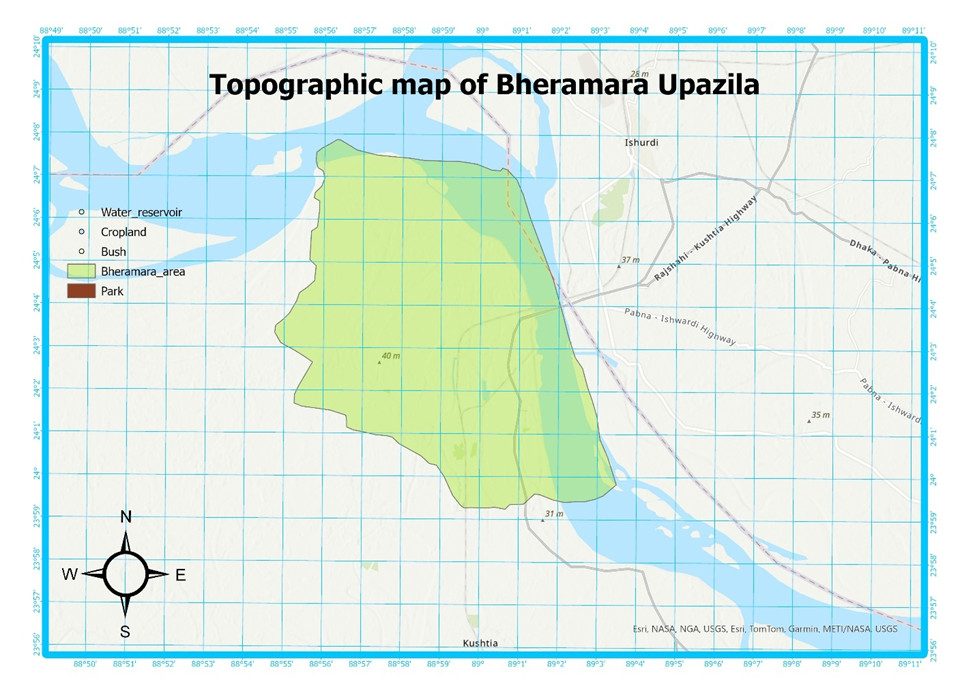
Figure 1. Bheramara Upazila of Bangladesh.
MATERIALS AND METHODS
Study area: This study was done in Bheramara Upazila (24°1'N and 88°59.5'E). Bheramara Government College of the northern side, beel and hatchery of south region, Padma River of east, and bamboo forest of west area were surveyed to note the birds’ availability (Figure 1). The ‘Moni Park’ of Bheramara was significant for many birds for its banyan tree and river bank. Inside this park, they have pigeons which allow other birds inside this park (Plate 1).
Collection of data: In order to collect data on birds, one day in a week, from 5:00 to 10 a.m, then 4:00 to 7:00 p. m. (total 8 hours) was spent. For nocturnal birds especially nightjars and owls, a simple torch light was enough. An android mobile phone (oppo) was perfect for taking occasional photographs and voice recordings of those birds. A pair of high-quality binoculars (10x-70x × 70mm, Comet)) was helpful for this survey. A DSLR camera (Canon, EOS Rebel T3i) with 200-500mm lens is used for necessary snaps.
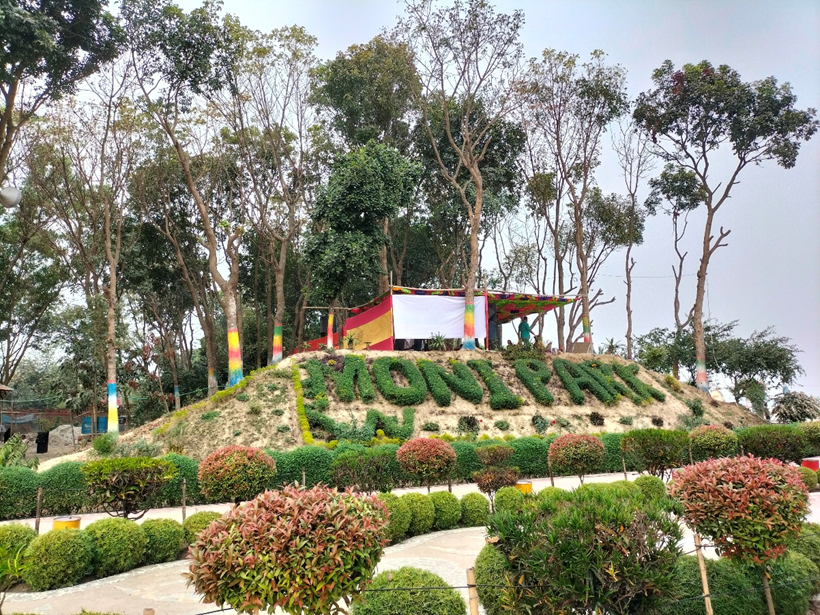
Plate 1. ‘Moni Park’ of Bheramara which is a significant shelter for many birds.
ArcGIS pro and R software: In order to make a standard map of Bheramara Upazila (location, ruler, grid, legend) ArcGIS pro and for species richness R package (Appendix 1) helped to explain the avian diversity in this area.
RESULTS
Out of 50 species of birds, 48 species were resident. Breeding birds were noticed 15 species. Based on the taxonomy of birds, identified orders and families were 14 and 30. The non-passerine birds were the highest (30 species) and passerine were the lowest (18 species) (Table 1; Table 2; Figure 2; Figure 3) due to different types of habitats (Site A (waterbody), Site B (cropland), Site C (ground), Site D (tree), Site E (bush), and Site F (flying) in this area (Figure 4; Plate 1; Appendix 1). All birds were least concern (LC) both in national and global status.
Table 1. Avian species in some areas Bheramara Upazila
|
Sl. |
Classification with names |
Family |
Availability and local status |
|
|
Columbiformes (3 species) (1 Family) |
|
|
|
1 |
*Wild rock-pigeon, Columba livia, Gmelin 1789 |
Columbidae |
Very common; resident |
|
2 |
Eurasian collared-dove, Streptopelia decaocto (Frivaldszky 1838) |
Columbidae |
Common; resident |
|
3 |
*Spotted-dove, Spilopelia chinensis (Scopoli 1786) |
Columbidae |
Very common; resident |
|
|
Psittaciformes (1 species) (1 Family) |
|
|
|
4 |
*Rose-ringed parakeet, Psittacula krameri (Scopoli 1769) |
Psittacidae |
Common; resident |
|
|
Anseriformes (1 species) (1 Family) |
|
|
|
5 |
Lesser whistling duck, Dendrocygna javanica (Horsfield 1821) |
Anatidae |
Very common; resident |
|
|
Accipitriformes (2 species) (1 Family) |
|
|
|
6 |
Black kite, Milvus migrans (Boddaert 1783) |
Accipitridae |
Common; resident |
|
7 |
Black-shouldered kite, Elanus caeruleus (Desfontains 1789) |
Accipitridae |
Common; resident |
|
|
Strigiformes (1 species) (1 Family) |
|
|
|
8 |
Spotted owlet, Athene brama (Temminck 1821) |
Strigidae |
Very common; resident |
|
|
Bucerotiformes (1 species) (1 Family) |
|
|
|
9 |
Eurasian hoopoe, Upupa epops, Linnaeus 1758 |
Upupidae |
Uncommon; winter visitor |
|
|
Coraciiformes (5 species) (3 Families) |
|
|
|
10 |
Common kingfisher, Alcedo atthis (Linnaeus 1758) |
Alcedinidae |
Very common; resident |
|
11 |
White-breasted kingfisher, Halcyon smyrnensis (Linnaeus 1758) |
Alcedinidae |
Very common; resident |
|
12 |
Pied kingfisher, Ceryle rudis (Linnaeus 1758) |
Alcedinidae |
Rare; resident |
|
13 |
Asian green bee-eater, Merops orientalis, Latham 1801 |
Meropidae |
Common; resident |
|
14 |
Indian roller, Coracias benghalensis (Linnaeus 1758) |
Coraciidae |
Common; resident |
|
|
Cuculiformes (4 species) (2 Families) |
|
|
|
15 |
Asian koel, Eudynamys scolopaceus (Linnaeus 1758) |
Cuculidae |
Common; summer visitor |
|
16 |
Common hawk-cuckoo, Hierococcyx varius (Vahl 1797) |
Cuculidae |
Common; resident |
|
17 |
Pied cuckoo, Clamator jacobinus (Boddaert 1783) |
Cuculidae |
Uncommon; summer visitor |
|
18 |
Greater coucal, Centropus sinensis (Stephens 1815) |
Centropodidae |
Common; resident |
|
|
Caprimulgiformes (2 species) (2 Families) |
|
|
|
19 |
*House swift, Apus nipalensis (Hodgson 1837) |
Apodidae |
Very common; resident |
|
20 |
Long-tailed nightjar, Caprimulgus macrurus (Horsfield 1821) |
Caprimulgidae |
Common; resident |
|
|
Gruiformes (1 species) (1 Family) |
|
|
|
21 |
*White-breasted waterhen, Amaurornis phoenicurus (Pennant 1769) |
Rallidae |
Very common; resident |
|
|
Suliformes (1 species) (1 Family) |
|
|
|
22 |
Little cormorant, Microcarbo niger (Vieillot 1817) |
Phalacrocoracidae |
Very common; resident |
|
|
Pelecaniformes (4 species) (1 Family) |
|
|
|
23 |
*Indian pond-heron, Ardeola grayii (Sykes 1832) |
Ardeidae |
Very common; resident |
|
24 |
Little egret, Egretta garzetta (Linnaeus 1766) |
Ardeidae |
Very common; resident |
|
25 |
Eastern cattle-egret, Bubulcus coromandus (Boddaert 1783) |
Ardeidae |
Very common; resident |
|
26 |
Yellow bittern, Botaurus sinensis (Gmelin 1789) |
Ardeidae |
Uncommon; resident |
|
|
Piciformes (4 species) (2 Families) |
|
|
|
27 |
Coppersmith barbet, Psilopogon haemacephalus (Muller 1776) |
Megalaimidae |
Very common; resident |
|
28 |
*Blue-throated barbet, Psilopogon asiaticus (Latham 1790) |
Megalaimidae |
Very common; resident |
|
29 |
Fulvous-breasted woodpecker, Dendrocopos macei (Vieillot 1818) |
Picidae |
Common; resident |
|
30 |
Black-rumped flameback woodpecker, Dinopium benghalense (Linnaeus 1758) |
Picidae |
Very common; resident |
|
|
Passeriformes (18 species) (12 Families) |
|
|
|
31 |
*Common myna, Acridotheres tristis (Linnaeus 1766) |
Sturnidae |
Very common; resident |
|
32 |
Jungle myna, Acridotheres fuscus (Wagler 1827) |
Sturnidae |
Few; resident |
|
33 |
*Grey-headed myna, Sturnia malabarica (Gmelin 1789) |
Sturnidae |
Common; resident |
|
34 |
*Indian pied myna, Gracupica contra (Linnaeus 1758) |
Sturnidae |
Very common; resident |
|
35 |
Black-headed oriole, Oriolus xanthornus (Linnaeus 1758) |
Oriolidae |
Common; resident |
|
36 |
*Black drongo, Dicrurus macrocercus, Vieillot 1817 |
Dicruridae |
Very common; resident |
|
37 |
*House crow, Corvus splendens, Vieillot 1817 |
Corvidae |
Very common; resident |
|
38 |
Large-billed crow, Corvus macrorhynchos, Wagler 1827 |
Corvidae |
Few; resident |
|
39 |
*Common tailorbird, Orthotomus sutorius (Pennant 1769) |
Cisticolidae |
Very common; resident |
|
40 |
Red-whiskered bulbul, Pycnonotus jacosus (Linnaeus 1758) |
Pycnonotidae |
Few; resident |
|
41 |
*Red-vented bulbul, Pycnonotus cafer (Linnaeus 1766) |
Pycnonotidae |
Very common; resident |
|
42 |
Jungle babbler, Argya striata (Dumont 1823) |
Leiothrichidae |
Very common; resident |
|
43 |
Orange-headed thrush, Geokichla citrina (Latham 1790) |
Turdidae |
Few; resident |
|
44 |
Taiga flycatcher, Ficedula albicilla (Pallas 1811) |
Muscicapidae |
Few; resident |
|
45 |
Pale-billed flowerpecker, Dicaeum erythrorhynchos (Latham 1790) |
Dicaeidae |
Common; resident |
|
46 |
Purple sunbird, Cinnyris asiaticus (Latham 1790) |
Nectariniidae |
Common; resident |
|
47 |
Purple-rumped sunbird, Leptocoma zeylonica (Linnaeus 1766) |
Nectariniidae |
Common; resident |
|
48 |
*Scaly-breasted munia, Lonchura punctulata (Linnaeus 1758) |
Estrildidae |
Very common; resident |
*=Birds are completing their breeding successfully
Table 2. Present status of birds in Bheramara
|
Order (14) |
*Family (30) |
Species (48) |
Breeding species (15) |
|
Columbiformes |
1 |
3 |
2 |
|
Psittaciformes |
1 |
1 |
1 |
|
Anseriformes |
1 |
1 |
0 |
|
Accipitriformes |
1 |
2 |
0 |
|
Strigiformes |
1 |
1 |
0 |
|
Bucerotiformes |
1 |
1 |
0 |
|
Coraciformes |
3 |
5 |
0 |
|
Cuculiformes |
2 |
4 |
0 |
|
Caprimulgiformes |
2 |
2 |
1 |
|
Gruiformes |
1 |
1 |
1 |
|
Suliformes |
1 |
1 |
0 |
|
Pelecaniformes |
1 |
4 |
1 |
|
Piciformes |
2 |
4 |
1 |
|
Passeriformes |
12 |
18 |
8 |
*As a small upazila, 30 families are showing a significant result
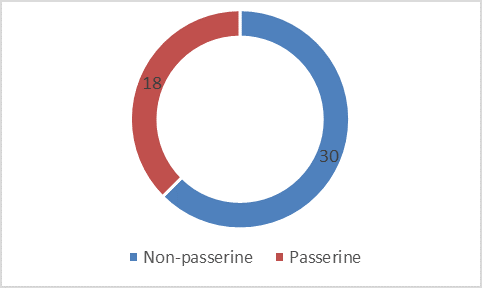
Figure 2. Major group of birds.
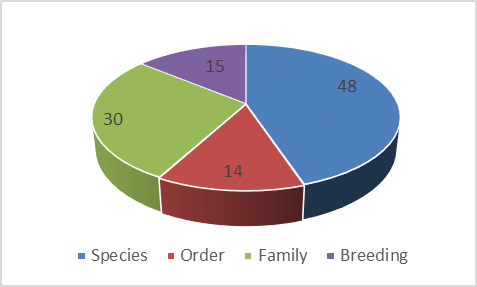
Figure 3. Abundance of birds.
Table 3. Avian indices in six sites
|
Sites |
Shannon-Wiener |
Simpson |
Evenness
|
|
Site-A (Waterbody) |
3.394 (high) |
0.939 (high) |
0.877 |
|
Site-B (Cropland) |
3.196 (high) |
0.918 (high) |
0.826 |
|
Site-C (Ground) |
2.902 (moderate) |
0.895 (high) |
0.750* |
|
Site-D (Tree) |
3.533 (very high) |
0.957 (high) |
0.913 |
|
Site-D (Bush) |
3.562 (very high) |
0.960 (high) |
0.920
|
|
Site-D (Flying) |
3.679* (very high) |
0.970 (high) |
0.950*
|
*Highlighted results are more significant in this area
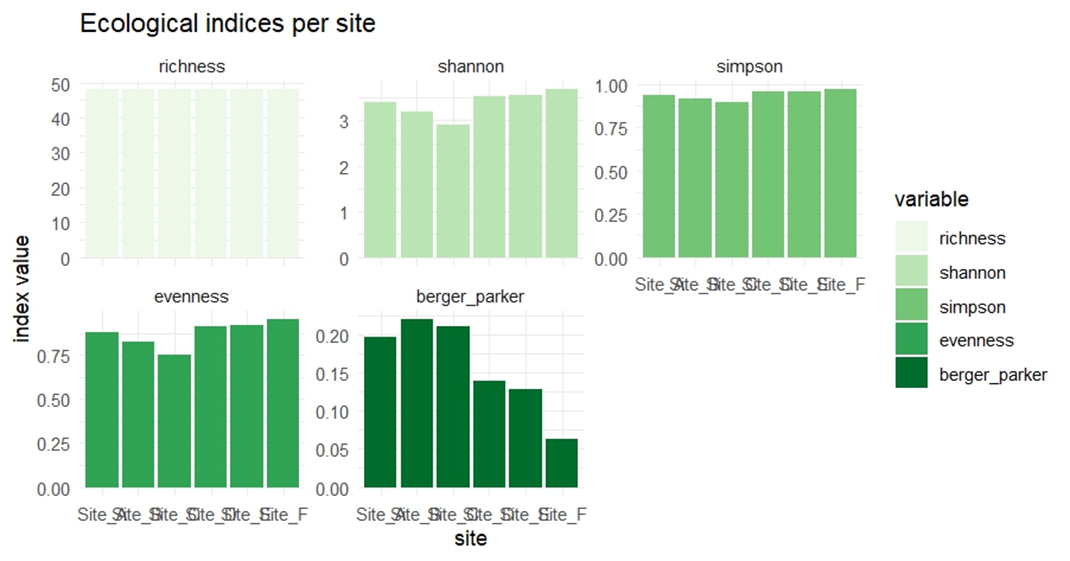
Figure 4. Data visualization on the basis of avian richness in several sites.
DISCUSSION
Bheramara town is renowned by its Padma River, so many fish species are available here and migratory birds are visited every year. Bheramara High School and inside Bheramara Government College have significant number of flowering plants allow many small birds. Parks and botanical gardens are always significant for gathering birds [2]. Urbanization has a negative impact on wildlife population [1]. Due to some urbanization, this area is facing problem to maintain biodiversity. Protected areas are always remarkable for the availability as well as breeding of wild birds [5], but in Bheramara Upazila there is no specific protected areas for wildlife, some are working to protect birds personally. Kabir [6] counted 150 rock-pigeons on the N. S. Road of Kushtia. An updated report has been published on the total birds of Kushtia District of 201 species with two introduced species [7]. Out of 201 species, 106 species in Kushtia Sadar Upazila is surely a noteworthy finding. Medium and bush type of trees is available in Bheramara town. Spotted-dove was everywhere either on busy roads or road-side jungles. This dove is found throughout Bangladesh with their successful breeding status [4]. Banyan trees were always good for sheltering and nesting herons and egrets (Plate 1) [8].
CONCLUSIONS
This upazila is famous in many aspects, especially its Padma River, trees, and some parks (Plate 1). Seasonal factors all the year round on various habitats especially wetland, cropland, ground, tree, bush, and during flying avian abundance were observed. Due to flying behavior, many birds were seen in Bheramara Upazila than the terrestrial habitats. Some private organizations are working jointly to protect biodiversity of this area. As a small upazila, forty-five resident birds of course a noteworthy finding to keep forward this type of research in the future.
ACKNOWLEDGEMENTS
The author of this article is giving thanks to his bosom friend ‘Ariful Islam’, Headmaster, Government Primary School, Bheramara for his valuable information on the birds of Bheramara Upazila. He was cordially helpful to communicate and shared all expeditions with wildlife as well as birds of his hometown Bheramara. The author is expressing his immense gratitude to the instructor ‘Sadhan Verma’ of NBICT Lab (www.nbict.org) in Dinajpur, Bangladesh especially for ArcGIS pro and R analysis.
CONFLICT OF INTEREST
The author declares that there is no conflict of interest.
REFERENCES
- Gregory R, Baillie S, Bashford R. (2004). Monitoring breeding birds in the United Kingdom. In: Bird Numbers 1995, Proceedings of the International Conference and 13th Meeting of the European Bird Census Council, Parnu, Estonia Bird Census News 13(2000) (ed. Anselin, A.). pp. 101-102.
- Golley M. (2004). Birds of Parks and Gardens. New Holland Publishers (UK) Ltd., London, Cape Town, Sydney, Auckland.
- Kabir MA. (2018). Nesting of Baya Weaver Ploceus philippinus in Mohammadpur village under Rajshahi Division of Bangladesh. International Journal of Research Studies in Science, Engineering and Technology. 5(7):21-25.
- Kabir A. (2024). Burmese/Malayan spotted dove (Spilopelia chinensis tigrina) (Aves: Columbiformes) in rural and urban areas of Bangladesh. Journal of Wildlife. 1(2):12-18.
- Kabir A. (2012). Breeding birds in Saidpur cantonment area, Bangladesh. International Research Journal of Biochemistry and Bioinformatics. 2(10):216-219.
- Kabir MA. (2016). Rock-pigeons in some parts of Bangladesh. The Journal of Middle East and North Africa Sciences. 2(3):45-49.
- Lepage D. (2024). Avibase – Bird Checklists of the World (Kushtia). Available at: https://avibase.bsc-eoc.org/checklist.jsp?region=BDkhku
- Kabir MA, Makhan D, Hawkeswood TJ. (2019). Colony breeding of the Great White Egret and the Black-crowned Night Heron in northern regions of Bangladesh. Calodema. 716:1-8.
Appendix 1. Number of birds at various sites in Bheramara Upazila
|
Species |
Site_A |
Site_B |
Site_C |
Site_D |
Site_E |
Site_F |
|
Species1 |
1 |
2 |
58 |
4 |
3 |
2 |
|
Species2 |
3 |
4 |
4 |
2 |
2 |
1 |
|
Species3 |
4 |
40 |
44 |
6 |
2 |
3 |
|
Species4 |
8 |
2 |
3 |
1 |
5 |
2 |
|
Species5 |
2 |
4 |
3 |
1 |
2 |
4 |
|
Species6 |
2 |
1 |
1 |
2 |
3 |
1 |
|
Species7 |
2 |
3 |
2 |
5 |
1 |
1 |
|
Species8 |
3 |
2 |
2 |
1 |
2 |
3 |
|
Species9 |
6 |
3 |
2 |
1 |
1 |
1 |
|
Species10 |
10 |
2 |
2 |
3 |
1 |
1 |
|
Species11 |
3 |
2 |
1 |
1 |
1 |
2 |
|
Species12 |
2 |
4 |
1 |
1 |
2 |
4 |
|
Species13 |
3 |
2 |
1 |
2 |
2 |
1 |
|
Species14 |
1 |
2 |
3 |
4 |
1 |
5 |
|
Species15 |
1 |
1 |
2 |
4 |
3 |
3 |
|
Species16 |
3 |
2 |
1 |
1 |
2 |
1 |
|
Species17 |
1 |
1 |
2 |
2 |
5 |
3 |
|
Species18 |
2 |
3 |
2 |
1 |
3 |
8 |
|
Species19 |
1 |
1 |
3 |
3 |
3 |
3 |
|
Species20 |
7 |
2 |
3 |
4 |
3 |
2 |
|
Species21 |
12 |
1 |
2 |
5 |
1 |
3 |
|
Species22 |
40 |
2 |
2 |
4 |
2 |
8 |
|
Species23 |
12 |
4 |
8 |
6 |
2 |
1 |
|
Species24 |
2 |
8 |
4 |
5 |
6 |
5 |
|
Species25 |
2 |
2 |
3 |
1 |
1 |
2 |
|
Species26 |
2 |
1 |
2 |
5 |
5 |
2 |
|
Species27 |
3 |
2 |
3 |
8 |
2 |
2 |
|
Species28 |
4 |
4 |
4 |
2 |
6 |
2 |
|
Species29 |
5 |
2 |
1 |
1 |
4 |
1 |
|
Species30 |
2 |
1 |
2 |
5 |
5 |
2 |
|
Species31 |
1 |
5 |
3 |
2 |
1 |
2 |
|
Species32 |
3 |
2 |
2 |
4 |
4 |
1 |
|
Species33 |
2 |
10 |
38 |
5 |
10 |
3 |
|
Species34 |
5 |
2 |
3 |
2 |
2 |
3 |
|
Species35 |
6 |
25 |
2 |
3 |
20 |
3 |
|
Species36 |
1 |
2 |
1 |
1 |
4 |
2 |
|
Species37 |
3 |
10 |
30 |
9 |
5 |
6 |
|
Species38 |
2 |
1 |
3 |
2 |
2 |
2 |
|
Species39 |
3 |
2 |
3 |
2 |
4 |
2 |
|
Species40 |
4 |
1 |
4 |
3 |
2 |
1 |
|
Species41 |
5 |
2 |
1 |
22 |
2 |
1 |
|
Species42 |
1 |
1 |
2 |
1 |
8 |
1 |
|
Species43 |
2 |
2 |
1 |
2 |
1 |
1 |
|
Species44 |
5 |
1 |
2 |
1 |
1 |
2 |
|
Species45 |
4 |
2 |
4 |
1 |
2 |
3 |
|
Species46 |
1 |
1 |
2 |
1 |
1 |
4 |
|
Species47 |
2 |
2 |
1 |
2 |
1 |
5 |
|
Species48 |
4 |
1 |
2 |
3 |
5 |
6 |
