Information Links
Related Conferences
Previous Issues Volume 10, Issue 1 - 2026
Conveying Feelings in Pigeons (Aves: Columbidae)
Ashraful Kabir*
Department of Biology, Cantonment Public College, Saidpur Cantonment―5311, Nilphamari, Bangladesh
*Corresponding Author: Ashraful Kabir, Department of Biology, Cantonment Public College, Saidpur Cantonment―5311, Nilphamari, Bangladesh; Email: [email protected]
Received Date: December 26, 2025
Published Date: January 30, 2026
Citation: Kabir A. (2026). Conveying Feelings in Pigeons (Aves: Columbidae). Mathews J Vet Sci. 10(1):99.
Copyrights: Kabir A. © (2026).
ABSTRACT
Keeping pigeons, this is urgent to understand their overall behavior to continue their adequate production. Yearly observation on their daily behavior or activities helped to accumulate this write-up. A small categorical dataset on common and visual behaviors of 30 pigeons (tumblers, bombai, Indian lotan, Bangladeshi lotan, racing homer, gola) was used in R package (Ross and Robert). The balloon chart showed different colors to represent the intensity or frequency of various behaviors of pigeons. Out of 10 behaviors, the result of the brown circles indicated that the most contributing cells in feeding behavior (17.53%) then regurgitation (15.34%) both male and female pigeons. Those circles indicate higher intensity of the behavior of studied pigeons. Those cells contribute about 32.87% to the total Chi-square score and thus account for most of the difference between expected and observed values. Yellow circles represented lower intensity of the behavior. The size of the circles also seemed to correlate with the frequency or intensity of the behavior, with larger circles indicating higher values.
Keywords: Pigeons, Behavior, Expression (Convey), Emotion (Feeling), Instinct.
INTRODUCTION
Experiments with pigeons and doves in the field of social behavior is complicated [1,2]. Domesticated variety is larger than the wild variety [3]. Pigeons spend a lot of time in cleaning, preening, and grooming as well. Hand reared birds showed a great social attachment to the humans. Fighting behavior which is sometimes a great fault comes in pigeons and doves at the age two or more months. Birds are covered by feathers and have no facial muscle, so they cannot express their emotions clearly. In pigeon and dove, aggressiveness with puffy feathers is remarkable expression (Plate 1). Behavior is a group of phenomena and it ends through emotion. French physician Duchenne suggested that expression comes from neurological problems and muscular disorders. There are three categories of the emotions—fear, anger, aggressiveness. In captivity, the process homeostasis may be lost and abnormal behavior begins and it leads to abnormal physiology in birds [4]. Kabir [5] explained 16 behaviors of pigeons and doves. Feeding behavior is very common in hungry pigeon especially in group feeding. Feeding and fighting behavior are useful for their survival (Plate 3). From egg laying to care their young, lots of breeding behavior were happened through parents. At the time of predator animals in lofts, escaping and frightening expression showed through bodily expression. Pigeons get rest by closing their eyes. After landing of tumblers or racing pigeons, their high breathing indicates painful expression (Plate 2). The objective of this study to mention some behaviors which are important to handle pigeons in farms.
MATERIALS AND METHODS
Pigeon breeds: For this study, 6 types of pigeon breeds (tumblers, bombai, Indian lotan, local lotan (Bangladeshi), racing homer, and gola were kept. Pet pigeons were very tame and performed their behaviors completely. Day-long observation on their behavior plotted in a table for analysis (Figure 1; Appendix 1). Inexperienced and young pigeons, and adults showed equal expression of emotion. By the presence of predator birds (kite, falcon, crow, black drongo, treepie) were shown frightened or escaping behavior. Pigeons were freed regular two times (morning and afternoon) to observe their many behaviors as well as flying behavior (Figure 1).
Supplied breeding materials: Less feeding, one-time feeding, and group feeding were maintained for observing various expressions in pigeons. Mud pot with its base, bamboo basket, newspaper for the nest material, and plastic eggs were used for observing overall breeding performance in farms.
Semi-intensive rearing system: The experimental cages were in size 24 x 24 x 36 and 18 x 16 x 12 inches. Circular cage is good for observing behavior because in this case birds do not get chance to take any corners [6].
R software: In order to explain the variables of some common behaviors of pigeons the R package was used (Appendix 1).
Appendix 1.
|
Female |
Alternating |
Male |
Jointly |
|
|
Incubating |
14 |
7 |
10 |
7 |
|
Aggressive |
2 |
0 |
8 |
3 |
|
Feeding |
40 |
10 |
42 |
50 |
|
Regurgitation |
50 |
10 |
55 |
10 |
|
Flying |
12 |
0 |
12 |
10 |
|
Courtship |
3 |
2 |
3 |
3 |
|
Nesting |
15 |
5 |
10 |
8 |
|
Mating |
3 |
2 |
3 |
3 |
|
Frightened |
10 |
3 |
8 |
10 |
|
Resting |
20 |
10 |
22 |
10 |
RESULTS AND DISCUSSION
Feeding and caring of young: In very hungry condition, this behavior can be identified easily. After serving food, within 5-10 minutes birds do not look any sides. In group feeding, very hungry birds try to take food first (Plate 3). Female pigeon fights with competition for the last few grains [6]. Feeding and fighting behavior are useful for its self-protection. The brain, spinal cord, sense organs, muscle, and glands are accessories for such kinds of behavior and expression of the animals [7]. After hatching to 30-40 days of squab, this exciting expression was found. In suckling stage, sometimes, parents especially female not takes any food. If female lays egg again beside squab, male is totally responsible for feeding young. At the end of this behavior female shows aggressive behavior to its own squabs. Prolactin hormone is responsible at the time of regurgitation [8].
Reproduction-related behaviors: After maturation, male tries to collect sticks/straws by the presence of female. That time male is continued to excite female to mate. If female agrees, shows their acceptance to the male. Male is always stimulated female [8]. The courtship and other behavior patterns in pigeons have been discussed in the classic work of Whitman [9-11]. After mating, short flying in both male and female, and puffy feathers are mentionable. Testosterone hormone of male had no effect on incubation behavior [8]. Limited space, lack of flight, and social contact causes severe physical complexity in birds [12].
Frightened and aggressiveness: Escaping and frightening expression were showed by the presence of predator animals in the loft. This is bodily expression of the pigeon during holding it or they show it for protecting their squab or egg. The feathers are erected at this behavior. Highly energy producing feed enhances this behavior. After egg laying, incubation, and in hatching, both male and female show this aggressive behavior (Plate 1).
Flying and resting: Hold pigeons exhibit this very often. Landing after any sorts of flying, their breathing is high so that painful expression can be seen easily. This expression is very clear in flying tumblers and racing homers. This behavior is very prominent in animals. This time, pigeons get rest by closing their eyes. This is very sensational and lovely expression (Plate 2).
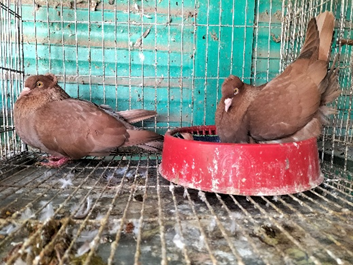
Plate 1. Aggressive.
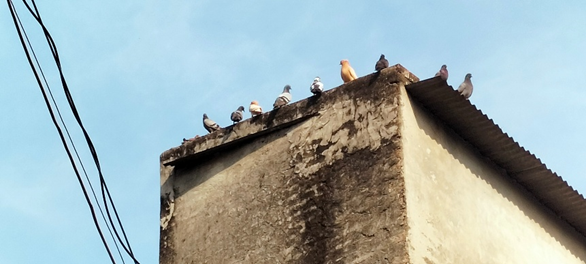
Plate 2. Resting after flying.
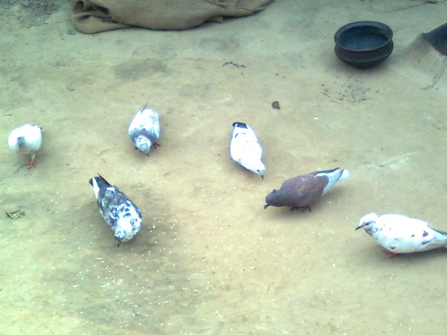
Plate 3. Feeding.
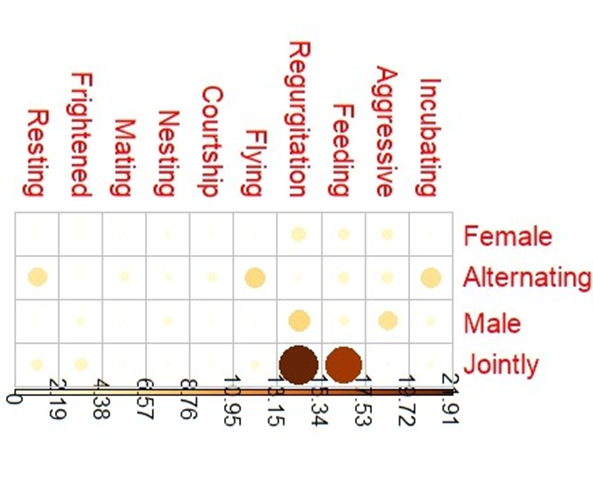
Figure 1. Common and visual behaviors of male-female pigeons; large dots on feeding and regurgitation were significant as results.
CONCLUSIONS
To get sufficient profit from a pigeon farm, it is urgent to know all behaviors of pigeons especially feeding and reproductive behaviors. In order to continue the profit, to maintain fitness of pigeons, and provided feed all are equally important as well. When parents will get proper feed, they could nourish their young properly. With other requirements, specifically, ideal and balanced feed could enhance the fitness of pigeons and those birds could produce quality squab.
ACKNOWLEDGEMENTS
None.
CONFLICT OF INTEREST
There is no conflict of interest.
REFERENCES
- Masure RH, Allee WC. (1934). The social order in flocks of the common chicken and pigeon. Auk. 51(3):306-327.
- Bennett MA. (1939). The social hierarchy in ring doves. Ecology. 20(3):337-357.
- Derek G. (1967). African Collared Dove (Streptopelia roseogrisea) Pigeons and Doves of the World. London: Trustee of the British Museum (Natural History). pp. 131-132.
- Echols MS. (2010). Captive bird welfare and enrichment (part 1-4). AAVAC/UEPV Annual Conference Hobart. pp. 129-200.
- Kabir MA. (2019). Expression of the emotions in pigeons. J Ethol & Animal Sci. 2(1):1-3.
- Castoro PL, Guhl AM. (1958). Pairing behavior of pigeons related to aggressiveness and territory. Dept. of Zoology, Kansas State College. 70(1):57-69.
- Levinthal CF. (2003). Introduction to Physiological Psychology. Prentice, Hall of India Private Limited, New Delhi-110001, India. 522 pp.
- Lehrman DS. (1964). The Reproductive Behavior of Ring Doves. W. H. Freeman and Company, California, USA.
- Whitman CO. (1919). The Behavior of Pigeons. Posthumous works, ed. by HA Carr. Carnegie Inst. Wash., Publ. no. 257. 3:1-161.
- Craig W. (1918). Appetites and aversions as constituents of instincts. Biology Bulletin. 34:91-107.
- Gifford EW. (1941). Taxonomy and habits of pigeons. Auk. 58(2):239-245.
- Meehan CL, Garner JP, Mench JA. (2004). Environmental enrichment and development of cage stereotypy in Orange-winged Amazon parrots (Amazona amazonica). Dev Psychobiol. 44(4):209-218.
