Information Links
Related Conferences
Current Issue Volume 5, Issue 1 - 2026
Arefin’s Oral Endoscopic Grading of Adenoid Hypertrophy: A New Perspective
Mostafa Kamal Arefin*
ENT Specialist & Hybrid ENT Surgeon, Consultant Popular Medical College Hospital, Bangladesh
*Corresponding author: Mostafa Kamal Arefin, MBBS, MCPS, FCPS, FICS (USA), FACS (USA), DLSB, ENT Specialist & Hybrid ENT Surgeon, Consultant Popular Medical College Hospital, Bangladesh, Phone: +8801671748866; Email: [email protected]
Received Date: February 24, 2026
Published Date: April 29, 2026
Citation: Arefin MK. (2026). Arefin’s Oral Endoscopic Grading of Adenoid Hypertrophy: A New Perspective. Mathews J Otolaryngol. 5(1):15.
Copyrights: Arefin MK. © (2026).
ABSTRACT
Background: Endoscopic evaluation is essential for grading adenoid hypertrophy. Most existing systems are based on nasal endoscopic views (0° telescope) assessing choanal obstruction. However, in children or patients with narrow nasal cavities, oral endoscopic visualization with a 70° or 90° telescope can provide an alternative, clearer view. Objective: To propose a new oral endoscopic grading system of adenoid hypertrophy that is simple, visual, and correlates with the degree of choanal obstruction. Methods: Based on intraoral 70° or 90° endoscopic assessment of adenoids through the mouth, a four-grade system was developed according to the visible extent of obstruction of choana and torus tubarius. The grading can be applied both under topical or general anesthesia. Results: Arefin’s Oral Endoscopic Grading (AOEG) system demonstrates consistent visualization of the adenoid mass, torus tubarius, and choanal opening without nasal manipulation. It is reproducible and correlates well with the established nasoendoscopic percentage-based systems. Conclusion: Arefin’s Oral Endoscopic Grading offers a practical and patient-friendly approach, especially for pediatric or uncooperative patients, and may serve as a complementary or alternative classification method for research and surgical planning.
Keywords: Oral, Endoscopic, Grading, Adenoid.
INTRODUCTION
Adenoid hypertrophy is a common cause of nasal obstruction, recurrent otitis media, and sleep-disordered breathing in children [1-3]. Accurate grading is crucial for diagnosis and treatment planning. Most existing grading systems—such as those proposed by Cassano (2003), Parikh (2006), and Clemens (1998)—are based on nasoendoscopic evaluation using a 0° telescope through the nasal cavity [1,4,5].
However, this approach is sometimes difficult in children due to nasal narrowness, septal deviation, or discomfort [6,7].
To overcome this limitation, visualization through the oral route using a 70° or 90° telescope provides a clear panoramic view of the adenoid pad, choana, and torus tubarius behind the soft palate [2,8].
This paper introduces a simple, reproducible system — Arefin’s Oral Endoscopic Grading (AOEG) — to describe adenoid hypertrophy based on oral endoscopic visualization.
METHODS
- Approach: Oral route, using a 70° or 90° rigid endoscope introduced behind the soft palate.
- View obtained: Posterior choana, adenoid pad, both torus tubarius, and soft palate movement.
- Observation: Grading based on adenoid tissue’s relationship with choana and torus tubarius.
- Scoring: Visual percentage of choanal obstruction (<25%, 25–50%, 50–75%, >75%) [9-11].
Arefin’s Oral Endoscopic Grading (AOEG) of Adenoid Hypertrophy
|
Grade |
Description (Oral Endoscopic View) |
Approx. Choanal Obstruction |
|
I |
Small adenoid tissue visible behind soft palate; does not touch choana or torus tubarius. |
<25% |
|
II |
Adenoid tissue touches posterior choanal margin but not torus tubarius. |
25–50% |
|
III |
Adenoid pad covering choana and partially covering one or both torus tubarius. |
50–75% |
|
IV |
Massive adenoid pad completely obstructing choana and both torus tubarius, touching soft palate. |
>75% |
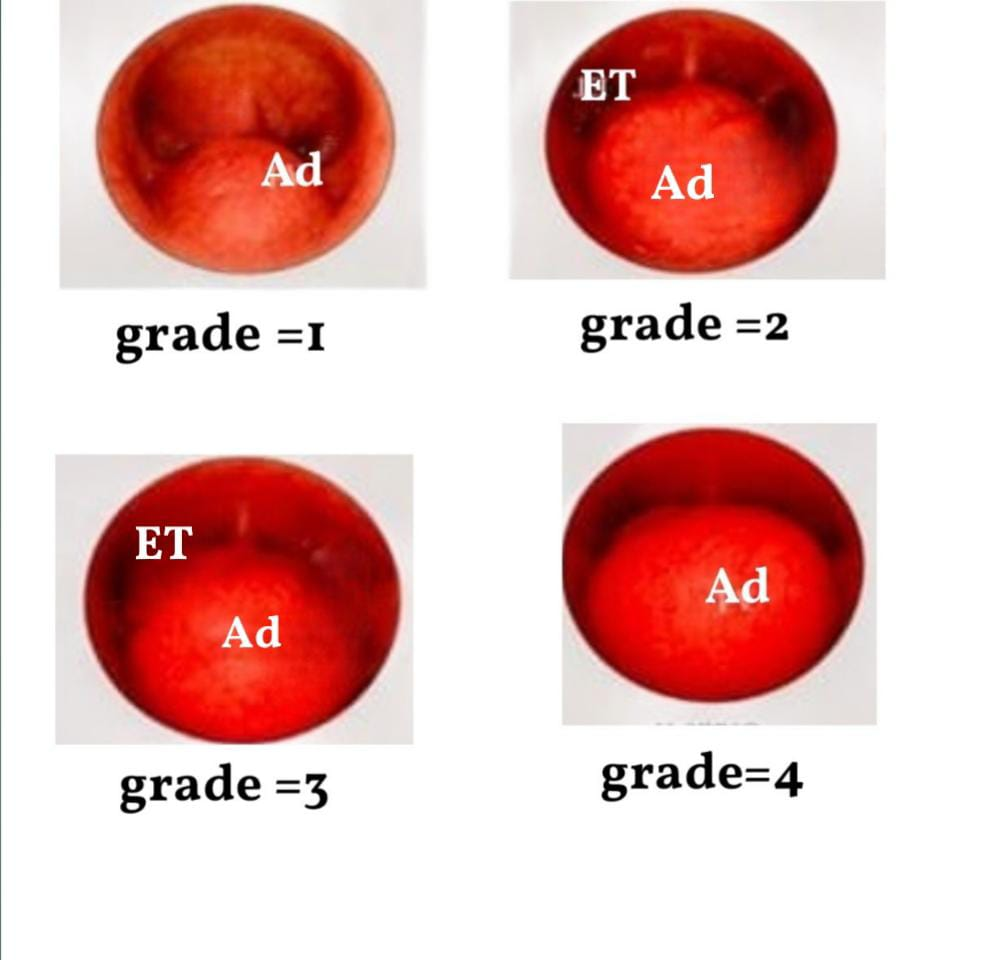
Figure 1. Arefin’s Oral Endoscopic Grading (AOEG) of Adenoid Hypertrophy — Oral endoscopic views (70°–90° telescope) showing progressive adenoidal enlargement behind the soft palate from Grade I (<25%) to Grade IV (>75%) obstruction of choana and torus tubarius. Landmarks: Ad = Adenoid pad; V = Vomer; ET = Eustachian tube opening.
DISCUSSION
Arefin’s Oral Endoscopic Grading provides a direct, comfortable, and accurate method of assessing adenoidal size, especially in situations where nasal endoscopy is difficult or contraindicated [3,7]. It allows a clear image of both choanae and Eustachian tube openings simultaneously.
Advantages include:
- Better visualization under anesthesia or during intraoperative assessment [2].
- Avoids nasal trauma and discomfort [8,10].
- Easily documented through video or photography for research validation [11].
- Can be correlated with tympanometry, audiological findings, and sleep symptom scores [12-14].
Clinical significance:
Grades III and IV strongly suggest surgical intervention (adenoidectomy ± tonsillectomy), while Grades I and II may be managed conservatively [3,13].
CONCLUSION
The Arefin’s Oral Endoscopic Grading (AOEG) system offers a novel, safe, and clinically applicable approach for evaluating adenoid hypertrophy via the oral route. This method complements existing nasal endoscopic grading systems and may improve preoperative evaluation, postoperative comparison, and documentation in both pediatric and adult populations.
Further validation through multicentric studies is recommended.
ACKNOWLEDGEMENTS
None.
CONFLICT OF INTEREST
No conflict of interest.
FUNDING SOURCE/ SPONSOR
None.
REFERENCES
- Cassano P, Gelardi M, Cassano M, Fiorella ML, Fiorella R. (2003). Adenoid tissue evaluation: proposal of a new grading system. Int J Pediatr Otorhinolaryngol. 67(12):1303-1309.
- Yildirim N, et al. (2008). Correlation between adenoid size and nasal obstruction. Int J Pediatr Otorhinolaryngol. 72(10):1547-1551.
- Mitchell RB. (2009). Adenoidectomy for obstructive sleep apnea in children. Sleep. 32(11):1391-1398.
- Parikh SR, Coronel M, Lee JJ, Brown SM. (2006). Validation of a new grading system for adenoid hypertrophy based on endoscopic assessment. Laryngoscope. 116(7):1232-1236.
- Clemens J, McMurray J. (1998). Adenoid size assessment: radiographic and endoscopic comparison. Otolaryngol Head Neck Surg. 118:349-354.
- Wang DY, et al. (1997). The adenoid: its role in pediatric nasal obstruction. Laryngoscope. 107(5):623-628.
- Lim J, et al. (2019). Endoscopic grading for adenoid hypertrophy: proposal for uniform reporting. Clin Exp Otorhinolaryngol. 12(2):182-188.
- Chisholm EJ, Lew-Gor S, Hajioff D, Caulfield H. (2012). Adenoid/tonsil size and airway obstruction: clinical correlation. Clin Otolaryngol. 37(5):410-417.
- Berkiten G, et al. (2016). Evaluation of adenoid hypertrophy using percentage of choanal obstruction. Am J Otolaryngol. 37(2):122-126.
- Sargi Z, Younis RT. (2007). Adenoidectomy vs. adenotonsillectomy for OSA. Laryngoscope. 117(10):1844-1848.
- Brietzke SE, Gallagher D. (2006). The effectiveness of adenoidectomy in treating pediatric OSA. Otolaryngol Head Neck Surg. 134(6):979-984.
- Isono S. (2012). Obstructive sleep apnea of children: pathophysiology and clinical features. Jpn Dent Sci Rev. 48(1):1-9.
- Proffit WR, Fields HW. (1983). Nasopharyngeal airway obstruction and facial growth. Angle Orthod. 53(2):93-104.
- Dutta M, et al. (2015). Correlation of endoscopic and radiologic adenoid grading. Indian J Otolaryngol Head Neck Surg. 67(4):381-386.
