Information Links
Related Conferences
Current Issue Volume 6, Issue 1 - 2026
Timely Revival of a Tiny Heart!
Moditha P1, Navdeep2,*, Swathi S Injineri3, Chethana M4, Yatish5
1Junior Resident, Department of Anaesthesiaology, M.S Ramaiah Medical College and Hospital, India
2Associate Professor, Department of Anaesthesiaology, M.S Ramaiah Medical College and Hospital, India
3Senior Resident, Department of Anaesthesiaology, M.S Ramaiah Medical College and Hospital, India
4(M.D), Senior Resident, Department of Anaesthesiaology, M.S Ramaiah Medical College and Hospital, India
5Professor, Department of Anaesthesiaology, M.S Ramaiah Medical College and Hospital, India
*Corresponding author: Dr. Navdeep, M.D, Associate Professor, Department of Anaesthesiaology, M.S Ramaiah Medical College and Hospital, India, Phone no: 9945557290, Email: [email protected]
Received Date: April 13, 2026
Published Date: May 12, 2026
Citation: Moditha P, et al. (2026). Timely Revival of a Tiny Heart! Mathews J Anesth. 6(1):18.
Copyrights: Moditha P, et al. © (2026).
ABSTRACT
Background: The anaesthetic handling of newborn undergoing major abdominal surgeries like laparotomies is one of the most demanding tasks for an anaesthesiologist. Case Report: This is a case of extremely preterm, very low birth weight baby weighing 895 grams with respiratory distress syndrome posted for Laparotomy for Necrotising enterocolitis who had intraoperative bradycardia and hypotension. Here, we enumerate the significance of vigilance and timely intervention and treatment which is very crucial in these small humans. Conclusion: In neonates whose condition is even more fragile due to prematurity and low birth weight, we need to be very alert and cautious to any cautious changes they show and should consider multidisciplinary management including Anaesthesiologist, Neonatologist and Pediatric surgeons because Time is Gold in such cases.
Written informed consent was obtained by the parents after clearly explaining the condition and risks involved including intraoperative and postoperative complications.
Ethical clearance has been taken for this case study.
Keywords: Necrotising Enterocolitis, Bradycardia, Hyperkalemia, Premature, Low Birth Weight, Newborn, Thrombocytopenia.
ABBREVIATIONS
PDA: Patent Ductus Arteriosus; NICU: Neonatal Intensive Care Unit; HFO: High Frequency Oxygen; Hb: Haemoglobin; TLC: Total Leukocyte Count; ETT: Endotracheal Tube; IV: Intravenous.
INTRODUCTION
Necrotising enterocolitis is most common bowel complication in preterm neonates which requires surgical management. Anaesthesia and surgery for premature infants is becoming more common and presents additional hazards in an already precarious life as immature physiological systems have limited ability to compensate for hemodynamic imbalance.
Here we describe a case where intraoperative bradycardia, desaturation and arrhythmia were managed vigilantly as a multidisciplinary team with immediate intraoperative diagnosis of the possibility of hyperkalemia and timely action in extreme preterm infant with very low birth weight posted for emergency laparotomy for necrotising enterocolitis.
CASE REPORT
A girl baby was born at 27th week of gestation due to preterm pre labour rupture of membrane via normal vaginal delivery with an extremely low birthweight of 895gms.
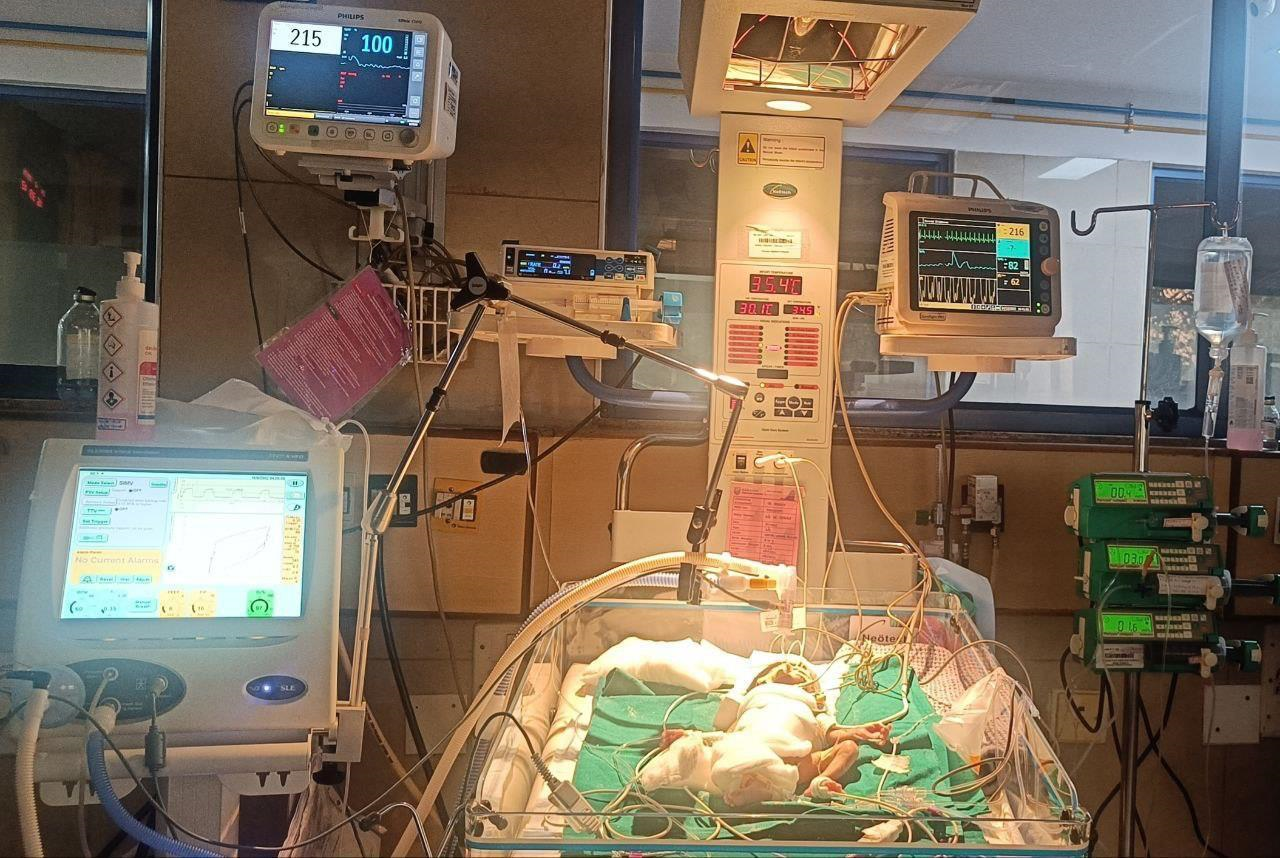
Baby was diagnosed with grade one germinal bleed with non-significant PDA. Surfactant was administered and baby was maintained on oxygen support in NICU. On day 28 of birth, baby developed respiratory distress and abdominal distension was noted and ventilatory support was started. A diagnosis of necrotising enterocolitis was made. On day 35 bowel perforation was suspected and exploratory laparotomy was planned.
The baby was on ventilatory support from 7 days prior to surgery on HFO mode with saturation of 88-92% on 96% FiO2, Heart rate of 182bpm and BP- 82/50mmHg.
Blood investigations showed Hb of 6.5g%, TLC -13.9k and thrombocytopenia- 37000. PRBC and Platelet transfusion was done on pre-operative day and Hb on day of surgery was 10.6g% and platelet count-36000. Baby was on Triple antibiotics I/v/o sepsis which was administered pre operatively as per the dosage advised by neonatologist.
A written informed consent was obtained from the parents explaining the condition and anticipated complications during the procedure.
Baby was shifted with ET tube insitu to OT. Standard monitors were attached and was induced with inhalational agent- Sevoflurane and Fentanyl was used for analgesia, and a muscle relaxant atracurium was administered as per the standard dose for body weight. ET tube was exchanged as it was 7th day of intubation. Surgery was started.
Intraoperatively, the baby was ventilated via a mapelson circuit F circuit (JR circuit) throughout in view of low birth weight. Midway through the surgery, when the surgeons opened the abdomen and were milking the bowel to remove fecal matter, the baby developed sudden onset bradycardia with heart rate drop from 140bpm to 110bpm and then to 60bpm and started desaturating. Immediately, the surgery was withheld and chest compressions were initiated with thumb encircling technique. Neonatologist was informed and called for help immediately once the baby started having bradycardia and arrhythmias. Inj Atropine 0.02mg IV administered. Inj Adrenaline 0.03mg IV administered. Platelets and PRBC (8ml each) was transfused to maintain intravascular volume. The baby had arrhythmia and was suspected to have hyperkalemia secondary to bowel handling hence calcium gluconate 0.5ml was administered along with 1mEq of Sodium bicarbonate. After arrhythmia settled and hemodynamic stability, baby was started on vasopressors to maintain the blood pressures and maintain perfusion with dobutamine at 1mcg/hr, dopamine at 0.5mcg/hr, and noradrenaline at 0.1mcg/hr.
The situation was comanaged by anaesthesiologists, neonatologist and paediatric surgeons as a team work.
Once the baby was hemodynamically stabilised, bowel was anastomosed and abdomen was closed.
Baby shifted back to NICU on ventilator on triple vasopressors for further monitoring and management.
Post shifting to ICU serial ABGs and other investigations followed up and gradually vasopressors support was tapered down and ventilator support was tapered down. PRBC and platelet transfusion done due to ongoing sepsis related thrombocytopenia. Baby developed one more episode of bradycardia in NICU when bowel was handled again in NICUpossibly due to hyperkalemia secondary to bowel handling.
DISCUSSION
This case emphasises on the sensitivity of the undeveloped physiology and hemodynamic instability in a preterm neonate. In this case low birth weight, presence of PDA and RDS imposes additional hazards in an already precarious life.
2011 NCEPOD report states that vast majority of peri operative mortality occurred in age <1 year and that neonates with necrotising enterocolitis accounted for 33.1% of deaths [1].
Hyperkalemia may result from various mechanisms or pathological processes including excessive potassium intake oral administration, increased endogenous production (Rhabdomyolysis), decreased renal excretion and intracellular to extracellular shifts [2]. However sometimes hyperkalemia can be idiopathic.
As hyperkalemia has potential risk of causing morbidity related to its effects on cardiac conditions [2], we need to be vigilant in diagnosing and treating the same. In our case the possibility of hyperkalemia and metabolic acidosis was picked up immediately and was treated.
CONCLUSION
Surgical and anaesthetic care for neonates requiring laparotomy is best delivered in centers which has multidisciplinary support for these challenging patients and performs such operations on a regular basis [3]. The case was managed as a multidisciplinary team including Paediatric surgeons, Neonatologist and the nursing staff along with our anaesthesiology team [4-6].
ACKNOWLEDGEMENTS
None.
CONSENT
A written informed consent for publication has been obtained by the parents.
CONFLICT OF INTEREST
No potential conflict of interest relevant to this article was reported.
REFERENCES
- Mason DG, Wilkinson K, Gough MJ, Lucas SB, Freeth H, Shotton H, et al. (2011). Are We There Yet? A Review of the organizational and Clinical Aspects of Children’s Surgery. London: NCEPOD.
- Lemus R, Craver A, Beebe A, Samora W, Tobias JD. (2020). Etiology and treatment of intraoperative hyperkalemia during posterior spinal fusion in an adolescent. J Med Cases. 11(6):152–156.
- Chandrashekhar S, Davis L, Challands J. (2015). Anaesthesia for neonatal emergency laparotomy. BJA Educ. 15(4):194-198.
- ten Barge JA, Zwiers AJM, Vermeulen MJ, Keyzer-Dekker CMG, Simons SHP, Staals LM, et al. (2024). Current anesthesia practice for preterm infants undergoing surgery for necrotizing enterocolitis: a European survey. J Clin Anesth. 89:111508.
- Jain AP, Parikh H, Patel VM, Bhalodia K, Rathwa C, Mehta V. (2025). Anaesthesia management of a 28-day-old male neonate undergoing surgery for occipital region meningo-myelo-encephalocele: A case report. RGUHS J Allied Health Sci. 5(1):43-46.
- Li J, Lu H, Yu L, Li H, Chen X, Chen C, Tao E. (2023). Case report: Catastrophic event: neonatal gastric perforation and complication of capillary leak syndrome. Front Pediatr. 11:1257491.
