Information Links
Related Conferences
Current Issue Volume 4, Issue 1 - 2025
Do Games Missed Predict Rankings in the NBA: A Machine Learning Approach
Brian Serrano, DC, Ph.D., ATC, CSCS, RSCC, CPSS1,2,*
1Chicago Bulls Basketball Club, USA
2Western Governors University, USA
*Corresponding author: Dr. Brian Serrano, DC, Ph.D., ATC, CSCS, RSCC, CPSS, Chicago Bulls Basketball Club & Western Governors University, USA, E-mail: [email protected]
Received Date: July 09, 2025
Published Date: September 03, 2025
Citation: Serrano B. (2025). Do Games Missed Predict Rankings in the NBA: A Machine Learning Approach. Mathews J Sports Med. 4(1):10.
Copyrights: Serrano B. © (2025).
ABSTRACT
The National Basketball Association (NBA) is the highest form of professional basketball in the world in terms of competition and revenue. The financial investment into each player increases each season, not only in terms of salary but also into their care via support staff (Athletic Trainers, Strength and Conditioning Coaches), Nutrition, etc. When teams have deep playoffs runs, their parent organizations stand to make large amounts of revenues from television deals, ticket sales, and apparel. It would seem logical that keeping their players healthy would be a high priority and this aligns with the current trend into popular concepts like workload management. Workload management seeks to find the optimal window of work and rest for players both on and off the court. In accordance with these concepts, this paper used Machine Learning (ML) to explore whether two season of data (2021-2022, 2022-2023) injury and final rankings could accurately predict the final rankings of the 2023-2024 season. Using a Support Vector Regression (SVE), the relationships between games missed-rankings, and season-ranking were explored and found to be weak (R^2 score: .0004, MSE: 76.9). Using injuries and rankings as the sole proxies for success, caution is warranted as human success is not binary. However, recent clinical evidence from high performance teams and the evolving style of the NBA may be pointing towards the merit of availability being a key controllable contributor to winning.
Keywords: Basketball, NBA, Machine Learning, Sports Medicine.
INTRODUCTION
Competition athletics ranges from scholastic, to recreational, collegiate, and professional. Prior to 2021, scholastic competition was meant as time for mass participation and student-athletes to explore sports, learn motor patters, and learn lessons that stretch beyond the field [1]. Recreationally, this presents an opportunity for adults to socialize, stay fit, and be happy. However, when it comes to competition, rules like NIL (Name, Image, and Likeness) in the NCAA and Professional Leagues focus on winning, and ultimately revenue [2]. In the United States, the 5 primary leagues are the National Football League (NFL), National Basketball Association (NBA), Major League Baseball (MLB), National Hockey League (NHL), and Major League Soccer (MLS) [3]. Of these leagues, the NBA has the highest salaries from a roster size standpoint. The current NBA roster consists of 15 players and 3 two-way players which are allowed a certain amount of games with the parent club and the rest with the G-league team (minor league affiliate) (www.gleague.nba.com). The average salary of an NBA player for the 2024-2025 season was $11,910,649 and the league minimum was $1,157,153 (www., sportsillustrated.com). The salary of players has only increased through the years which means the financial investment from each organization into each player has also increased.
This is evident through larger practice facilities, larger and more specialized support staffs, and better-quality collective bargaining agreements (CBA) [4]. It would seem reasonable that organizations would want each player to optimize their performance by being healthy and be available for all 82 games of the NBA season. This concept has become difficult with the travel schedule, game density, and off-court demands required from NBA players today which leads to the concept of workload management [5]. Briefly, workload management is a non-specific term used to describe any type of regulation of stress on players in an effort to optimize their performance [6].
Workload management seems to be a concept thrown around loosely in the sports performance world, and injury time loss has been very difficult to define in past literature. This study seeks to take a machine learning approach and see if games missed from two NBA seasons can accurately predict rankings of a future season.
METHODS
This study was performed as part of a thesis project for a Master of Science degree in Data Science. Although no human subjects were used and the information was publicly available, this project was still reviewed and approved by Western Governors University for Academic purposes (Institutional Review Board). The premise of this study was obtaining time lost and regular season rankings from the NBA 2021-2022 and 2022-2023 using spotrac.com. A machine learning model (multinomial regression) was then applied to see if a prediction could be made for regular season rankings in the 2023-2024 from the previous two seasons using the Python Scikit-learn library.
RESULTS
From the 2021-2022 season, the team with top 3-time loss injuries were the Los Angeles Clippers ($80 Million), Brooklyn Nets ($69 Million), and Portland Trailblazers ($57 Million). The regular season rankings were as follows: Phoenix Suns (64-18), Memphis Grizzlies (56-26), Miami Heat /Golden State Warriors (53-29). The finals that season were won by the Golden State Warriors and the Boston Celtics came in second place (Post-season).
From the 2022-2023 season, the teams with the top 3-time loss injuries were Golden State Warriors ($53 Million), Phoenix Suns ($49 Million), and Milwaukee Bucks ($45 Million). The regular season rankings were as follows: Milwaukee Bucks (58-24), Boston Celtics (57-25), Philadelphia 76ers (54-28). The finals that season were won by the Denver Nuggets and Miami Heat were second place (Post-season).
From the 2023-2024 season, the teams with the top 3-time loss injuries were Memphis Grizzlies ($74 Million), Portland Trailblazers ($61 Million), and Chicago Bulls ($58 Million). The regular season rankings were as follows: Boston Celtics (64-18), OKC Thunder/Denver Nuggets (57-25), Minnesota Timberwolves (56-26). The finals that season were won by the Boston Celtics and Dallas Mavericks were second place (Post-season).
The multinomial regression had a predictive power of 0.16 (Figure 1) (MSE 76.9, R^2 0.004) from games missed to ranking in both regular season and post season. Even when season was accounted for, the predictive power did not change as shown by Figure 2.
.png)
Figure 1. Correlation Matrix showing relationship between all variables.
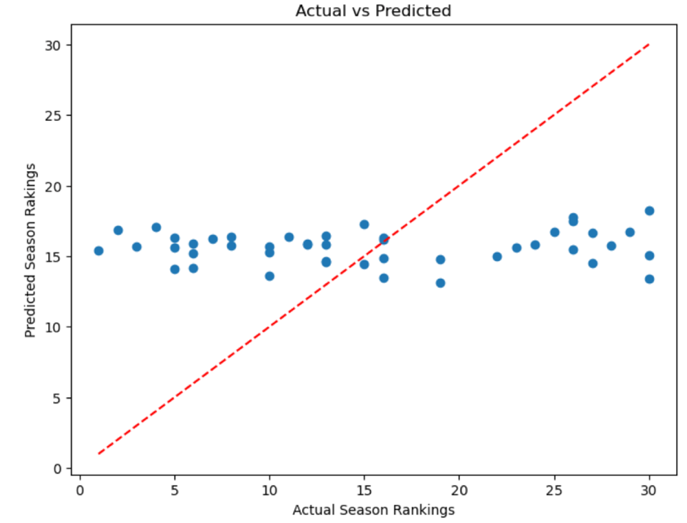
Figure 2. The actual vs predicted values even with season accounted for
DISCUSSION
Player health and performance are at the forefront of professional sport for multiple reasons, chief among being them being player health. When players are not healthy, from a physical, emotional, psychological, or psychological standpoint, they cannot perform their best [7]. This begins a cascading negative effect on team performance, fan experience, leading to eventually and potentially losses in revenue. As salaries in the NBA continues to increase each season, each game lost becomes more significant both to the player themselves and the organization. As players begin to accumulate injuries, both acute and chronic, this may lead to negative changes in team dynamics and potential tactics.
Drakos MC, et al. [4] conducted an analysis of the NBA database from 1988-1989 to 2004-2005 seasons to explore injuries. The authors calculated game injury rates per 1000 athletic exposures and the time was standardized as 1 game (48 minutes). It was found that the knee (10,737) ankle (6838), and lumbar spine (6729) were the most common reasons games were missed in the regular season. The average amount of games per player of injury was not recorded which would have added extremely valuable insight to this discussion. However, it does serve the sheer magnitude of how negatively impactful injuries are to player health.
Tummala SV, et al. (2023) [3] looked at ankle injuries from the lens of the NBA vs other professional sports. The 2015-2016 through 2019-2020 seasons were analyzed per 1000 game-exposures and within basketball players there was an incidence of 4.06 injuries per 1000 exposures. The average games missed were 2-10, which highlights not only the performance but also financial implications of how games missed affects teams.
Cauteruccio F, et al. [9] examined injury patterns in the NBA and their impact on player performance. The authors found that 65.54% of all injuries were musculoskeletal (MSK), which are most likely to lead to time lost. Ankle area injuries caused a time loss of 41.9 days while hand injuries a time loss of 70.5 days. From a salary standpoint, this translates to between $155,840 - $1,077,624.8 per injury, per player and continues to highlight the potential loss in revenue for both the player and organization involved.
.png)
Figure 3. The mean squared error of the model.
LIMITATIONS
This study only used two season worth of data which may not have been enough to properly produce an efficient model. The process of creating an accurate machine learning model involves training, then testing which two seasons may not have been sufficient. Games missed were summed by team rather than per player which may skew results as now averages are being used vs assessing the impact of starters vs role-players which is very important is today’s NBA. Lastly, only regular season rankings were truly assessed, outside of the two teams who make the finals it is difficult to justify 3rd and 4th place teams which left the model to be trained on games missed vs regular season record. This may not be an accurate reflection of the true nature of what we are aiming to explore.
CONCLUSION
Player health and performance should be the top priority for any NBA organization. As salaries continue to increase each season, the financial investment made into each player by organizations only continues to grow not only directly but indirectly. Thus, when a player gets injured and misses games, not only does team performance suffer, but so does financial revenue for the club. Using machine learning, this study sought to predict regular season NBA rankings from 2 previous seasons rankings and games missed injuries. The accuracy and predictive power of the model were too weak for statistical or practical significance. Human performance is not binary, so creating models for prediction is extremely difficult. However, further exploration should be inquired into injury data and predictors of success.
ACKNOWLEDGEMENTS
None.
CONFLICTS OF INTEREST
The authors declare that there are no conflicts of interest.
REFERENCES
- Dees W, Cianfrone BA, Andrew D. (2021). Show me the money! A review of current issues in the new NIL era. Journal of Applied Sport Management. 13(2):2.
- Li I, Derdenger T. (2025). Does Personalized Pricing Increase Competition: Evidence from NIL in College Football. DOI: 10.2139/SSRN.4917741.
- Tummala SV, Morikawa L, Brinkman JC, Crijns TJ, Vij N, Gill V, et al. (2023). Characterization of Ankle Injuries and Associated Risk Factors in the National Basketball Association: Minutes Per Game and Usage Rate Associated With Time Loss. Orthop J Sports Med. 11(7):23259671231184459.
- Wilkinson R. (2024). THE NBA AS A MODEL OF INTERNATIONAL BUSINESS DEVELOPMENT: LESSONS AND STRATEGIES.
- McLean BD, Strack D, Russell J, Coutts AJ. (2019). Quantifying Physical Demands in the National Basketball Association-Challenges Around Developing Best-Practice Models for Athlete Care and Performance. Int J Sports Physiol Perform. 14(4):414-420.
- Jildeh TR. (2024). Editorial Commentary: Load Management Is Essential to Prevent Season-Ending Injuries in the National Basketball Association. Arthroscopy. 40(9):2474-2476.
- Brodsky, A. (2022). How the NBA Should Address Mental Health in its Next Collective Bargaining Agreement. Cardozo International & Comparative Law Review (CICLR) Blog. Available at: https://larc.cardozo.yu.edu/ciclr-online/49
- Drakos MC, Domb B, Starkey C, Callahan L, Allen AA. (2010). Injury in the national basketball association: a 17-year overview. Sports Health. 2(4):284-290.
- Cauteruccio F, Zhang Y, Sarlis V, Papageorgiou G, Tjortjis C. (2024). Injury Patterns and Impact on Performance in the NBA League Using Sports Analytics. Computation. 12(2):36.
